Australian Kestrel

Australian Kestrel

Falco cenchroides

Silhouette: Shyamal · PhyloPic

LCLeast ConcernNTVUENCR
Daily sighting probability <5% · Rare
at Daintree National Park

In 3 days ~10% in a week ~20%

64 Verified sightings at Daintree National Park From 2019 to 2026
2,236 In all 17 parks
February Best month
☀️ Diurnal When it's spotted

About the Australian Kestrel

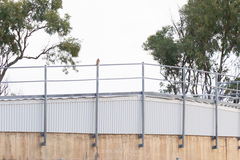
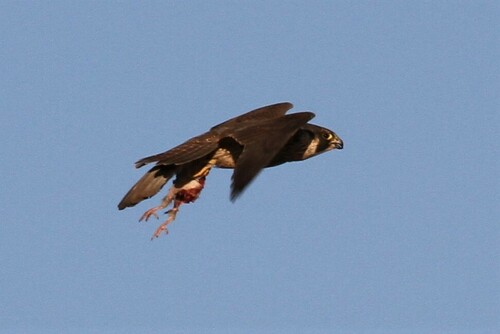
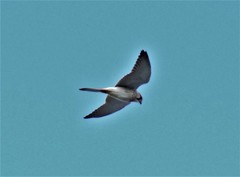
The nankeen kestrel (Falco cenchroides), also known as the Australian kestrel, is a raptor native to Australia and New Guinea. It is one of the smallest falcons, and unlike many, does not rely on speed to catch its prey. Instead, it simply perches in an exposed position, but it also has a distinctive technique of hovering over crop and grasslands.

The nankeen kestrel is a species of the genus Falco, allied to a subgenus Tinnunculus. They were first described by Nicholas Vigors, James Gleeson and Thomas Horsfield in 1827. Further descriptions — regarded as synonyms for the species — were published: Cerchneis immaculata Brehm, 1845; the later name Cerchneis unicolor by Alexander Milligan was published in Emu in 1904; and that author's name appearing in the assignment to a subspecies, Cerchneis cenchroides milligani, published by Gregory Mathews in 1912.

The generic name is Late Latin falco 'falcon' (from falx falcis, 'sickle') and the specific epithet is derived from Ancient Greek kenkhris 'kestrel' and -oides 'resembling'. The common names mosquito hawk, kestrel, windhover, hoverer are cited in the Australian Faunal Directory. Its common descriptor refers to the colour... Wikipedia →

Sounds

Call0:14

Australia · 2021

© Marc Anderson · XC1001914 · CC BY-NC-ND 4.0

Call0:04

Australia · 2023

© Peter Boesman · XC859876 · CC BY-NC-ND 4.0

Call0:09

Australia · 2017

© Greg McLachlan · XC396000 · CC BY-NC-SA 4.0

Global Distribution

Parks Where Found

# Park Country Daily sighting probability
1 Ningaloo Marine Park 🇦🇺 Australia
~60%
2 Cape Range 🇦🇺 Australia
~50%
3 Uluru-Kata Tjuta National Park 🇦🇺 Australia
~50%
4 Rottnest Island 🇦🇺 Australia
~50%
5 Flinders Ranges National Park 🇦🇺 Australia
~30%
6 Flinders Chase 🇦🇺 Australia
~30%
7 Kosciuszko National Park 🇦🇺 Australia
~10%
8 Hattah-Kulkyne National Park 🇦🇺 Australia
~10%
9 Great Otway National Park 🇦🇺 Australia
~10%
10 Grampians National Park 🇦🇺 Australia
~10%
11 Royal National Park 🇦🇺 Australia
<5%
12 Blue Mountains National Park 🇦🇺 Australia
<5%
13 Daintree National Park 🇦🇺 Australia
<5%
14 Wilsons Promontory National Park 🇦🇺 Australia
<5%
15 Kakadu National Park 🇦🇺 Australia
<5%
16 Booderee National Park 🇦🇺 Australia
<5%
17 Lamington National Park 🇦🇺 Australia
<5%

Cities Where Found

# City Country Daily sighting probability
1 Sydney 🇦🇺 Australia
<5%
2 Melbourne 🇦🇺 Australia
<5%
3 Perth 🇦🇺 Australia
<5%
4 Brisbane 🇦🇺 Australia
<5%

Zoos & Centres Where Found

# Zoo / Centre Country
1 Kyabram Fauna Park 🇦🇺 Australia In captivity
2 Featherdale Sydney Wildlife Park 🇦🇺 Australia In captivity
3 Caversham Wildlife Park 🇦🇺 Australia In captivity
4 Kangaroo Island Wildlife Park 🇦🇺 Australia In captivity
5 Ranger Red’s Zoo & Conservation Park 🇦🇺 Australia In captivity

Before you go

What are the chances of seeing an Australian Kestrel in Daintree National Park?

Rare

Under 5% of wildlife watchers report an Australian Kestrel sighting in Daintree National Park on a given day, based on 64 verified sightings from GBIF citizen-science data from 2019 to 2026. It is the 115th most-seen of the 208 birds we can rate there. Over three days the chance rises to about 10%, and over a week to about 20%, if each day is a fresh chance.

When is the best time to see an Australian Kestrel in Daintree National Park?

February and May

In those months about 10% of wildlife watchers report an Australian Kestrel in Daintree National Park on a given day, against under 5% in March–April and June–January, the lowest months.

What time of day is best to see an Australian Kestrel?

Between noon and 3 pm

Across all the parks we cover, that three-hour window holds the most Australian Kestrel sightings with a recorded time, and nearly all of them come between 6 am and 6 pm: it is a daytime animal.

Where does the Australian Kestrel sighting chance come from?

GBIF citizen-science records

It is estimated from how often the Australian Kestrel is recorded against all the birds logged in Daintree National Park (64 verified sightings from 2019 to 2026), calibrated against known sighting rates. Figures are rounded to the nearest 10% because citizen-science data supports honest approximations, not decimals, and months with records from fewer than five people show "—". How it works.

← Back to Daintree National Park