Red-billed Quelea

Red-billed Quelea

Quelea quelea

Silhouette: Sheatherius · PhyloPic

LCLeast ConcernNTVUENCR
Daily sighting probability ~30% · Possible
at Gonarezhou National Park

In 3 days ~70% in a week ~90%

47 Verified sightings at Gonarezhou National Park From 2019 to 2026
8,766 In all 47 parks
October Best month
☀️ Diurnal When it's spotted

About the Red-billed Quelea

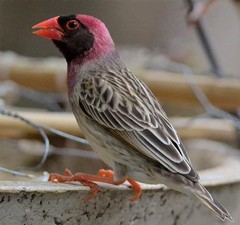
The red-billed quelea (Quelea quelea), also known as the red-billed weaver or red-billed dioch, is a small, seasonally nomadic, sparrow-like bird of the weaver family, Ploceidae, native to sub-Saharan Africa. It is approximately 12 cm (4.7 in) long and weighs 15 to 26 g (0.53 to 0.92 oz).

It was named by Linnaeus in 1758, who considered it a bunting, but Ludwig Reichenbach assigned it in 1850 to the new genus Quelea. Non-breeding birds have light underparts, striped brown upper parts, yellow-edged flight feathers and a reddish bill. Breeding females attain a yellowish bill. Breeding males have a black (or rarely white) facial mask, surrounded by a purplish, pinkish, rusty or yellowish wash on the head and breast. The species avoids forests, deserts and colder areas such as those at high altitude and in southern South Africa. It constructs oval roofed nests woven from strips of grass hanging from thorny branches, sugar cane or reeds. It breeds in very large colonies.

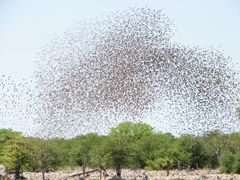
The red-billed quelea feeds primarily on seeds of annual grasses, but also causes extensive damage to cereal crops. Therefore, it is sometimes called "Africa's feathered locust". The usual pest-control measures are spraying avicides or detonating fire-bombs in the enormous colonies during the night. Extensive control measures have been largely unsuccessful in limiting the quelea population. When food runs out, the species moves to locations of recent rainfall and plentiful grass seed; hence it exploits its food source very efficiently. It is regarded as the most numerous undomesticated bird on earth, with the total post-breeding population sometimes peaking at an estimated 1.5 billion individuals. It feeds in huge flocks of millions of individuals, with birds that run out of food at the rear flying over the entire group to a fresh feeding zone at the front, creating an image of a rolling cloud. The conservation status of red-billed quelea is least concern according to the IUCN Red List. Wikipedia →

Sounds

Call0:41

Gambia · 2025

© Romuald Mikusek · XC1018446 · CC BY-NC-SA 4.0

Song0:43

Ghana · 2022

© Peter Boesman · XC719470 · CC BY-NC-ND 4.0

Call0:21

Ethiopia · 2024

© Marcin Sołowiej · XC960421 · CC BY-NC-SA 4.0

Global Distribution

Parks Where Found

# Park Country Daily sighting probability
1 Tsavo East National Park 🇰🇪 Kenya
~50%
2 Tsavo West National Park 🇰🇪 Kenya
~50%
3 Awash National Park 🇪🇹 Ethiopia
~50%
4 South Luangwa National Park 🇿🇲 Zambia
~40%
5 Niokolo-Koba National Park 🇸🇳 Senegal
~30%
6 Queen Elizabeth National Park 🇺🇬 Uganda
~30%
7 Gonarezhou National Park 🇿🇼 Zimbabwe
~30%
8 Samburu National Reserve 🇰🇪 Kenya
~30%
9 Tarangire National Park 🇹🇿 Tanzania
~30%
10 Ruaha National Park 🇹🇿 Tanzania
~30%
11 Mana Pools National Park 🇿🇼 Zimbabwe
~30%
12 Lower Zambezi National Park 🇿🇲 Zambia
~30%
13 Lake Manyara National Park 🇹🇿 Tanzania
~30%
14 Meru National Park 🇰🇪 Kenya
~20%
15 Hwange National Park 🇿🇼 Zimbabwe
~20%
16 Kruger National Park 🇿🇦 South Africa
~20%
17 Etosha National Park 🇳🇦 Namibia
~20%
18 Akagera National Park 🇷🇼 Rwanda
~20%
19 Mkomazi National Park 🇹🇿 Tanzania
~20%
20 Amboseli National Park 🇰🇪 Kenya
~20%
21 Kgalagadi Transfrontier Park 🇿🇦 South Africa
~20%
22 Nairobi National Park 🇰🇪 Kenya
~20%
23 Kidepo Valley National Park 🇺🇬 Uganda
~20%
24 Golden Gate Highlands National Park 🇿🇦 South Africa
~20%
25 Gorongosa National Park 🇲🇿 Mozambique
~20%
26 Murchison Falls National Park 🇺🇬 Uganda
~10%
27 uMkhuze Game Reserve 🇿🇦 South Africa
~10%
28 Chobe National Park 🇧🇼 Botswana
~10%
29 Virunga National Park 🇨🇩 Democratic Republic of the Congo
~10%
30 Moremi Game Reserve 🇧🇼 Botswana
~10%
31 Kafue National Park 🇿🇲 Zambia
~10%
32 Lake Mburo National Park 🇺🇬 Uganda
~10%
33 Hluhluwe-Imfolozi Park 🇿🇦 South Africa
~10%
34 Ngorongoro Conservation Area 🇹🇿 Tanzania
~10%
35 Pilanesberg National Park 🇿🇦 South Africa
~10%
36 Addo Elephant National Park 🇿🇦 South Africa
~10%
37 Serengeti National Park 🇹🇿 Tanzania
~10%
38 Liwonde National Park 🇲🇼 Malawi
~10%
39 Waterberg Plateau Park 🇳🇦 Namibia
<5%
40 Mikumi National Park 🇹🇿 Tanzania
<5%
41 Arusha National Park 🇹🇿 Tanzania
<5%
42 Lake Nakuru National Park 🇰🇪 Kenya
<5%
43 Masai Mara National Reserve 🇰🇪 Kenya
<5%
44 Volcanoes National Park 🇷🇼 Rwanda
<5%
45 iSimangaliso Wetland Park 🇿🇦 South Africa
<5%
46 Namib-Naukluft National Park 🇳🇦 Namibia
<5%
47 Kibale National Park 🇺🇬 Uganda
<5%

Cities Where Found

# City Country Daily sighting probability
1 Dakar 🇸🇳 Senegal
~60%
2 Mombasa 🇰🇪 Kenya
~10%
3 Kigali 🇷🇼 Rwanda
~10%
4 N'Djamena 🇹🇩 Chad
~10%
5 Harare 🇿🇼 Zimbabwe
<5%
6 Dar es-Salaam 🇹🇿 Tanzania
<5%
7 Pretoria 🇿🇦 South Africa
<5%
8 Durban 🇿🇦 South Africa
<5%
9 Serrekunda 🇬🇲 Gambia
<5%
10 Nairobi 🇰🇪 Kenya
<5%

Zoos & Centres Where Found

# Zoo / Centre Country
1 Safaripark Beekse Bergen 🇳🇱 Netherlands In captivity
2 Warsaw Zoo 🇵🇱 Poland In captivity
3 Vogelpark Heiligenkirchen 🇩🇪 Germany In captivity
4 herpetarium warszawskiego ZOO 🇵🇱 Poland In captivity
5 akwarium warszawskiego ZOO 🇵🇱 Poland In captivity

Before you go

What are the chances of seeing a Red-billed Quelea in Gonarezhou National Park?

Possible

About 30% of wildlife watchers report a Red-billed Quelea sighting in Gonarezhou National Park on a given day, based on 47 verified sightings from GBIF citizen-science data from 2019 to 2026. It is the 89th most-seen of the 233 birds we can rate there. Over three days the chance rises to about 70%, and over a week to about 90%, if each day is a fresh chance.

When is the best time to see a Red-billed Quelea in Gonarezhou National Park?

July and October

In those months about 40% of wildlife watchers report a Red-billed Quelea in Gonarezhou National Park on a given day, against about 20% in September and November, the lowest months. Those are among Gonarezhou National Park's driest months, with about 10 mm of rain a month against 150 mm in January. March–April, June and December–January have too few records to rate.

What time of day is best to see a Red-billed Quelea?

Between 8 and 11 am

Across all the parks we cover, that three-hour window holds the most Red-billed Quelea sightings with a recorded time, and about 9 in 10 of them come between 6 am and 6 pm: it is a daytime animal.

Which relatives of the Red-billed Quelea live in Gonarezhou National Park?

Same family: Ploceidae

The closest relatives of the Red-billed Quelea that you can see in Gonarezhou National Park (family Ploceidae, Weavers and Allies) are Red-billed Buffalo-Weaver (about 30%), Spectacled Weaver (about 30%) and Red-headed Weaver (about 30%), with each one's daily chance of a sighting.

Where does the Red-billed Quelea sighting chance come from?

GBIF citizen-science records

It is estimated from how often the Red-billed Quelea is recorded against all the birds logged in Gonarezhou National Park (47 verified sightings from 2019 to 2026), calibrated against known sighting rates. Figures are rounded to the nearest 10% because citizen-science data supports honest approximations, not decimals, and months with records from fewer than five people show "—". How it works.

← Back to Gonarezhou National Park