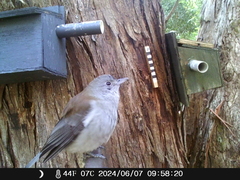

Gray Shrikethrush

Gray Shrikethrush

Colluricincla harmonica

Silhouette: Sheatherius · PhyloPic

LCLeast ConcernNTVUENCR
Daily sighting probability ~50% · Likely
at Grampians National Park

In 3 days ~90% in a week >90%

477 Verified sightings at Grampians National Park From 2019 to 2026
10,696 In all 19 parks
July Best month
☀️ Diurnal When it's spotted

About the Gray Shrikethrush

The grey shrikethrush or grey shrike-thrush (Colluricincla harmonica), formerly commonly known as grey thrush, is a songbird of Australasia. It is moderately common to common in most parts of Australia, but absent from the driest of the inland deserts. It is also found in New Guinea.

The grey shrikethrush was originally described in the genus Turdus. Alternate names include the brown shrike-thrush, buff-bellied shrike-thrush, grey shrike-flycatcher, northern shrike-thrush and south-western shrike-thrush.

Found in northern Australia and Melville Island Found in eastern New Guinea, islands in the Torres Strait and north-eastern Australia Found in Tasmania and the islands in the Bass Strait (Australia) Found in western, southern... Wikipedia →

Sounds

Song0:10

Australia · 2026

© Khristos Nizamis · XC1181671 · CC BY-NC-ND 4.0

Call0:28

Australia · 2024

© Romuald Mikusek · XC1173904 · CC BY-NC-SA 4.0

Recording0:15

Australia · 2025

© Mengshuai Ge · XC1050929 · CC BY-NC-SA 4.0

Global Distribution

Parks Where Found

# Park Country Daily sighting probability
1 Lamington National Park 🇦🇺 Australia
~70%
2 Great Otway National Park 🇦🇺 Australia
~60%
3 Flinders Ranges National Park 🇦🇺 Australia
~60%
4 Uluru-Kata Tjuta National Park 🇦🇺 Australia
~50%
5 Kosciuszko National Park 🇦🇺 Australia
~50%
6 Hattah-Kulkyne National Park 🇦🇺 Australia
~50%
7 Grampians National Park 🇦🇺 Australia
~50%
8 Springbrook National Park 🇦🇺 Australia
~40%
9 Wilsons Promontory National Park 🇦🇺 Australia
~40%
10 Freycinet National Park 🇦🇺 Australia
~40%
11 Blue Mountains National Park 🇦🇺 Australia
~30%
12 Cradle Mountain-Lake St Clair National Park 🇦🇺 Australia
~30%
13 Noosa National Park 🇦🇺 Australia
~20%
14 Flinders Chase 🇦🇺 Australia
~20%
15 Booderee National Park 🇦🇺 Australia
~20%
16 Royal National Park 🇦🇺 Australia
~20%
17 Kakadu National Park 🇦🇺 Australia
~10%
18 Nitmiluk National Park 🇦🇺 Australia
<5%
19 Litchfield National Park 🇦🇺 Australia
<5%

Cities Where Found

# City Country Daily sighting probability
1 Brisbane 🇦🇺 Australia
~30%
2 Melbourne 🇦🇺 Australia
~10%
3 Hobart 🇦🇺 Australia
~10%
4 Sydney 🇦🇺 Australia
<5%
5 Perth 🇦🇺 Australia
<5%

Zoos & Centres Where Found

# Zoo / Centre Country
1 Featherdale Sydney Wildlife Park 🇦🇺 Australia In captivity
2 National Aquarium 🇺🇸 United States In captivity

Before you go

What are the chances of seeing a Gray Shrikethrush in Grampians National Park?

Likely

About 50% of wildlife watchers report a Gray Shrikethrush sighting in Grampians National Park on a given day, based on 477 verified sightings from GBIF citizen-science data from 2019 to 2026. It is the 15th most-seen of the 145 birds we can rate there. Over three days the chance rises to about 90%, and over a week to over 90%, if each day is a fresh chance.

When is the best time to see a Gray Shrikethrush in Grampians National Park?

July and November

In those months about 60% of wildlife watchers report a Gray Shrikethrush in Grampians National Park on a given day, against about 40% in January to May, the lowest months.

What time of day is best to see a Gray Shrikethrush?

Between 9 am and noon

Across all the parks we cover, that three-hour window holds the most Gray Shrikethrush sightings with a recorded time, and nearly all of them come between 6 am and 6 pm: it is a daytime animal.

Which relatives of the Gray Shrikethrush live in Grampians National Park?

Same family: Pachycephalidae

The closest relatives of the Gray Shrikethrush that you can see in Grampians National Park (family Pachycephalidae, Whistlers and Allies) are Golden Whistler (about 30%) and Rufous Whistler (about 20%), with each one's daily chance of a sighting.

Where does the Gray Shrikethrush sighting chance come from?

GBIF citizen-science records

It is estimated from how often the Gray Shrikethrush is recorded against all the birds logged in Grampians National Park (477 verified sightings from 2019 to 2026), calibrated against known sighting rates. Figures are rounded to the nearest 10% because citizen-science data supports honest approximations, not decimals, and months with records from fewer than five people show "—". How it works.

← Back to Grampians National Park