Townsend's Warbler

Townsend's Warbler

Setophaga townsendi

Silhouette: Dylan GE Gomes · PhyloPic

LCLeast ConcernNTVUENCR
Daily sighting probability ~10% · With luck
at Guadalupe Mountains National Park

In 3 days ~20% in a week ~50%

67 Verified sightings at Guadalupe Mountains National Park From 2019 to 2026
8,430 In all 42 parks
September Best month
☀️ Diurnal When it's spotted

About the Townsend's Warbler

Townsend's warbler (Setophaga townsendi) is a small songbird of the New World warbler family. Townsend's warbler was formally described in 1837 by the American naturalist John Kirk Townsend under the binomial name Sylvia townsendi. The type locality is Fort Vancouver on the Columbia River in the state of Washington. After the merger of the genera Dendroica and Setophaga, Townsend's warbler is now placed in the genus Setophaga that was introduced by the English naturalist William Swainson in 1827. The species is monotypic: no subspecies are recognised.

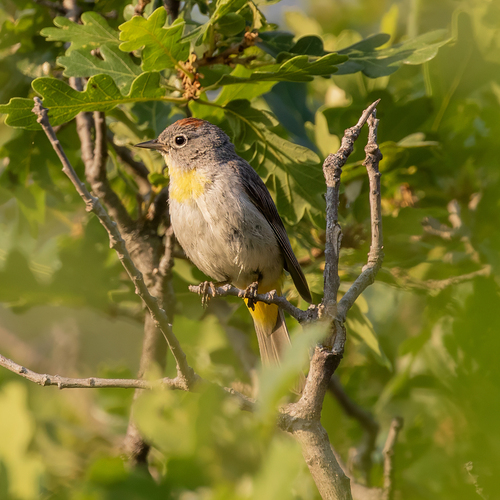
Townsend's warbler has a yellow face with a black stripe across its cheeks extending into an ear patch, a thin pointed bill, two white wing bars, olive upperparts with black streaks on their backs and flanks, and a white belly. Adult males have a black cap, black throat and yellow lower breast; females have a dark cap and a yellow throat. Immature birds are similar to females with a dark green cap and cheeks.

Their breeding habitats are coniferous forests with large trees on the northwestern coast of North America. Their nests are shallow cups built with grass and lined with moss. These... Wikipedia →

Sounds

Call0:22

Mexico · 2025

© Bobby Wilcox · XC1035703 · CC BY-NC-SA 4.0

Song0:11

Canada · 2003

© Simon Elliott · XC597954 · CC BY-NC-ND 4.0

Call0:29

United States · 2022

© Sam Smith · XC707449 · CC BY-NC-SA 4.0

Global Distribution

Parks Where Found

# Park Country Daily sighting probability
1 Reserva de la Biosfera Mariposa Monarca 🇲🇽 Mexico
~50%
2 El Triunfo 🇲🇽 Mexico
~40%
3 Pacific Rim National Park Reserve 🇨🇦 Canada
~30%
4 Banff National Park 🇨🇦 Canada
~30%
5 Glacier National Park 🇺🇸 United States
~20%
6 Great Bear Rainforest 🇨🇦 Canada
~20%
7 Celaque National Park 🇭🇳 Honduras
~10%
8 La Tigra National Park 🇭🇳 Honduras
~10%
9 Big Bend National Park 🇺🇸 United States
~10%
10 Olympic National Park 🇺🇸 United States
~10%
11 Cumbres de Monterrey National Park 🇲🇽 Mexico
~10%
12 Channel Islands National Park 🇺🇸 United States
~10%
13 Guadalupe Mountains National Park 🇺🇸 United States
~10%
14 Kenai Fjords National Park 🇺🇸 United States
~10%
15 Redwood National Park 🇺🇸 United States
~10%
16 Sequoia and Kings Canyon National Parks 🇺🇸 United States
~10%
17 Jasper National Park 🇨🇦 Canada
~10%
18 Yosemite National Park 🇺🇸 United States
~10%
19 Irazú Volcano National Park 🇨🇷 Costa Rica
~10%
20 Death Valley National Park 🇺🇸 United States
<5%
21 Grand Canyon National Park 🇺🇸 United States
<5%
22 Los Quetzales National Park 🇨🇷 Costa Rica
<5%
23 Chirripó National Park 🇨🇷 Costa Rica
<5%
24 Tapantí-Macizo de la Muerte National Park 🇨🇷 Costa Rica
<5%
25 Joshua Tree National Park 🇺🇸 United States
<5%
26 El Vizcaíno Biosphere Reserve 🇲🇽 Mexico
<5%
27 Monteverde Cloud Forest Reserve 🇨🇷 Costa Rica
<5%
28 Denali National Park 🇺🇸 United States
<5%
29 Bahía de Loreto National Park 🇲🇽 Mexico
<5%
30 Poás Volcano National Park 🇨🇷 Costa Rica
<5%
31 Cañón del Sumidero National Park 🇲🇽 Mexico
<5%
32 Rocky Mountain National Park 🇺🇸 United States
<5%
33 Grand Teton National Park 🇺🇸 United States
<5%
34 Saguaro National Park 🇺🇸 United States
<5%
35 Volcán Barú National Park 🇵🇦 Panama
<5%
36 Rincón de la Vieja National Park 🇨🇷 Costa Rica
<5%
37 Braulio Carrillo National Park 🇨🇷 Costa Rica
<5%
38 Point Pelee National Park 🇨🇦 Canada
<5%
39 La Amistad International Park (Panama) 🇵🇦 Panama
<5%
40 Yellowstone National Park 🇺🇸 United States
<5%
41 Zion National Park 🇺🇸 United States
<5%
42 Arenal Volcano National Park 🇨🇷 Costa Rica
<5%

Cities Where Found

# City Country Daily sighting probability
1 Toluca 🇲🇽 México
~40%
2 San Francisco 🇺🇸 United States
~20%
3 Tijuana 🇲🇽 México
~20%
4 Mexico City 🇲🇽 México
~20%
5 Guatemala City 🇬🇹 Guatemala
~10%
6 Los Angeles 🇺🇸 United States
~10%
7 San Diego 🇺🇸 United States
~10%
8 Portland 🇺🇸 United States
~10%
9 Guadalajara 🇲🇽 México
~10%
10 Puebla 🇲🇽 México
~10%

Before you go

What are the chances of seeing a Townsend's Warbler in Guadalupe Mountains National Park?

With luck

About 10% of wildlife watchers report a Townsend's Warbler sighting in Guadalupe Mountains National Park on a given day, based on 67 verified sightings from GBIF citizen-science data from 2019 to 2026. It is the 72nd most-seen of the 141 birds we can rate there. Over three days the chance rises to about 20%, and over a week to about 50%, if each day is a fresh chance.

When is the best time to see a Townsend's Warbler in Guadalupe Mountains National Park?

September

In that month about 40% of wildlife watchers report a Townsend's Warbler in Guadalupe Mountains National Park on a given day, against under 5% in June–July and November–April, the lowest months. That is one of Guadalupe Mountains National Park's wettest months, with about 40 mm of rain against 10 mm in April.

What time of day is best to see a Townsend's Warbler?

Between 1 and 4 pm

Across all the parks we cover, that three-hour window holds the most Townsend's Warbler sightings with a recorded time, and about 9 in 10 of them come between 6 am and 6 pm: it is a daytime animal.

Which relatives of the Townsend's Warbler live in Guadalupe Mountains National Park?

Same genus: Setophaga

The closest relatives of the Townsend's Warbler that you can see in Guadalupe Mountains National Park (genus Setophaga, Setophaga Warblers) are Yellow-rumped Warbler (about 30%), Audubon's Warbler (about 20%) and Grace's Warbler (about 10%), with each one's daily chance of a sighting.

Where does the Townsend's Warbler sighting chance come from?

GBIF citizen-science records

It is estimated from how often the Townsend's Warbler is recorded against all the birds logged in Guadalupe Mountains National Park (67 verified sightings from 2019 to 2026), calibrated against known sighting rates. Figures are rounded to the nearest 10% because citizen-science data supports honest approximations, not decimals, and months with records from fewer than five people show "—". How it works.

← Back to Guadalupe Mountains National Park