



Completed


Laughing Kookaburra
Dacelo novaeguineae
Silhouette: Craig Dylke · PhyloPic
- KingdomAnimalia (Animals)
- PhylumChordata (Chordates)
- ClassAves (Birds)
- OrderCoraciiformes (Rollers, Kingfishers, and Allies)
- FamilyAlcedinidae (Kingfishers)
- GenusDacelo (Kookaburras)
- SpeciesDacelo novaeguineae (Laughing Kookaburra)
In 3 days ~70% in a week ~90%
476 Verified sightings at Hattah-Kulkyne National Park From 2019 to 2026
11,855 In all 16 parks
April Best month
☀️ Diurnal When it's spotted


Completed
About the Laughing Kookaburra
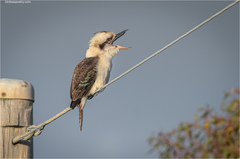
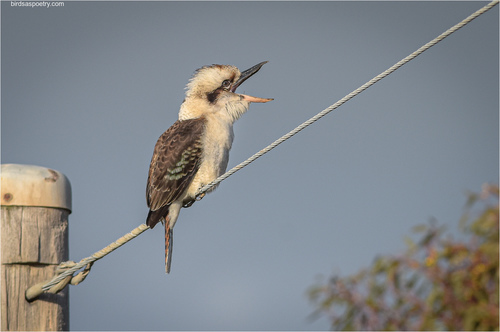
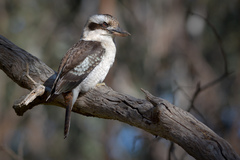
The laughing kookaburra (Dacelo novaeguineae) is a bird in the kingfisher subfamily Halcyoninae. It is a large kingfisher with a whitish head and a brown eye-stripe. The upperparts are mostly dark brown but there is a mottled light-blue patch on the wing coverts. The underparts are cream-white and the tail is barred with rufous and black. The plumage of the male and female birds is similar. The territorial call is a distinctive laugh that is often delivered by several birds at the same time, and is widely used as a stock sound effect in situations that involve a jungle setting.
The laughing kookaburra is native to eastern mainland Australia, but has also been introduced to parts of New Zealand, Tasmania, and Western Australia. It occupies dry eucalypt forest, woodland, city parks and gardens. This species is sedentary and occupies the same territory throughout the year. It is monogamous, retaining the same partner for life. A breeding pair can be accompanied by up to five fully grown non-breeding offspring from previous years that help the parents defend their territory and raise their young. The laughing kookaburra generally breeds in unlined tree holes or in excavated holes in arboreal termite nests. The usual clutch is three white eggs. The parents and the helpers incubate the eggs and feed the chicks. The youngest of the three nestlings or chicks is often killed by the older siblings. When the chicks fledge they continue to be fed by the group for six to ten weeks until they are able to forage independently.
A predator of a wide variety of small animals, the laughing kookaburra typically waits perched on a branch until it sees an animal on the ground and then flies down and pounces on its prey. Its diet includes lizards, insects, worms, snakes, mice and it is known to take goldfish out of garden ponds.
The International Union for Conservation of Nature (IUCN) has classed the laughing kookaburra as a species of least concern as it has a large range and population, with no widespread threats. Wikipedia →
Recent sightings of Laughing Kookaburra in Hattah-Kulkyne National Park
LIVEiNaturalistGlobal Distribution
Parks Where Found
| # | Park | Country | Daily sighting probability |
|---|---|---|---|
| 1 | Royal National Park | 🇦🇺 Australia | |
| 2 | Maria Island National Park | 🇦🇺 Australia | |
| 3 | Grampians National Park | 🇦🇺 Australia | |
| 4 | Springbrook National Park | 🇦🇺 Australia | |
| 5 | Booderee National Park | 🇦🇺 Australia | |
| 6 | Kosciuszko National Park | 🇦🇺 Australia | |
| 7 | Blue Mountains National Park | 🇦🇺 Australia | |
| 8 | Great Otway National Park | 🇦🇺 Australia | |
| 9 | Freycinet National Park | 🇦🇺 Australia | |
| 10 | Flinders Ranges National Park | 🇦🇺 Australia | |
| 11 | Wilsons Promontory National Park | 🇦🇺 Australia | |
| 12 | Noosa National Park | 🇦🇺 Australia | |
| 13 | Hattah-Kulkyne National Park | 🇦🇺 Australia | |
| 14 | Daintree National Park | 🇦🇺 Australia | |
| 15 | Cradle Mountain-Lake St Clair National Park | 🇦🇺 Australia | |
| 16 | Lamington National Park | 🇦🇺 Australia |
Zoos & Centres Where Found
| # | Zoo / Centre | Country | |
|---|---|---|---|
| 1 | Ragunan Zoo | 🇮🇩 Indonesia | |
| 2 | SeaWorld Orlando | 🇺🇸 United States | |
| 3 | Busch Gardens Tampa | 🇺🇸 United States | |
| 4 | San Diego Zoo | 🇺🇸 United States | |
| 5 | Pairi Daiza | 🇧🇪 Belgium | |
| 6 | ZooParc de Beauval | 🇫🇷 France | |
| 7 | SeaWorld Abu Dhabi | 🇦🇪 United Arab Emirates | |
| 8 | Denver Zoo | 🇺🇸 United States | |
| 9 | Copenhagen Zoo | 🇩🇰 Denmark | |
| 10 | Cleveland Metroparks Zoo | 🇺🇸 United States | |
| 11 | Cincinnati Zoo and Botanical Garden | 🇺🇸 United States | |
| 12 | Zürich Zoo | 🇨🇭 Switzerland | |
| 13 | Barcelona Zoo | 🇪🇸 Spain | |
| 14 | North Carolina Zoo | 🇺🇸 United States | |
| 15 | Parc Phœnix | 🇫🇷 France | |
| 16 | Liberec Zoo | 🇨🇿 Czechia | |
| 17 | Jihlava Zoo | 🇨🇿 Czechia | |
| 18 | Greensboro Science Center | 🇺🇸 United States | |
| 19 | Walsrode World Bird Park | 🇩🇪 Germany | |
| 20 | Zoologic park de Lille | 🇫🇷 France | |
| 21 | Parc des oiseaux | 🇫🇷 France | |
| 22 | Zoo Hluboka | 🇨🇿 Czechia | |
| 23 | Zoo de Maubeuge | 🇫🇷 France | |
| 24 | Zoobotánico Jerez | 🇪🇸 Spain | |
| 25 | Zoo d'Amiens | 🇫🇷 France | |
| 26 | Zoo Miami | 🇺🇸 United States | |
| 27 | Toronto Zoo | 🇨🇦 Canada | |
| 28 | Taipei Zoo | 🇹🇼 Taiwan | |
| 29 | Safari West | 🇺🇸 United States | |
| 30 | Busch Gardens Williamsburg | 🇺🇸 United States | |
| 31 | Living Desert Zoo and Gardens | 🇺🇸 United States | |
| 32 | Columbus Zoo and Aquarium | 🇺🇸 United States | |
| 33 | Poznań Nowe Zoo | 🇵🇱 Poland | |
| 34 | Bronx Zoo | 🇺🇸 United States | |
| 35 | Wildlife Safari | 🇺🇸 United States | |
| 36 | Kansas City Zoo | 🇺🇸 United States | |
| 37 | Badoca Safari Park | 🇵🇹 Portugal | |
| 38 | Ramat Gan Safari | 🇮🇱 Israel | |
| 39 | Brookfield Zoo | 🇺🇸 United States | |
| 40 | Baton Rouge Zoo | 🇺🇸 United States | |
| 41 | Saitama Children's Zoo | 🇯🇵 Japan | |
| 42 | Sedgwick County Zoo | 🇺🇸 United States | |
| 43 | Omaha’s Henry Doorly Zoo and Aquarium | 🇺🇸 United States | |
| 44 | Parc zoologique de Lisieux | 🇫🇷 France | |
| 45 | Blair Drummond Safari and Adventure Park | 🇬🇧 United Kingdom | |
| 46 | Banham Zoo | 🇬🇧 United Kingdom | |
| 47 | Johannesburg Zoo | 🇿🇦 South Africa | |
| 48 | Los Angeles Zoo | 🇺🇸 United States | |
| 49 | The Maryland Zoo | 🇺🇸 United States | |
| 50 | Toledo Zoo | 🇺🇸 United States |
Closest Relatives at Hattah-Kulkyne National Park


Before you go
What are the chances of seeing a Laughing Kookaburra in Hattah-Kulkyne National Park?
Possible
About 30% of wildlife watchers report a Laughing Kookaburra sighting in Hattah-Kulkyne National Park on a given day, based on 476 verified sightings from GBIF citizen-science data from 2019 to 2026. It is the 38th most-seen of the 170 birds we can rate there. Over three days the chance rises to about 70%, and over a week to about 90%, if each day is a fresh chance.
When is the best time to see a Laughing Kookaburra in Hattah-Kulkyne National Park?
April
In that month about 50% of wildlife watchers report a Laughing Kookaburra in Hattah-Kulkyne National Park on a given day, against about 20% in January, May and July, the lowest months.
What time of day is best to see a Laughing Kookaburra?
Between noon and 3 pm
Across all the parks we cover, that three-hour window holds the most Laughing Kookaburra sightings with a recorded time, and nearly all of them come between 6 am and 6 pm: it is a daytime animal.
Is Hattah-Kulkyne National Park the best place to see a Laughing Kookaburra?
13th of 16
Of the 16 parks where we can rate Laughing Kookaburra sightings, Hattah-Kulkyne National Park ranks 13th at about 30%. The best odds are in Royal National Park (Australia, about 70%), Maria Island National Park (Australia, about 70%) and Grampians National Park (Australia, about 70%). All parks ranked.
Where does the Laughing Kookaburra sighting chance come from?
GBIF citizen-science records
It is estimated from how often the Laughing Kookaburra is recorded against all the birds logged in Hattah-Kulkyne National Park (476 verified sightings from 2019 to 2026), calibrated against known sighting rates. Figures are rounded to the nearest 10% because citizen-science data supports honest approximations, not decimals, and months with records from fewer than five people show "—". How it works.
