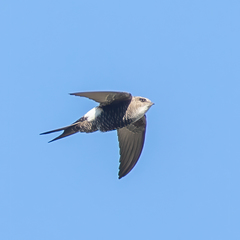
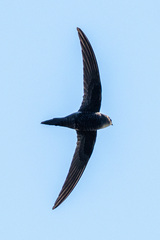

Pacific Swift

Pacific Swift

Apus pacificus

Silhouette: Ferran Sayol · PhyloPic

LCLeast ConcernNTVUENCR
Daily sighting probability <5% · Rare
at Kinabatangan Wildlife Sanctuary

In 3 days <5%

5 Verified sightings at Kinabatangan Wildlife Sanctuary From 2019 to 2026
895 In all 26 parks
February Best month
☀️ Diurnal When it's spotted

About the Pacific Swift

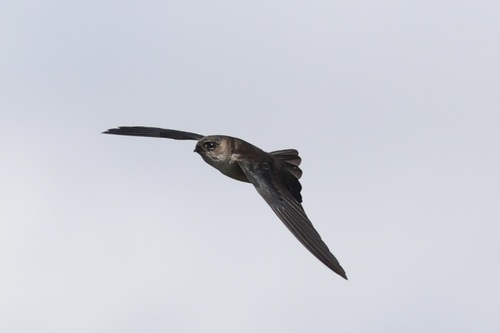
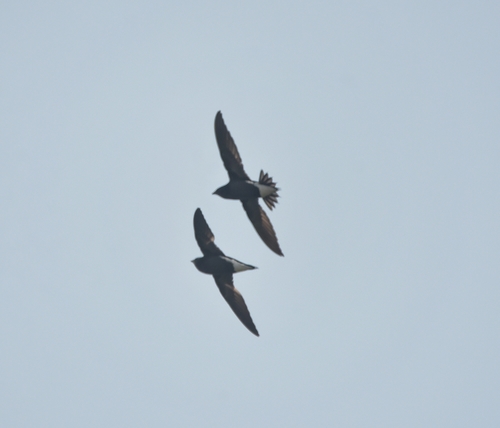
The Pacific swift (Apus pacificus) is a species of bird that is part of the Swift family. It breeds in eastern Asia. It is strongly migratory, spending the northern hemisphere's winter in Southeast Asia and Australia. The general shape and blackish plumage recall its relative, the common swift, from which it is distinguished by a white rump band and heavily marked underparts. The sexes are identical in appearance, although young birds can be identified by pale fringes to the wing feathers that are absent in adults. This swift's main call is a screech typical of its family. It is one of a group of closely related Asian swifts formerly regarded as one species.

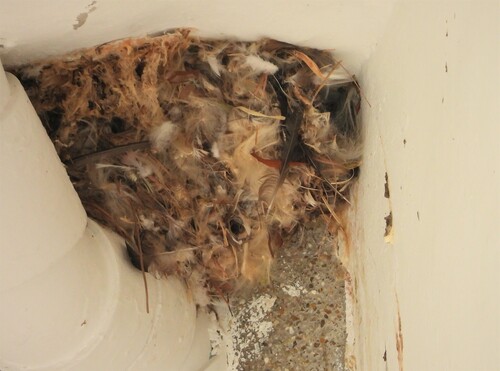
The Pacific swift is found in a wide range of climatic zones and habitats. It breeds in sheltered locations such as caves, natural rock crevices or under the roofs of houses. The nest is a half-cup of dry grass and other fine material that is gathered in flight, cemented with saliva and attached to a vertical surface. The two or three white eggs are incubated for about seventeen days to hatching. Subsequently, the chicks have a long but variable period in the nest before they are fully fledged. When the parents cannot find sufficient food in bad weather, the young can survive for days without being fed by metabolising body fat.

Like all members of its family, the Pacific swift feeds exclusively on insects caught in flight. It tends to hunt higher than most of its relatives other than the white-throated needletail. The Pacific swift has a large population and extensive breeding area, and faces few threats from predators or human activities. It is classed as being of least concern by the International Union for Conservation of Nature. It has occurred as far afield as the US and New Zealand, and it is a very rare vagrant in Europe. Wikipedia →

Sounds

Call0:31

China · 2026

© Peter Boesman · XC1147368 · CC BY-NC-ND 4.0

Flight call0:25

China · 2024

© Ding Li Yong · XC915151 · CC BY-NC-ND 4.0

Call0:11

Italy · 2025

© Maurizio Azzolini · XC1019539 · CC BY-NC-SA 4.0

Global Distribution

Parks Where Found

# Park Country Daily sighting probability
1 Gobi Gurvansaikhan National Park 🇲🇳 Mongolia
~40%
2 Khao Sok National Park 🇹🇭 Thailand
~10%
3 Bali Barat National Park 🇮🇩 Indonesia
~10%
4 Kaeng Krachan National Park 🇹🇭 Thailand
~10%
5 Taroko National Park 🇹🇼 Taiwan
~10%
6 Nikko National Park 🇯🇵 Japan
~10%
7 Gunung Leuser National Park 🇮🇩 Indonesia
<5%
8 Way Kambas National Park 🇮🇩 Indonesia
<5%
9 Raja Ampat 🇮🇩 Indonesia
<5%
10 Khao Luang National Park 🇹🇭 Thailand
<5%
11 Komodo National Park 🇮🇩 Indonesia
<5%
12 Litchfield National Park 🇦🇺 Australia
<5%
13 Danum Valley Conservation Area 🇲🇾 Malaysia
<5%
14 Taman Negara National Park 🇲🇾 Malaysia
<5%
15 Daintree National Park 🇦🇺 Australia
<5%
16 Khao Yai National Park 🇹🇭 Thailand
<5%
17 Sepilok 🇲🇾 Malaysia
<5%
18 Tangkoko Nature Reserve 🇮🇩 Indonesia
<5%
19 Cat Tien National Park 🇻🇳 Vietnam
<5%
20 Lamington National Park 🇦🇺 Australia
<5%
21 Kakadu National Park 🇦🇺 Australia
<5%
22 Royal National Park 🇦🇺 Australia
<5%
23 Kinabatangan Wildlife Sanctuary 🇲🇾 Malaysia
<5%
24 Doi Inthanon National Park 🇹🇭 Thailand
<5%
25 Kinabalu Park 🇲🇾 Malaysia
<5%
26 Great Otway National Park 🇦🇺 Australia
<5%

Cities Where Found

# City Country Daily sighting probability
1 Ulaanbaatar 🇲🇳 Mongolia
~40%
2 Busan 🇰🇷 South Korea
~10%
3 Singapore 🇸🇬 Singapore
~10%
4 Sendai 🇯🇵 Japan
<5%
5 Jakarta 🇮🇩 Indonesia
<5%
6 Chengdu 🇨🇳 China
<5%
7 Hong Kong 🇨🇳 China
<5%
8 Denpasar 🇮🇩 Indonesia
<5%
9 Beijing 🇨🇳 China
<5%
10 Kuala Lumpur 🇲🇾 Malaysia
<5%

Before you go

What are the chances of seeing a Pacific Swift in Kinabatangan Wildlife Sanctuary?

Rare

Under 5% of wildlife watchers report a Pacific Swift sighting in Kinabatangan Wildlife Sanctuary on a given day, based on 5 verified sightings from GBIF citizen-science data from 2019 to 2026. It is the 221st most-seen of the 231 birds we can rate there. Over three days the chance rises to under 5%, if each day is a fresh chance.

When is the best time to see a Pacific Swift in Kinabatangan Wildlife Sanctuary?

Any time of year

In every month with enough records, under 5% of wildlife watchers report a Pacific Swift in Kinabatangan Wildlife Sanctuary on a given day, so our monthly data shows no clear season.

What time of day is best to see a Pacific Swift?

Between 10 am and 1 pm

Across all the parks we cover, that three-hour window holds the most Pacific Swift sightings with a recorded time, and about 7 in 10 of them come between 6 am and 6 pm: it is a daytime animal.

Where does the Pacific Swift sighting chance come from?

GBIF citizen-science records

It is estimated from how often the Pacific Swift is recorded against all the birds logged in Kinabatangan Wildlife Sanctuary (5 verified sightings from 2019 to 2026), calibrated against known sighting rates. Figures are rounded to the nearest 10% because citizen-science data supports honest approximations, not decimals, and months with records from fewer than five people show "—". How it works.

← Back to Kinabatangan Wildlife Sanctuary