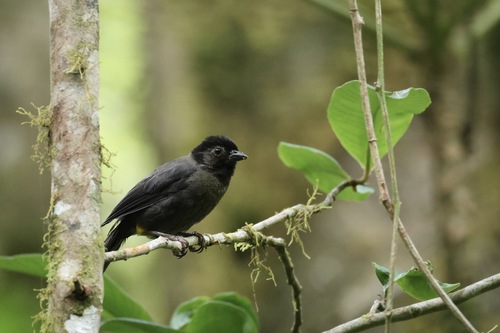
Gray-breasted Wood-Wren

Gray-breasted Wood-Wren

Henicorhina leucophrys

Silhouette: Matt Wilkins · PhyloPic

LCLeast ConcernNTVUENCR
Daily sighting probability ~50% · Likely
at Los Quetzales National Park

In 3 days ~80% in a week >90%

4,639 Verified sightings at Los Quetzales National Park From 2019 to 2026
24,278 In all 24 parks
August Best month
☀️ Diurnal When it's spotted

About the Gray-breasted Wood-Wren

The grey-breasted wood wren (Henicorhina leucophrys) is a species of bird in the family Troglodytidae. It is found from Mexico to Bolivia. The grey-breasted wood-wren's taxonomy at the subspecies level is unsettled. According to the International Ornithological Committee (IOC), it has 17 subspecies. The Clements taxonomy and Handbook of Birds of the World (HBW) recognize 13 of them. The South American Classification Committee of the American Ornithological Society (SACC/AOS) cites a 2019 publication that "there are as many as 35 lineages within H. leucophrys that could merit recognition as species under some species concepts."

The nominate subspecies of grey-breasted wood wren is 10 to 11.5 cm (3.9 to 4.5 in) long and weighs 13.5 to 17.7 g (0.48 to 0.62 oz). Its crown feathers are dull black with dark brown tips. Its nape and shoulders are a dark olive brown and its lower back, rump, and tail chestnut brown. The tail has blackish bars. It has a long gray-white supercilium, a wide black stripe behind the eye, and black cheeks streaked with pale gray. Its chin and throat are pale gray, the chest and belly a darker gray, and the sides of... Wikipedia →

Sounds

Call0:47

Colombia · 2025

© Alain Verneau · XC1141730 · CC BY-NC-SA 4.0

Song0:15

Ecuador · 2026

© Daan van der Hoeven · XC1105459 · CC BY-NC-SA 4.0

Call/song1:12

Ecuador · 2017

© Manuel Sánchez-Nivicela · XC1105180 · CC BY-NC-ND 4.0

Global Distribution

Parks Where Found

# Park Country Daily sighting probability
1 Volcán Barú National Park 🇵🇦 Panama
~60%
2 Los Quetzales National Park 🇨🇷 Costa Rica
~50%
3 Monteverde Cloud Forest Reserve 🇨🇷 Costa Rica
~40%
4 Irazú Volcano National Park 🇨🇷 Costa Rica
~30%
5 Farallones de Cali National Natural Park 🇨🇴 Colombia
~30%
6 Poás Volcano National Park 🇨🇷 Costa Rica
~30%
7 El Triunfo 🇲🇽 Mexico
~30%
8 Tapantí-Macizo de la Muerte National Park 🇨🇷 Costa Rica
~30%
9 Henri Pittier National Park 🇻🇪 Venezuela
~30%
10 Los Nevados National Natural Park 🇨🇴 Colombia
~20%
11 La Amistad International Park (Panama) 🇵🇦 Panama
~20%
12 Chirripó National Park 🇨🇷 Costa Rica
~20%
13 Braulio Carrillo National Park 🇨🇷 Costa Rica
~20%
14 Cusuco National Park 🇭🇳 Honduras
~10%
15 Chingaza National Natural Park 🇨🇴 Colombia
~10%
16 Darién National Park 🇵🇦 Panama
~10%
17 Arenal Volcano National Park 🇨🇷 Costa Rica
~10%
18 Tayrona National Natural Park 🇨🇴 Colombia
~10%
19 Podocarpus National Park 🇪🇨 Ecuador
<5%
20 Amboró National Park 🇧🇴 Bolivia
<5%
21 Tenorio Volcano National Park 🇨🇷 Costa Rica
<5%
22 Pico Bonito National Park 🇭🇳 Honduras
<5%
23 Machalilla National Park 🇪🇨 Ecuador
<5%
24 Chagres National Park 🇵🇦 Panama
<5%

Cities Where Found

# City Country Daily sighting probability
1 Guatemala City 🇬🇹 Guatemala
~10%
2 Bogota 🇨🇴 Colombia
<5%
3 San José 🇨🇷 Costa Rica
<5%
4 Cali 🇨🇴 Colombia
<5%
5 Medellín 🇨🇴 Colombia
<5%
6 Caracas 🇻🇪 Venezuela
<5%

Before you go

What are the chances of seeing a Gray-breasted Wood-Wren in Los Quetzales National Park?

Likely

About 50% of wildlife watchers report a Gray-breasted Wood-Wren sighting in Los Quetzales National Park on a given day, based on 4,639 verified sightings from GBIF citizen-science data from 2019 to 2026. It is the 23rd most-seen of the 252 birds we can rate there. Over three days the chance rises to about 80%, and over a week to over 90%, if each day is a fresh chance.

When is the best time to see a Gray-breasted Wood-Wren in Los Quetzales National Park?

March–April, July–October and December

In those months about 50% of wildlife watchers report a Gray-breasted Wood-Wren in Los Quetzales National Park on a given day, against about 40% in January–February, May–June and November, the lowest months.

What time of day is best to see a Gray-breasted Wood-Wren?

Between 7 and 10 am

Across all the parks we cover, that three-hour window holds the most Gray-breasted Wood-Wren sightings with a recorded time, and about 9 in 10 of them come between 6 am and 6 pm: it is a daytime animal.

Is Los Quetzales National Park the best place to see a Gray-breasted Wood-Wren?

2nd of 24

Of the 24 parks where we can rate Gray-breasted Wood-Wren sightings, Los Quetzales National Park ranks 2nd at about 50%. The best odds are in Volcán Barú National Park (Panama, about 60%). All parks ranked.

Which relatives of the Gray-breasted Wood-Wren live in Los Quetzales National Park?

Same family: Troglodytidae

The closest relatives of the Gray-breasted Wood-Wren that you can see in Los Quetzales National Park (family Troglodytidae, Wrens) are Ochraceous Wren (about 20%) and Timberline Wren (about 10%), with each one's daily chance of a sighting.

Where does the Gray-breasted Wood-Wren sighting chance come from?

GBIF citizen-science records

It is estimated from how often the Gray-breasted Wood-Wren is recorded against all the birds logged in Los Quetzales National Park (4,639 verified sightings from 2019 to 2026), calibrated against known sighting rates. Figures are rounded to the nearest 10% because citizen-science data supports honest approximations, not decimals, and months with records from fewer than five people show "—". How it works.

← Back to Los Quetzales National Park