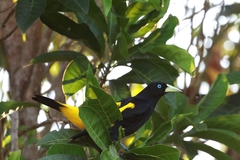
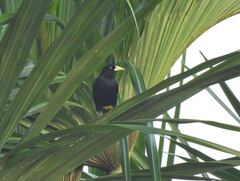
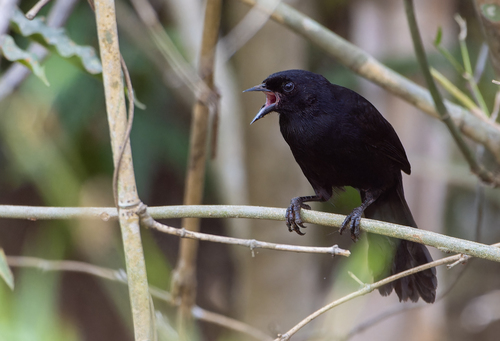
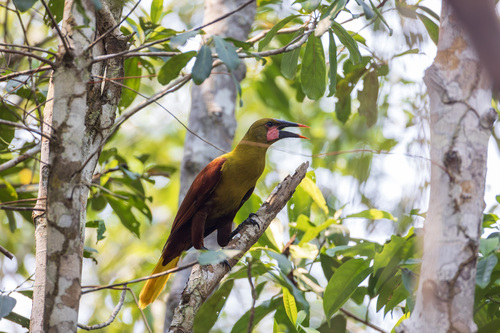
The yellow-rumped cacique (Cacicus cela) is a passerine bird in the New World family Icteridae. It breeds in much of northern South America from Panama, Venezuela and Trinidad south to Peru, Bolivia and central Brazil. However, they have been sighted as far north as Nayarit state in Mexico.
The yellow-rumped cacique was formally described by the Swedish naturalist Carl Linnaeus in 1758 in the tenth edition of his Systema Naturae under the binomial name Parus cela. Why Linnaeus picked this specific epithet is uncertain but it may be shorthand for the Ancient Greek kelainos meaning "black". Linnaeus mistakenly specified the Habitat as in Indiis (India). The type location was designated as Suriname by the Austrian ornithologist Carl Eduard Hellmayr in 1906. The yellow-rumped cacique is now placed in the genus Cacique that was introduced by the Bernard Germain de Lacépède in 1799.
Three subspecies are recognised: