Brown Booby

Brown Booby

Sula leucogaster

Silhouette: Jon Hill (Photo by Benjamint444: http://en.wikipedia.org/wiki/File:Blue-footed-booby.jpg) · PhyloPic

LCLeast ConcernNTVUENCR
Daily sighting probability <5% · Rare
at Gandoca-Manzanillo Wildlife Refuge

In 3 days ~10% in a week ~20%

53 Verified sightings at Gandoca-Manzanillo Wildlife Refuge From 2019 to 2026
2,628 In all 20 parks
July Best month
☀️ Diurnal When it's spotted

About the Brown Booby

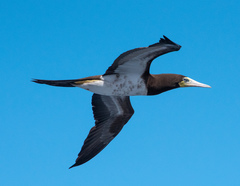
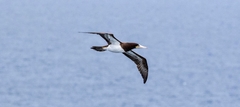
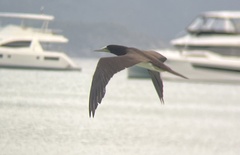
The brown booby (Sula leucogaster) is a large seabird in the booby and gannet family Sulidae, of which it is one of the most common and widespread species. It has a pantropical range, which overlaps with that of other booby species. The gregarious brown booby commutes and forages at low height over inshore waters. Flocks plunge-dive to take small fish, especially when these are driven near the surface by their predators. They nest only on the ground, and roost on solid objects rather than the water surface.

The brown booby was described by the French polymath Georges-Louis Leclerc, Comte de Buffon in his Histoire Naturelle des Oiseaux in 1781. The bird was also illustrated in a hand-coloured plate engraved by François-Nicolas Martinet in the Planches Enluminées D'Histoire Naturelle which was produced under the supervision of Edme-Louis Daubenton to accompany Buffon's text. Buffon did not include a scientific name with his description but in 1783 the Dutch naturalist Pieter Boddaert coined the binomial name Pelecanus leucogaster in his catalogue of the Planches Enluminées. The type locality is Cayenne in French Guiana.

The current genus Sula was introduced by the French... Wikipedia →

Sounds

Call0:14

Brazil · 2024

© JAYRSON ARAUJO DE OLIVEIRA · XC927122 · CC BY-NC-SA 4.0

Begging call1:16

Mexico · 2016

© Manuel Grosselet · XC335796 · CC BY-NC-SA 4.0

Call0:06

Saudi Arabia · 2020

© David Darrell-Lambert · XC739064 · CC BY-NC-SA 4.0

Global Distribution

Parks Where Found

# Park Country Daily sighting probability
1 Bastimentos Island National Marine Park 🇵🇦 Panama
~20%
2 Jaragua National Park 🇩🇴 Dominican Republic
~10%
3 Main Ridge Forest Reserve 🇹🇹 Trinidad and Tobago
~10%
4 La Amistad International Park (Panama) 🇵🇦 Panama
~10%
5 San Lorenzo Protected Forest 🇵🇦 Panama
~10%
6 Sian Ka'an Biosphere Reserve 🇲🇽 Mexico
~10%
7 Tijuca National Park 🇧🇷 Brazil
<5%
8 Komodo National Park 🇮🇩 Indonesia
<5%
9 Padre Island National Seashore 🇺🇸 United States
<5%
10 Raja Ampat 🇮🇩 Indonesia
<5%
11 Bali Barat National Park 🇮🇩 Indonesia
<5%
12 Gandoca-Manzanillo Wildlife Refuge 🇨🇷 Costa Rica
<5%
13 Cahuita National Park 🇨🇷 Costa Rica
<5%
14 Tortuguero National Park 🇨🇷 Costa Rica
<5%
15 Los Haitises National Park 🇩🇴 Dominican Republic
<5%
16 Noosa National Park 🇦🇺 Australia
<5%
17 Ría Lagartos Biosphere Reserve 🇲🇽 Mexico
<5%
18 Celestún Biosphere Reserve 🇲🇽 Mexico
<5%
19 Tayrona National Natural Park 🇨🇴 Colombia
<5%
20 Merritt Island National Wildlife Refuge 🇺🇸 United States
<5%

Cities Where Found

# City Country Daily sighting probability
1 Dakar 🇸🇳 Senegal
~20%
2 Rio de Janeiro 🇧🇷 Brazil
~10%
3 Vitória 🇧🇷 Brazil
~10%
4 Padang 🇮🇩 Indonesia
~10%
5 Jeddah 🇸🇦 Saudi Arabia
<5%
6 Santos 🇧🇷 Brazil
<5%
7 Denpasar 🇮🇩 Indonesia
<5%
8 Niterói 🇧🇷 Brazil
<5%
9 Santo Domingo 🇩🇴 Dominican Republic
<5%
10 Colombo [Sri Jayawardenepura Kotte] 🇱🇰 Sri Lanka
<5%

Zoos & Centres Where Found

# Zoo / Centre Country
1 Sea World 🇦🇺 Australia In captivity
2 Honolulu Zoo 🇺🇸 United States In captivity
3 Zooparque Itatiba 🇧🇷 Brazil In captivity

Before you go

What are the chances of seeing a Brown Booby in Gandoca-Manzanillo Wildlife Refuge?

Rare

Under 5% of wildlife watchers report a Brown Booby sighting in Gandoca-Manzanillo Wildlife Refuge on a given day, based on 53 verified sightings from GBIF citizen-science data from 2019 to 2026. It is the 217th most-seen of the 329 birds we can rate there. Over three days the chance rises to about 10%, and over a week to about 20%, if each day is a fresh chance.

When is the best time to see a Brown Booby in Gandoca-Manzanillo Wildlife Refuge?

January, July and October

In those months about 10% of wildlife watchers report a Brown Booby in Gandoca-Manzanillo Wildlife Refuge on a given day, against under 5% in February–June, August–September and November–December, the lowest months.

What time of day is best to see a Brown Booby?

Between 10 am and 1 pm

Across all the parks we cover, that three-hour window holds the most Brown Booby sightings with a recorded time, and about 9 in 10 of them come between 6 am and 6 pm: it is a daytime animal.

Which relatives of the Brown Booby live in Gandoca-Manzanillo Wildlife Refuge?

Same order: Suliformes

The closest relatives of the Brown Booby that you can see in Gandoca-Manzanillo Wildlife Refuge (order Suliformes, Gannets, Cormorants, and Allies) are Magnificent Frigatebird (about 20%) and Bigua cormorant (about 10%), with each one's daily chance of a sighting.

Where does the Brown Booby sighting chance come from?

GBIF citizen-science records

It is estimated from how often the Brown Booby is recorded against all the birds logged in Gandoca-Manzanillo Wildlife Refuge (53 verified sightings from 2019 to 2026), calibrated against known sighting rates. Figures are rounded to the nearest 10% because citizen-science data supports honest approximations, not decimals, and months with records from fewer than five people show "—". How it works.

← Back to Gandoca-Manzanillo Wildlife Refuge