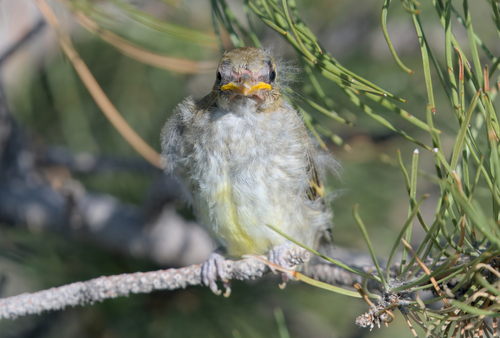
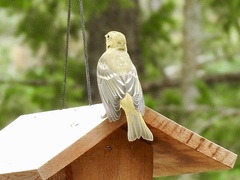
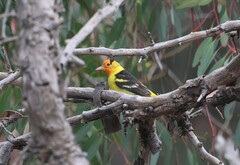

Western Tanager

Western Tanager

Piranga ludoviciana

Silhouette: Sheatherius · PhyloPic

LCLeast ConcernNTVUENCR
Daily sighting probability ~10% · With luck
at Reserva de la Biosfera Mariposa Monarca

In 3 days ~20% in a week ~30%

11 Verified sightings at Reserva de la Biosfera Mariposa Monarca From 2019 to 2026
14,355 In all 45 parks
February Best month
☀️ Diurnal When it's spotted

About the Western Tanager

The western tanager (Piranga ludoviciana) is a medium-sized American songbird. Formerly placed in the tanager family (Thraupidae), it and other members of its genus are classified in the cardinal family (Cardinalidae). The species' plumage and vocalizations are similar to other members of the cardinal family.

The western tanager was illustrated and formally described by American ornithologist Alexander Wilson in 1811 under the binomial name Tanagra ludoviciana from a specimen collected on the Lewis and Clark Expedition (1804–1806). The type locality is Kamiah, Idaho. The specific epithet is from the Late Latin ludovicianus for "Louis". The name is from Louisiana, the 18th-century French administrative district of New France, rather than the modern state. The western tanager is now placed in the genus Piranga that was introduced by French ornithologist Louis Pierre Vieillot in 1808. The species is monotypic; no subspecies are recognized.

Measurements: Length: 6.3–7.5 in (16–19 cm) Weight: 0.8–1.3 oz (24–36 g) Wingspan: 11.5 in (29 cm) Adults have pale, stout pointed bills, yellow underparts, and light wing bars. Adult males have a bright red face and... Wikipedia →

Sounds

Song0:58

United States · 2026

© Ed Pandolfino · XC1145169 · CC BY-NC-SA 4.0

Call0:26

United States · 2022

© Richard E. Webster · XC776919 · CC BY-NC-SA 4.0

Subsong1:14

United States · 2021

© Steve Hampton · XC649393 · CC BY-NC-SA 4.0

Global Distribution

Parks Where Found

# Park Country Daily sighting probability
1 Grand Teton National Park 🇺🇸 United States
~40%
2 Yosemite National Park 🇺🇸 United States
~40%
3 Glacier National Park 🇺🇸 United States
~40%
4 Sequoia and Kings Canyon National Parks 🇺🇸 United States
~30%
5 El Triunfo 🇲🇽 Mexico
~30%
6 Cañón del Sumidero National Park 🇲🇽 Mexico
~30%
7 Guadalupe Mountains National Park 🇺🇸 United States
~30%
8 Yellowstone National Park 🇺🇸 United States
~20%
9 Santa Rosa National Park 🇨🇷 Costa Rica
~20%
10 Zion National Park 🇺🇸 United States
~20%
11 Rocky Mountain National Park 🇺🇸 United States
~20%
12 Grand Canyon National Park 🇺🇸 United States
~20%
13 Big Bend National Park 🇺🇸 United States
~10%
14 Cabo Pulmo National Park 🇲🇽 Mexico
~10%
15 Death Valley National Park 🇺🇸 United States
~10%
16 Wood Buffalo National Park 🇨🇦 Canada
~10%
17 Olympic National Park 🇺🇸 United States
~10%
18 Cumbres de Monterrey National Park 🇲🇽 Mexico
~10%
19 Saguaro National Park 🇺🇸 United States
~10%
20 Joshua Tree National Park 🇺🇸 United States
~10%
21 Celaque National Park 🇭🇳 Honduras
~10%
22 Rincón de la Vieja National Park 🇨🇷 Costa Rica
~10%
23 Reserva de la Biosfera Mariposa Monarca 🇲🇽 Mexico
~10%
24 Jasper National Park 🇨🇦 Canada
~10%
25 Redwood National Park 🇺🇸 United States
~10%
26 Great Bear Rainforest 🇨🇦 Canada
~10%
27 El Vizcaíno Biosphere Reserve 🇲🇽 Mexico
~10%
28 Elk Island National Park 🇨🇦 Canada
<5%
29 Bahía de Loreto National Park 🇲🇽 Mexico
<5%
30 La Tigra National Park 🇭🇳 Honduras
<5%
31 Banff National Park 🇨🇦 Canada
<5%
32 Channel Islands National Park 🇺🇸 United States
<5%
33 Cabo Blanco Absolute Nature Reserve 🇨🇷 Costa Rica
<5%
34 Ostional Wildlife Refuge 🇨🇷 Costa Rica
<5%
35 Pacific Rim National Park Reserve 🇨🇦 Canada
<5%
36 Las Baulas Marine National Park 🇨🇷 Costa Rica
<5%
37 Carara National Park 🇨🇷 Costa Rica
<5%
38 Masaya Volcano National Park 🇳🇮 Nicaragua
<5%
39 Point Pelee National Park 🇨🇦 Canada
<5%
40 Los Quetzales National Park 🇨🇷 Costa Rica
<5%
41 Volcán Barú National Park 🇵🇦 Panama
<5%
42 Palo Verde National Park 🇨🇷 Costa Rica
<5%
43 Piedras Blancas National Park 🇨🇷 Costa Rica
<5%
44 La Amistad International Park (Panama) 🇵🇦 Panama
<5%
45 Tapantí-Macizo de la Muerte National Park 🇨🇷 Costa Rica
<5%

Cities Where Found

# City Country Daily sighting probability
1 Puebla 🇲🇽 México
~30%
2 Guadalajara 🇲🇽 México
~20%
3 Mexico City 🇲🇽 México
~10%
4 Guatemala City 🇬🇹 Guatemala
~10%
5 Tijuana 🇲🇽 México
~10%
6 San Salvador 🇸🇻 El Salvador
~10%
7 Sacramento 🇺🇸 United States
~10%
8 Portland 🇺🇸 United States
~10%
9 Los Angeles 🇺🇸 United States
~10%
10 Salt Lake City 🇺🇸 United States
~10%

Zoos & Centres Where Found

# Zoo / Centre Country
1 Arizona-Sonora Desert Museum 🇺🇸 United States In captivity

Before you go

What are the chances of seeing a Western Tanager in Reserva de la Biosfera Mariposa Monarca?

With luck

About 10% of wildlife watchers report a Western Tanager sighting in Reserva de la Biosfera Mariposa Monarca on a given day, based on 11 verified sightings from GBIF citizen-science data from 2019 to 2026. It is the 76th most-seen of the 103 birds we can rate there. Over three days the chance rises to about 20%, and over a week to about 30%, if each day is a fresh chance.

When is the best time to see a Western Tanager in Reserva de la Biosfera Mariposa Monarca?

February and November

In those months about 10% of wildlife watchers report a Western Tanager in Reserva de la Biosfera Mariposa Monarca on a given day, against under 5% in March, May, October and December–January, the lowest months. Those are among Reserva de la Biosfera Mariposa Monarca's driest months, with about 35 mm of rain a month against 270 mm in July. April and June–September have too few records to rate.

What time of day is best to see a Western Tanager?

Between 8 and 11 am

Across all the parks we cover, that three-hour window holds the most Western Tanager sightings with a recorded time, and about 9 in 10 of them come between 6 am and 6 pm: it is a daytime animal.

Which relatives of the Western Tanager live in Reserva de la Biosfera Mariposa Monarca?

Same genus: Piranga

The closest relatives of the Western Tanager that you can see in Reserva de la Biosfera Mariposa Monarca (genus Piranga, Piranga Tanagers) are Hepatic Tanager (about 30%) and Summer Tanager (about 10%), with each one's daily chance of a sighting.

Where does the Western Tanager sighting chance come from?

GBIF citizen-science records

It is estimated from how often the Western Tanager is recorded against all the birds logged in Reserva de la Biosfera Mariposa Monarca (11 verified sightings from 2019 to 2026), calibrated against known sighting rates. Figures are rounded to the nearest 10% because citizen-science data supports honest approximations, not decimals, and months with records from fewer than five people show "—". How it works.

← Back to Reserva de la Biosfera Mariposa Monarca