
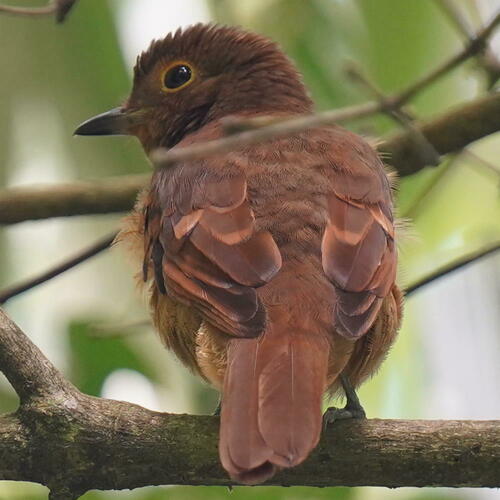
Rose-throated Becard

Rose-throated Becard

Pachyramphus aglaiae

Silhouette: Sheatherius · PhyloPic

LCLeast ConcernNTVUENCR
Daily sighting probability ~10% · With luck
at Pico Bonito National Park

In 3 days ~20% in a week ~40%

55 Verified sightings at Pico Bonito National Park From 2019 to 2026
5,958 In all 27 parks
July Best month
☀️ Diurnal When it's spotted

About the Rose-throated Becard

The rose-throated becard (Pachyramphus aglaiae) is a medium-sized passerine bird in the family Tityridae. It breeds from southeasternmost Arizona and extreme southern Texas in the United States and across Central America to western Panama. Males are mostly gray with a dark crest and have a characteristic rose-colored neck bib, which is absent in certain rainforest populations. Females also have a dark crest but are otherwise browner, with rusty-brown upperparts and pale buffy underparts.

The rose-throated becard is an omnivore, consuming fruit, berries, seeds, and (primarily) insects, either on the wing or by gleaning. Its typical habitat is riparian woodland and other semi-arid or subtropical open habitats with scattered trees. Breeding typically begins in May, with three to six eggs being laid in a domed nest suspended from a high tree branch.

The rose-throated becard was formally described by French ornithologist and baron Frédéric de Lafresnaye in 1839 under the binomial name Pachyrhynchus aglaiae. This binomial is now considered invalid due to the name Pachyrhynchus already being used for a genus of beetles. The rose-throated becard is now placed in the genus Pachyramphus... Wikipedia →

Sounds

Song1:18

Guatemala · 2023

© Max Noack · XC791888 · CC BY-NC-SA 4.0

Call0:04

Mexico · 2020

© Isain Contreras Rodríguez · XC540658 · CC BY-NC-SA 4.0

Flight call0:57

Mexico · 2012

© Elvis Herrera Rodríguez · XC197077 · CC BY-NC-SA 4.0

Global Distribution

Parks Where Found

# Park Country Daily sighting probability
1 Masaya Volcano National Park 🇳🇮 Nicaragua
~40%
2 Sian Ka'an Biosphere Reserve 🇲🇽 Mexico
~30%
3 El Triunfo 🇲🇽 Mexico
~30%
4 Ostional Wildlife Refuge 🇨🇷 Costa Rica
~20%
5 Carara National Park 🇨🇷 Costa Rica
~20%
6 Cerro Azul Meámbar National Park 🇭🇳 Honduras
~20%
7 Cumbres de Monterrey National Park 🇲🇽 Mexico
~20%
8 Calakmul Biosphere Reserve 🇲🇽 Mexico
~20%
9 Las Baulas Marine National Park 🇨🇷 Costa Rica
~20%
10 Cabo Blanco Absolute Nature Reserve 🇨🇷 Costa Rica
~20%
11 Palo Verde National Park 🇨🇷 Costa Rica
~10%
12 Tikal National Park 🇬🇹 Guatemala
~10%
13 Rincón de la Vieja National Park 🇨🇷 Costa Rica
~10%
14 Cockscomb Basin Wildlife Sanctuary 🇧🇿 Belize
~10%
15 Pico Bonito National Park 🇭🇳 Honduras
~10%
16 Arrecifes de Cozumel National Park 🇲🇽 Mexico
~10%
17 Celestún Biosphere Reserve 🇲🇽 Mexico
~10%
18 Santa Rosa National Park 🇨🇷 Costa Rica
~10%
19 Piedras Blancas National Park 🇨🇷 Costa Rica
<5%
20 Lago de Yojoa 🇭🇳 Honduras
<5%
21 Corcovado National Park 🇨🇷 Costa Rica
<5%
22 Reserva de la Biosfera Mariposa Monarca 🇲🇽 Mexico
<5%
23 Cusuco National Park 🇭🇳 Honduras
<5%
24 Manuel Antonio National Park 🇨🇷 Costa Rica
<5%
25 Monteverde Cloud Forest Reserve 🇨🇷 Costa Rica
<5%
26 La Amistad International Park (Panama) 🇵🇦 Panama
<5%
27 Tortuguero National Park 🇨🇷 Costa Rica
<5%

Cities Where Found

# City Country Daily sighting probability
1 Monterrey 🇲🇽 México
~10%
2 Managua 🇳🇮 Nicaragua
~10%
3 San Salvador 🇸🇻 El Salvador
~10%
4 San Pedro Sula 🇭🇳 Honduras
~10%
5 Guatemala City 🇬🇹 Guatemala
<5%
6 Guadalajara 🇲🇽 México
<5%
7 San José 🇨🇷 Costa Rica
<5%

Before you go

What are the chances of seeing a Rose-throated Becard in Pico Bonito National Park?

With luck

About 10% of wildlife watchers report a Rose-throated Becard sighting in Pico Bonito National Park on a given day, based on 55 verified sightings from GBIF citizen-science data from 2019 to 2026. It is the 138th most-seen of the 271 birds we can rate there. Over three days the chance rises to about 20%, and over a week to about 40%, if each day is a fresh chance.

When is the best time to see a Rose-throated Becard in Pico Bonito National Park?

July

In that month about 20% of wildlife watchers report a Rose-throated Becard in Pico Bonito National Park on a given day, against under 5% in March, May, August–September and November–December, the lowest months. That is one of Pico Bonito National Park's driest months, with about 110 mm of rain against 450 mm in November.

What time of day is best to see a Rose-throated Becard?

Between 7 and 10 am

Across all the parks we cover, that three-hour window holds the most Rose-throated Becard sightings with a recorded time, and about 9 in 10 of them come between 6 am and 6 pm: it is a daytime animal.

Is Pico Bonito National Park the best place to see a Rose-throated Becard?

15th of 27

Of the 27 parks where we can rate Rose-throated Becard sightings, Pico Bonito National Park ranks 15th at about 10%. The best odds are in Masaya Volcano National Park (Nicaragua, about 40%), Sian Ka'an Biosphere Reserve (Mexico, about 30%) and El Triunfo (Mexico, about 30%).

Which relatives of the Rose-throated Becard live in Pico Bonito National Park?

Same family: Cotingidae

The closest relatives of the Rose-throated Becard that you can see in Pico Bonito National Park (family Cotingidae, Cotingas) are Masked Tityra (about 50%), Lovely Cotinga (about 20%) and Black-crowned Tityra (about 10%), with each one's daily chance of a sighting.

Where does the Rose-throated Becard sighting chance come from?

GBIF citizen-science records

It is estimated from how often the Rose-throated Becard is recorded against all the birds logged in Pico Bonito National Park (55 verified sightings from 2019 to 2026), calibrated against known sighting rates. Figures are rounded to the nearest 10% because citizen-science data supports honest approximations, not decimals, and months with records from fewer than five people show "—". How it works.

← Back to Pico Bonito National Park