Australasian Grebe

Australasian Grebe

Tachybaptus novaehollandiae

Silhouette: Tisha Mukherjee · PhyloPic

LCLeast ConcernNTVUENCR
Daily sighting probability <5% · Rare
at Springbrook National Park

In 3 days ~10% in a week ~30%

23 Verified sightings at Springbrook National Park From 2019 to 2026
1,430 In all 17 parks
August Best month
☀️ Diurnal When it's spotted

About the Australasian Grebe

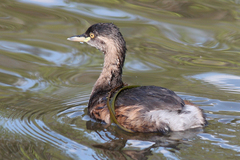
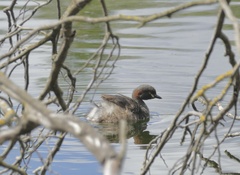
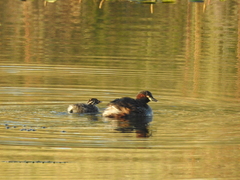
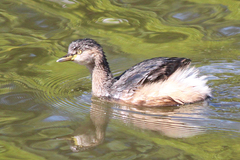
The Australasian grebe (Tachybaptus novaehollandiae) is a small waterbird common on fresh water lakes and rivers in greater Australia, New Zealand and on nearby Pacific islands. At 25–27 cm (9.8–10.6 in) in length, it is one of the smallest members of the grebe family, along with the least grebe and little grebe.

Tachybaptus novaehollandiae, (Stephens, 1826) Tachybaptus novaehollandiae javanicus, (Mayr, 1943), Java Tachybaptus novaehollandiae fumosus, (Mayr, 1943), Talaud & Sangihe Islands Tachybaptus novaehollandiae incola, (Mayr, 1943), northern New Guinea

Tachybaptus novaehollandiae novaehollandiae, (Stephens, 1826), southern New Guinea, Australia, Tasmania & New Zealand Tachybaptus novaehollandiae leucosternos, (Mayr, 1931), Vanuatu & New Caledonia Tachybaptus novaehollandiae rennellianus, (Mayr, 1943), Rennell Island (Solomon Islands)

Both sexes are dark brown above with a glossy-black head and neck and a striking chestnut facial stripe, extending from behind the eye to the base of the neck. The eye is yellow, with a prominent pale yellow face spot below.

Both sexes are generally... Wikipedia →

Sounds

Song0:11

Australia · 2022

© Marc Anderson · XC1001940 · CC BY-NC-ND 4.0

Begging call0:28

Australia · 2022

© nick talbot · XC706134 · CC BY-NC-SA 4.0

Call0:53

Australia · 2017

© Greg McLachlan · XC381466 · CC BY-NC-SA 4.0

Global Distribution

Parks Where Found

# Park Country Daily sighting probability
1 Uluru-Kata Tjuta National Park 🇦🇺 Australia
~20%
2 Hattah-Kulkyne National Park 🇦🇺 Australia
~10%
3 Royal National Park 🇦🇺 Australia
~10%
4 Litchfield National Park 🇦🇺 Australia
~10%
5 Flinders Ranges National Park 🇦🇺 Australia
~10%
6 Blue Mountains National Park 🇦🇺 Australia
~10%
7 Booderee National Park 🇦🇺 Australia
~10%
8 Flinders Chase 🇦🇺 Australia
~10%
9 Grampians National Park 🇦🇺 Australia
~10%
10 Kakadu National Park 🇦🇺 Australia
~10%
11 Springbrook National Park 🇦🇺 Australia
<5%
12 Great Otway National Park 🇦🇺 Australia
<5%
13 Maria Island National Park 🇦🇺 Australia
<5%
14 Kosciuszko National Park 🇦🇺 Australia
<5%
15 Wilsons Promontory National Park 🇦🇺 Australia
<5%
16 Lamington National Park 🇦🇺 Australia
<5%
17 Daintree National Park 🇦🇺 Australia
<5%

Cities Where Found

# City Country Daily sighting probability
1 Perth 🇦🇺 Australia
~50%
2 Melbourne 🇦🇺 Australia
~30%
3 Brisbane 🇦🇺 Australia
~20%
4 Sydney 🇦🇺 Australia
~20%
5 Auckland 🇳🇿 New Zealand
<5%

Zoos & Centres Where Found

# Zoo / Centre Country
1 Territory Wildlife Park 🇦🇺 Australia In captivity
2 Alice Springs Desert Park 🇦🇺 Australia In captivity

Closest Relatives at Springbrook National Park

No species of the same family or order lives in Springbrook National Park, so these are its closest relatives here: other birds.

Before you go

What are the chances of seeing an Australasian Grebe in Springbrook National Park?

Rare

Under 5% of wildlife watchers report an Australasian Grebe sighting in Springbrook National Park on a given day, based on 23 verified sightings from GBIF citizen-science data from 2019 to 2026. It is the 101st most-seen of the 136 birds we can rate there. Over three days the chance rises to about 10%, and over a week to about 30%, if each day is a fresh chance.

When is the best time to see an Australasian Grebe in Springbrook National Park?

June and August

In those months about 10% of wildlife watchers report an Australasian Grebe in Springbrook National Park on a given day, against under 5% in July and September–May, the lowest months. Those are among Springbrook National Park's driest months, with about 55 mm of rain a month against 210 mm in February.

What time of day is best to see an Australasian Grebe?

Between 2 and 5 pm

Across all the parks we cover, that three-hour window holds the most Australasian Grebe sightings with a recorded time, and nearly all of them come between 6 am and 6 pm: it is a daytime animal.

Where does the Australasian Grebe sighting chance come from?

GBIF citizen-science records

It is estimated from how often the Australasian Grebe is recorded against all the birds logged in Springbrook National Park (23 verified sightings from 2019 to 2026), calibrated against known sighting rates. Figures are rounded to the nearest 10% because citizen-science data supports honest approximations, not decimals, and months with records from fewer than five people show "—". How it works.

← Back to Springbrook National Park