Black-tailed Godwit

Black-tailed Godwit

Limosa limosa

Silhouette: Alexandre Vong · PhyloPic

LCNTNear ThreatenedVUENCR
Daily sighting probability ~20% · Possible
at Wadden Sea National Park

In 3 days ~40% in a week ~70%

1,546 Verified sightings at Wadden Sea National Park From 2019 to 2026
4,954 In all 24 parks
May Best month
☀️ Diurnal When it's spotted

About the Black-tailed Godwit

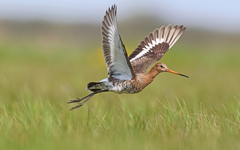
The black-tailed godwit (Limosa limosa) is a large, long-legged, long-billed shorebird first described by Carl Linnaeus in 1758. It is a member of the godwit genus, Limosa. There are four subspecies, all with orange head, neck and chest in breeding plumage and dull grey-brown winter coloration, and distinctive black and white wingbar at all times.

Its breeding range stretches from Iceland through Europe and areas of central Asia. Black-tailed godwits spend (the northern hemisphere) winter in areas as diverse as the Indian subcontinent, Australia, New Zealand, western Europe and west Africa. The species breeds in fens, lake edges, damp meadows, moorlands and bogs and uses estuaries, swamps and floods in (the northern hemisphere) winter; it is more likely to be found inland and on freshwater than the similar bar-tailed godwit. The world population is estimated to be 634,000 to 805,000 birds and is classified as Near Threatened.

The black-tailed godwit was formally described by the Swedish naturalist Carl Linnaeus in 1758 in the tenth edition of his Systema Naturae under the binomial name Scolopax limosa. It is now placed with three other godwits in the genus Limosa that... Wikipedia →

Sounds

Song0:17

Netherlands · 2026

© Joost van Bruggen · XC1103923 · CC BY-NC-ND 4.0

Call0:38

China · 2023

© Bo Shunqi 薄顺奇 · XC841380 · CC BY-NC-SA 4.0

Alarm call0:45

Poland · 2020

© Romuald Mikusek · XC745163 · CC BY-NC-SA 4.0

Global Distribution

Parks Where Found

# Park Country Daily sighting probability
1 Biebrza National Park 🇵🇱 Poland
~30%
2 Doñana National Park 🇪🇸 Spain
~30%
3 Hortobágy National Park 🇭🇺 Hungary
~30%
4 Kiskunság National Park 🇭🇺 Hungary
~30%
5 Wadden Sea National Park 🇩🇪 Germany
~20%
6 Wilpattu National Park 🇱🇰 Sri Lanka
~10%
7 Snowdonia National Park 🇬🇧 United Kingdom
~10%
8 Ranthambore National Park 🇮🇳 India
~10%
9 Vatnajokull National Park 🇮🇸 Iceland
~10%
10 Yala National Park 🇱🇰 Sri Lanka
~10%
11 Keoladeo National Park 🇮🇳 India
~10%
12 Amboseli National Park 🇰🇪 Kenya
~10%
13 Cape Range 🇦🇺 Australia
~10%
14 Camargue 🇫🇷 France
<5%
15 Fertő-Hanság National Park 🇭🇺 Hungary
<5%
16 Ningaloo Marine Park 🇦🇺 Australia
<5%
17 Bavarian Forest National Park 🇩🇪 Germany
<5%
18 Lake Nakuru National Park 🇰🇪 Kenya
<5%
19 Gobi Gurvansaikhan National Park 🇲🇳 Mongolia
<5%
20 Białowieża National Park 🇵🇱 Poland
<5%
21 Kaziranga National Park 🇮🇳 India
<5%
22 Satpura National Park 🇮🇳 India
<5%
23 Nagarhole National Park 🇮🇳 India
<5%
24 Ngorongoro Conservation Area 🇹🇿 Tanzania
<5%

Cities Where Found

# City Country Daily sighting probability
1 Liverpool 🇬🇧 United Kingdom
~40%
2 Karachi 🇵🇰 Pakistan
~20%
3 Dublin 🇮🇪 Ireland
~20%
4 Chennai 🇮🇳 India
~10%
5 Dakar 🇸🇳 Senegal
~10%
6 Kochi 🇮🇳 India
~10%
7 Mumbai 🇮🇳 India
~10%
8 Novosibirsk 🇷🇺 Russia
~10%
9 Guangzhou 🇨🇳 China
~10%
10 Rotterdam [The Hague] 🇳🇱 Netherlands
~10%

Zoos & Centres Where Found

# Zoo / Centre Country
1 Slimbridge Wetland Centre 🇬🇧 United Kingdom In captivity
2 Santillana Zoo 🇪🇸 Spain In captivity

Before you go

What are the chances of seeing a Black-tailed Godwit in Wadden Sea National Park?

Possible

About 20% of wildlife watchers report a Black-tailed Godwit sighting in Wadden Sea National Park on a given day, based on 1,546 verified sightings from GBIF citizen-science data from 2019 to 2026. It is the 66th most-seen of the 285 birds we can rate there. Over three days the chance rises to about 40%, and over a week to about 70%, if each day is a fresh chance.

When is the best time to see a Black-tailed Godwit in Wadden Sea National Park?

April to July

In those months about 30% of wildlife watchers report a Black-tailed Godwit in Wadden Sea National Park on a given day, against under 5% in January–February and November, the lowest months.

What time of day is best to see a Black-tailed Godwit?

Between 9 am and noon

Across all the parks we cover, that three-hour window holds the most Black-tailed Godwit sightings with a recorded time, and about 9 in 10 of them come between 6 am and 6 pm: it is a daytime animal.

Is Wadden Sea National Park the best place to see a Black-tailed Godwit?

5th of 24

Of the 24 parks where we can rate Black-tailed Godwit sightings, Wadden Sea National Park ranks 5th at about 20%. The best odds are in Biebrza National Park (Poland, about 30%), Doñana National Park (Spain, about 30%) and Hortobágy National Park (Hungary, about 30%).

Where does the Black-tailed Godwit sighting chance come from?

GBIF citizen-science records

It is estimated from how often the Black-tailed Godwit is recorded against all the birds logged in Wadden Sea National Park (1,546 verified sightings from 2019 to 2026), calibrated against known sighting rates. Figures are rounded to the nearest 10% because citizen-science data supports honest approximations, not decimals, and months with records from fewer than five people show "—". How it works.

← Back to Wadden Sea National Park