


Completed
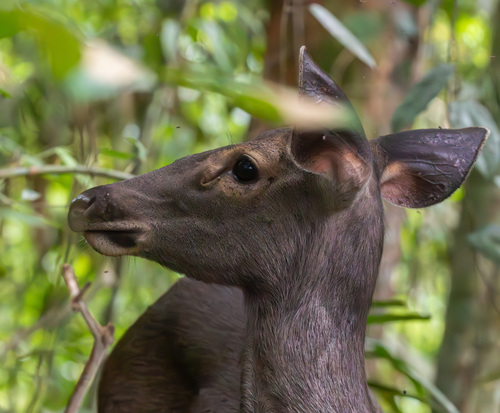

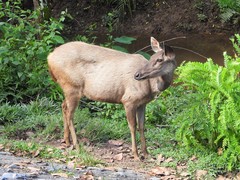
Sambar
Rusa unicolor
Silhouette: Steven Traver · PhyloPic
- KingdomAnimalia (Animals)
- PhylumChordata (Chordates)
- ClassMammalia (Mammals)
- OrderArtiodactyla (Even-toed Ungulates and Cetaceans)
- FamilyCervidae (Deer)
- GenusRusa (Rusa Deer)
- SpeciesRusa unicolor (Sambar)
In 3 days ~90% in a week >90%
117 Verified sightings at Yala National Park From 2019 to 2026
2,296 In all 28 parks
January Best month
🌅 Crepuscular When it's spotted
About the Sambar
The sambar (Rusa unicolor) is a large deer native to the Indian subcontinent, South China and Southeast Asia. It has been listed as a vulnerable species on the IUCN Red List since 2008, as populations have declined substantially due to hunting, local insurgency, and industrial exploitation of habitat.
Genetic analysis shows that the closest living relative of the sambar is most likely the Javan rusa of Indonesia. This is supported by reports that sambar can still interbreed to produce fertile hybrids with this species.
Fossil sambar are known from the early Pleistocene, although they are very similar in form to early deer species from the Pliocene, with less of a resemblance to more modern cervines. The species probably arose in the tropical reaches of southern Asia, and later spread across its current range. Epirusa and Eucladoceros have both been proposed as possible ancestors of the living species and its closest relatives.
Seven sambar subspecies are recognised: The appearance and the size of the sambar vary widely across its range, which has led to considerable taxonomic confusion in the past; over 40 different scientific... Wikipedia →
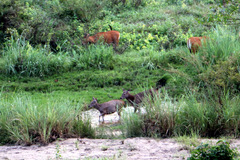
Recent sightings of Sambar in Yala National Park
LIVEiNaturalistGlobal Distribution
Parks Where Found
Cities Where Found
| # | City | Country | Daily sighting probability |
|---|---|---|---|
| 1 | Melbourne | 🇦🇺 Australia |
Zoos & Centres Where Found
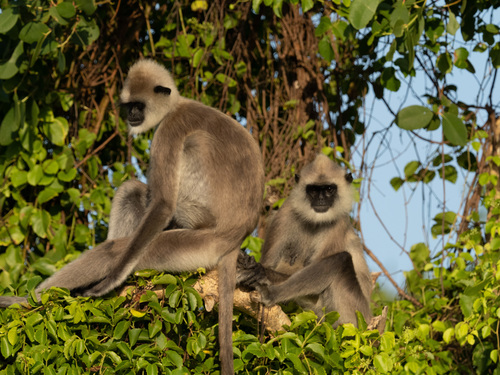
Closest Relatives at Yala National Park






Before you go
What are the chances of seeing a Sambar in Yala National Park?
Likely
About 60% of wildlife watchers report a Sambar sighting in Yala National Park on a given day, based on 117 verified sightings from GBIF citizen-science data from 2019 to 2026. It is the 9th most-seen of the 16 mammals we can rate there. Over three days the chance rises to about 90%, and over a week to over 90%, if each day is a fresh chance.
When is the best time to see a Sambar in Yala National Park?
January
In that month about 80% of wildlife watchers report a Sambar in Yala National Park on a given day, against about 30% in August, the lowest month.
What time of day is best to see a Sambar?
Between 3 and 6 pm
Across all the parks we cover, that three-hour window holds the most Sambar sightings with a recorded time, and about 7 in 10 of them come between 6 am and 6 pm: it is most active around dawn and dusk.
Is Yala National Park the best place to see a Sambar?
8th of 28
Of the 28 parks where we can rate Sambar sightings, Yala National Park ranks 8th at about 60%. The best odds are in Ranthambore National Park (India, about 80%), Khao Yai National Park (Thailand, about 80%) and Bandhavgarh National Park (India, about 80%). All parks ranked.
Where does the Sambar sighting chance come from?
GBIF citizen-science records
It is estimated from how often the Sambar is recorded against all the mammals logged in Yala National Park (117 verified sightings from 2019 to 2026), calibrated against known sighting rates. Figures are rounded to the nearest 10% because citizen-science data supports honest approximations, not decimals, and months with records from fewer than five people show "—". How it works.
