


Completed


Common Caiman
Caiman crocodilus
Silhouette: Berrucomons · PhyloPic
- KingdomAnimalia (Animals)
- PhylumChordata (Chordates)
- ClassCrocodylia
- FamilyAlligatoridae (Alligators and Caimans)
- GenusCaiman (Typical Caimans)
- SpeciesCaiman crocodilus (Common Caiman)
In 3 days ~70% in a week ~90%
49 Verified sightings at Yasuní National Park From 2019 to 2026
2,141 In all 23 parks
September Best month
☀️ Diurnal When it's spotted
About the Common Caiman
The spectacled caiman (Caiman crocodilus), also known as the white caiman, common caiman, and speckled caiman, is a crocodilian in the family Alligatoridae. It is brownish-, greenish-, or yellowish-gray colored and has a spectacle-like ridge between its eyes, which is where its common name come from. It grows to a length of 1.4–2.5 m (4 ft 7 in – 8 ft 2 in) and a weight of 7–40 kg (15–88 lb), with males being both longer and heavier than females. Its diet varies seasonally, commonly consisting of crabs, fish, small mammals, amphibians and snails. Breeding occurs from May to August and 14–40 eggs are laid in July and August. This crocodilian has a large range and population; it is native to much of Latin America, and has been introduced to the United States, Cuba, and Puerto Rico.
The spectacled caiman was described by Carl Linnaeus in 1758, originally as Lacerta crocodilus. It has since been redescribed several times, including as Caiman sclerops by Schneider in 1801. Although Caiman crocodilus is now the scientific name of the species, some scientists still prefer using sclerops, as having crocodilus as the scientific name for a caiman may cause confusion. Wikipedia →
Recent sightings of Common Caiman in Yasuní National Park
LIVEiNaturalistGlobal Distribution
Parks Where Found
Cities Where Found
| # | City | Country | Daily sighting probability |
|---|---|---|---|
| 1 | Manaus | 🇧🇷 Brazil | |
| 2 | Valencia | 🇻🇪 Venezuela | |
| 3 | São Luís | 🇧🇷 Brazil | |
| 4 | Panama City | 🇵🇦 Panama | |
| 5 | Cali | 🇨🇴 Colombia |
Zoos & Centres Where Found
Closest Relatives at Yasuní National Park






Before you go
What are the chances of seeing a Common Caiman in Yasuní National Park?
Possible
About 30% of wildlife watchers report a Common Caiman sighting in Yasuní National Park on a given day, based on 49 verified sightings from GBIF citizen-science data from 2019 to 2026. It is the 10th most-seen of the 49 reptiles we can rate there. Over three days the chance rises to about 70%, and over a week to about 90%, if each day is a fresh chance.
When is the best time to see a Common Caiman in Yasuní National Park?
March, June–July, September and November
In those months about 40% of wildlife watchers report a Common Caiman in Yasuní National Park on a given day, against under 5% in October, the lowest month.
What time of day is best to see a Common Caiman?
Between 7 and 10 am
Across all the parks we cover, that three-hour window holds the most Common Caiman sightings with a recorded time, and about 7 in 10 of them come between 6 am and 6 pm: it is a daytime animal.
Is Yasuní National Park the best place to see a Common Caiman?
15th of 23
Of the 23 parks where we can rate Common Caiman sightings, Yasuní National Park ranks 15th at about 30%. The best odds are in Tortuguero National Park (Costa Rica, about 80%), Piedras Blancas National Park (Costa Rica, about 60%) and Bastimentos Island National Marine Park (Panama, about 50%). All parks ranked.
Which relatives of the Common Caiman live in Yasuní National Park?
Same family: Alligatoridae
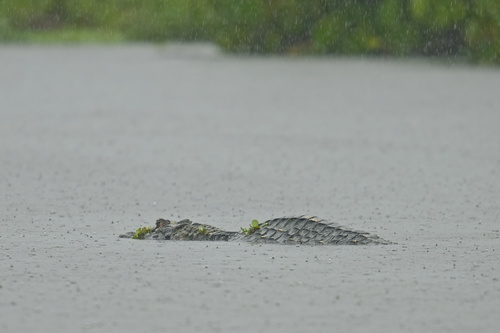
The closest relatives of the Common Caiman that you can see in Yasuní National Park (family Alligatoridae, Alligators and Caimans) are Black Caiman (about 30%) and Smooth-fronted Caiman (about 20%), with each one's daily chance of a sighting.
Where does the Common Caiman sighting chance come from?
GBIF citizen-science records
It is estimated from how often the Common Caiman is recorded against all the reptiles logged in Yasuní National Park (49 verified sightings from 2019 to 2026), calibrated against known sighting rates. Figures are rounded to the nearest 10% because citizen-science data supports honest approximations, not decimals, and months with records from fewer than five people show "—". How it works.
