Curlew Sandpiper

Curlew Sandpiper

Calidris ferruginea

Silhouette: Edwin Price · PhyloPic

LCNTVUVulnerableENCR
Daily sighting probability <5% · Rare
at Bali Barat National Park

In 3 days <5% in a week ~10%

19 Verified sightings at Bali Barat National Park From 2019 to 2026
3,040 In all 32 parks
April Best month
☀️ Diurnal When it's spotted

About the Curlew Sandpiper

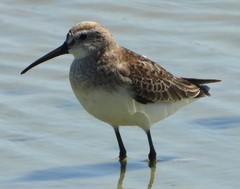
The curlew sandpiper (Calidris ferruginea) is a small wader. It is a long-distance migrant, breeding in the bogs and coastal lowlands of the Siberian Arctic, arriving there in June and staying until August or September. After the breeding season, it migrates south to spend the winter in Africa and along the coasts of Oceania and southern Eurasia, occupying tidal mudflats and saltpans.

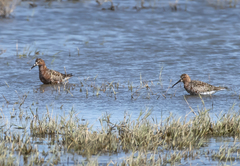
It has three main plumages that change with maturity and season. The non-breeding plumage shows brown-greyish upperparts and white underparts. The breeding plumage is much more striking, with the entire front tinted a deep rusty colour, more intensely so in males. The first-year bird does not migrate or breed, instead remaining in its overwintering range throughout the breeding season. It may occasionally moult into its breeding plumage, which is largely similar to that of an adult but with white spots on the chest. The non-breeding juvenile plumage is also like that of an adult, except with creamy-coloured streaking on the breast and pale fringes on some of the wing feathers, leading to a scaly appearance. Adults superficially resemble the larger but shorter-billed red knot and the red phalarope in breeding plumage, and the dunlin and stilt sandpiper while not breeding. Juveniles may be confused with the larger and yellow-legged juvenile ruff, or the juvenile dunlin, which has a streaked chest.

The curlew sandpiper's courtship behaviour is complex and involves several distinct displays. In one, the male constructs a faux nest on the ground to present to the female. Another is a graceful aerial chase accompanied by frequent warbling calls. In a third, the male dances around the female on the ground, displaying his tail feathers and rump; this display sometimes culminates in copulation. The female almost always lays one clutch of eggs, usually around the end of June, which hatch after 20 days and fully fledge at 14–20 days. Chicks are relatively mature and mobile at birth. The curlew sandpiper's breeding success is linked to the lemming population; in years with many lemmings, its predators hunt them instead. It is omnivorous, foraging in large flocks in wetlands for various invertebrates, including crabs and insects.

The curlew sandpiper is listed as a vulnerable species on the IUCN Red List because land development and the invasive smooth cordgrass have caused significant habitat loss to its overwintering and migratory sites, and climate change has lowered its breeding productivity. The curlew sandpiper has an estimated annual survival rate of 75–80%. Wikipedia →

Sounds

Nocturnal flight call0:04

France · 2025

© MILLON Xavier · XC1050782 · CC BY-NC-SA 4.0

Flight call0:07

Mongolia · 2022

© Stanislas Wroza · XC765875 · CC BY-NC-SA 4.0

Call0:22

Ireland · 2022

© Paul Kelly · XC746671 · CC BY-NC-SA 4.0

Global Distribution

Parks Where Found

# Park Country Daily sighting probability
1 West Coast National Park 🇿🇦 South Africa
~50%
2 Doñana National Park 🇪🇸 Spain
~10%
3 Ngorongoro Conservation Area 🇹🇿 Tanzania
~10%
4 Amboseli National Park 🇰🇪 Kenya
~10%
5 Lake Nakuru National Park 🇰🇪 Kenya
~10%
6 iSimangaliso Wetland Park 🇿🇦 South Africa
~10%
7 Yala National Park 🇱🇰 Sri Lanka
~10%
8 Wadden Sea National Park 🇩🇪 Germany
~10%
9 Rottnest Island 🇦🇺 Australia
~10%
10 Serengeti National Park 🇹🇿 Tanzania
<5%
11 Hortobágy National Park 🇭🇺 Hungary
<5%
12 Etosha National Park 🇳🇦 Namibia
<5%
13 Wilpattu National Park 🇱🇰 Sri Lanka
<5%
14 Kiskunság National Park 🇭🇺 Hungary
<5%
15 Camargue 🇫🇷 France
<5%
16 Liwonde National Park 🇲🇼 Malawi
<5%
17 Queen Elizabeth National Park 🇺🇬 Uganda
<5%
18 Wilsons Promontory National Park 🇦🇺 Australia
<5%
19 Akagera National Park 🇷🇼 Rwanda
<5%
20 Fertő-Hanság National Park 🇭🇺 Hungary
<5%
21 Addo Elephant National Park 🇿🇦 South Africa
<5%
22 Bali Barat National Park 🇮🇩 Indonesia
<5%
23 De Hoop Nature Reserve 🇿🇦 South Africa
<5%
24 Namib-Naukluft National Park 🇳🇦 Namibia
<5%
25 Białowieża National Park 🇵🇱 Poland
<5%
26 Tsavo East National Park 🇰🇪 Kenya
<5%
27 Sundarbans National Park 🇮🇳 India
<5%
28 Moremi Game Reserve 🇧🇼 Botswana
<5%
29 Tarangire National Park 🇹🇿 Tanzania
<5%
30 Snowdonia National Park 🇬🇧 United Kingdom
<5%
31 Kruger National Park 🇿🇦 South Africa
<5%
32 Sierra de Guadarrama National Park 🇪🇸 Spain
<5%

Cities Where Found

# City Country Daily sighting probability
1 Zanzibar City 🇹🇿 Tanzania
~30%
2 Maputo 🇲🇿 Mozambique
~20%
3 Manama 🇧🇭 Bahrain
~20%
4 Kuwait City 🇰🇼 Kuwait
~10%
5 Quanzhou 🇨🇳 China
~10%
6 Karachi 🇵🇰 Pakistan
~10%
7 Dar es-Salaam 🇹🇿 Tanzania
<5%
8 Mombasa 🇰🇪 Kenya
<5%
9 Mumbai 🇮🇳 India
<5%
10 Dubai 🇦🇪 United Arab Emirates
<5%

Before you go

What are the chances of seeing a Curlew Sandpiper in Bali Barat National Park?

Rare

Under 5% of wildlife watchers report a Curlew Sandpiper sighting in Bali Barat National Park on a given day, based on 19 verified sightings from GBIF citizen-science data from 2019 to 2026. It is the 145th most-seen of the 173 birds we can rate there. Over three days the chance rises to under 5%, and over a week to about 10%, if each day is a fresh chance.

When is the best time to see a Curlew Sandpiper in Bali Barat National Park?

Any time of year

In every month with enough records, under 5% of wildlife watchers report a Curlew Sandpiper in Bali Barat National Park on a given day, so our monthly data shows no clear season.

What time of day is best to see a Curlew Sandpiper?

Between 10 am and 1 pm

Across all the parks we cover, that three-hour window holds the most Curlew Sandpiper sightings with a recorded time, and about 8 in 10 of them come between 6 am and 6 pm: it is a daytime animal.

Which relatives of the Curlew Sandpiper live in Bali Barat National Park?

Same genus: Calidris

The closest relatives of the Curlew Sandpiper that you can see in Bali Barat National Park (genus Calidris, Calidris Sandpipers) are Red-necked Stint (about 20%) and Long-toed Stint (about 20%), with each one's daily chance of a sighting.

Where does the Curlew Sandpiper sighting chance come from?

GBIF citizen-science records

It is estimated from how often the Curlew Sandpiper is recorded against all the birds logged in Bali Barat National Park (19 verified sightings from 2019 to 2026), calibrated against known sighting rates. Figures are rounded to the nearest 10% because citizen-science data supports honest approximations, not decimals, and months with records from fewer than five people show "—". How it works.

← Back to Bali Barat National Park