Black Swan

Black Swan

Cygnus atratus

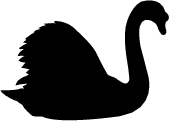
Silhouette: An Ignorant Atheist · PhyloPic

LCLeast ConcernNTVUENCR
Daily sighting probability ~10% · With luck
at Booderee National Park

In 3 days ~40% in a week ~60%

85 Verified sightings at Booderee National Park From 2019 to 2026
1,104 In all 20 parks
September Best month
☀️ Diurnal When it's spotted

About the Black Swan

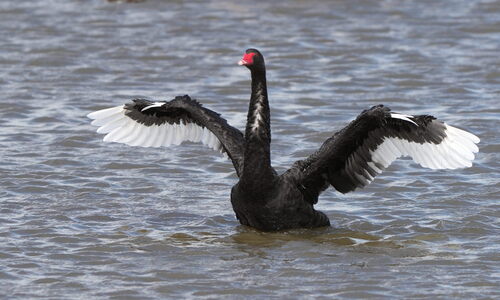
The black swan (Cygnus atratus) is a large waterbird, a species of swan which breeds mainly in the southeast and southwest regions of Australia. Within Australia, the black swan is nomadic, with erratic migration patterns dependent on climatic conditions. It is a large bird with black plumage and a red bill. It is a monogamous breeder, with both partners sharing incubation and cygnet-rearing duties.

Black swans can be found singly, or in loose companies numbering into the hundreds or even thousands. It is a popular bird in zoological gardens and bird collections, and escapees are sometimes seen outside their natural range. The black swan was introduced to various countries as an ornamental bird in the 1800s, but has managed to escape and form stable populations.

This bird is a regional symbol of both Western Australia, where it is native, and the English town of Dawlish, where it is an introduced species. Described scientifically by English naturalist John Latham in 1790 as Anas atrata, the black swan was later placed into the genus Chenopis. In 1997, the species was placed in the genus Cygnus, in the subgenus Chenopis. The species is monotypic. Wikipedia →
Sounds

Call0:20

Australia · 2026

© Khristos Nizamis · XC1154809 · CC BY-NC-ND 4.0

Alarm call0:05

France · 2024

Sonothèque ADVL · XC954554 · CC0

Song0:21

Australia · 2022

© nick talbot · XC737407 · CC BY-NC-SA 4.0

Global Distribution

Parks Where Found

# Park Country Daily sighting probability
1 Gauja National Park 🇱🇻 Latvia
~40%
2 Wilsons Promontory National Park 🇦🇺 Australia
~20%
3 Maria Island National Park 🇦🇺 Australia
~10%
4 Booderee National Park 🇦🇺 Australia
~10%
5 Freycinet National Park 🇦🇺 Australia
~10%
6 Cévennes National Park 🇫🇷 France
~10%
7 Great Otway National Park 🇦🇺 Australia
~10%
8 Abel Tasman National Park 🇳🇿 New Zealand
~10%
9 Flinders Chase 🇦🇺 Australia
~10%
10 Grampians National Park 🇦🇺 Australia
<5%
11 Rottnest Island 🇦🇺 Australia
<5%
12 Fiordland National Park 🇳🇿 New Zealand
<5%
13 Kosciuszko National Park 🇦🇺 Australia
<5%
14 Blue Mountains National Park 🇦🇺 Australia
<5%
15 Noosa National Park 🇦🇺 Australia
<5%
16 Hattah-Kulkyne National Park 🇦🇺 Australia
<5%
17 Snowdonia National Park 🇬🇧 United Kingdom
<5%
18 Rakiura National Park 🇳🇿 New Zealand
<5%
19 Wadden Sea National Park 🇩🇪 Germany
<5%
20 Royal National Park 🇦🇺 Australia
<5%

Cities Where Found

# City Country Daily sighting probability
1 Perth 🇦🇺 Australia
~50%
2 Auckland 🇳🇿 New Zealand
~30%
3 Belém 🇧🇷 Brazil
~30%
4 Melbourne 🇦🇺 Australia
~20%
5 Goiânia 🇧🇷 Brazil
~20%
6 Sydney 🇦🇺 Australia
~20%
7 Brisbane 🇦🇺 Australia
~10%
8 Beijing 🇨🇳 China
~10%
9 Singapore 🇸🇬 Singapore
<5%
10 Shanghai 🇨🇳 China
<5%

Zoos & Centres Where Found

# Zoo / Centre Country
1 Disney's Animal Kingdom 🇺🇸 United States In captivity
2 Busch Gardens Tampa 🇺🇸 United States In captivity
3 SeaWorld San Diego 🇺🇸 United States In captivity
4 Moscow Zoo 🇷🇺 Russia In captivity
5 Basel Zoo 🇨🇭 Switzerland In captivity
6 Natura Artis Magistra 🇳🇱 Netherlands In captivity
7 Izhevsk Zoo 🇷🇺 Russia In captivity
8 Zoo Pilsen 🇨🇿 Czechia In captivity
9 Parc Phœnix 🇫🇷 France In captivity
10 Réserve africaine de Sigean 🇫🇷 France In captivity
11 Jihlava Zoo 🇨🇿 Czechia In captivity
12 Rostov Zoo 🇷🇺 Russia In captivity
13 Kaliningrad Zoo 🇷🇺 Russia In captivity
14 Hodonín Zoo 🇨🇿 Czechia In captivity
15 Zoobotánico Jerez 🇪🇸 Spain In captivity
16 Zoo d'Amiens 🇫🇷 France In captivity
17 Karagandy Zoo 🇰🇿 Kazakhstan In captivity
18 Taronga Western Plains Zoo 🇦🇺 Australia In captivity
19 Vinpearl Safari 🇻🇳 Vietnam In captivity
20 Nandankanan Zoological Park 🇮🇳 India In captivity
21 Zoo Miami 🇺🇸 United States In captivity
22 Chengdu Research Base of Giant Panda Breeding 🇨🇳 China In captivity
23 Beijing Wildlife Park 🇨🇳 China In captivity
24 Ridiyagama Safari Park 🇱🇰 Sri Lanka In captivity
25 Toronto Zoo 🇨🇦 Canada In captivity
26 Parque Zoológico 🇧🇷 Brazil In captivity
27 La Reserva del Castillo de las Guardas 🇪🇸 Spain In captivity
28 Safari West 🇺🇸 United States In captivity
29 Nehru Zoological Park 🇮🇳 India In captivity
30 Kudykina Gora 🇷🇺 Russia In captivity
31 Columbus Zoo and Aquarium 🇺🇸 United States In captivity
32 Wildlife Safari 🇺🇸 United States In captivity
33 Hainan Tropical Wildlife Park and Botanical Garden 🇨🇳 China In captivity
34 Parc du Belvédère 🇹🇳 Tunisia In captivity
35 Yumka' 🇲🇽 Mexico In captivity
36 Zoológico de Brasília 🇧🇷 Brazil In captivity
37 Kansas City Zoo 🇺🇸 United States In captivity
38 Ramat Gan Safari 🇮🇱 Israel In captivity
39 Tallinn Zoo 🇪🇪 Estonia In captivity
40 Chiang Mai Night Safari 🇹🇭 Thailand In captivity
41 Planète Sauvage 🇫🇷 France In captivity
42 Chimelong Safari Park 🇨🇳 China In captivity
43 National Zoological Park Delhi 🇮🇳 India In captivity
44 Zoofari 🇲🇽 Mexico In captivity
45 Curitiba Zoo 🇧🇷 Brazil In captivity
46 Indira Gandhi Zoological Park 🇮🇳 India In captivity
47 Shanghai Zoo 🇨🇳 China In captivity
48 Sedgwick County Zoo 🇺🇸 United States In captivity
49 Omaha’s Henry Doorly Zoo and Aquarium 🇺🇸 United States In captivity
50 Shenzhen Safari Park 🇨🇳 China In captivity

Before you go

What are the chances of seeing a Black Swan in Booderee National Park?

With luck

About 10% of wildlife watchers report a Black Swan sighting in Booderee National Park on a given day, based on 85 verified sightings from GBIF citizen-science data from 2019 to 2026. It is the 55th most-seen of the 128 birds we can rate there. Over three days the chance rises to about 40%, and over a week to about 60%, if each day is a fresh chance.

When is the best time to see a Black Swan in Booderee National Park?

September

In that month about 30% of wildlife watchers report a Black Swan in Booderee National Park on a given day, against under 5% in May, the lowest month. That is one of Booderee National Park's driest months, with about 60 mm of rain against 150 mm in March.

What time of day is best to see a Black Swan?

Between 2 and 5 pm

Across all the parks we cover, that three-hour window holds the most Black Swan sightings with a recorded time, and about 9 in 10 of them come between 6 am and 6 pm: it is a daytime animal.

Which relatives of the Black Swan live in Booderee National Park?

Same family: Anatidae

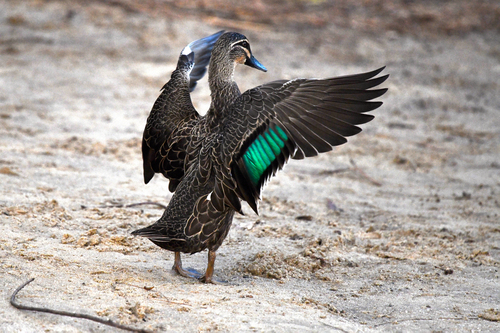
The closest relatives of the Black Swan that you can see in Booderee National Park (family Anatidae, Ducks, Geese, and Swans) are Australian Wood Duck (about 20%), Chestnut Teal (about 20%) and Pacific Black Duck (about 20%), with each one's daily chance of a sighting.

Where does the Black Swan sighting chance come from?

GBIF citizen-science records

It is estimated from how often the Black Swan is recorded against all the birds logged in Booderee National Park (85 verified sightings from 2019 to 2026), calibrated against known sighting rates. Figures are rounded to the nearest 10% because citizen-science data supports honest approximations, not decimals, and months with records from fewer than five people show "—". How it works.

← Back to Booderee National Park