



Completed

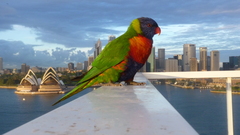
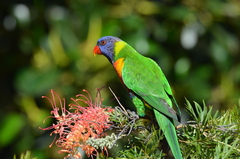
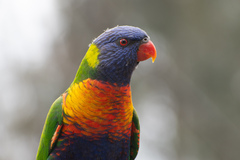
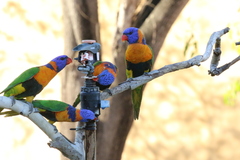
Coconut Lorikeet
Trichoglossus haematodus
Silhouette: Farelli (photo), John E. McCormack, Michael G. Harvey, Brant C. Faircloth, Nicholas G. Crawford, Travis C. Glenn, Robb T. Brumfield & T. Michael Keesey · PhyloPic
- KingdomAnimalia (Animals)
- PhylumChordata (Chordates)
- ClassAves (Birds)
- OrderPsittaciformes (Parrots)
- FamilyPsittacidae (New World and African Parrots)
- GenusTrichoglossus (Rainbow Lorikeets and Allies)
- SpeciesTrichoglossus haematodus (Coconut Lorikeet)
In 3 days <5%
11 Verified sightings at Auckland
8,792 In all 14 parks From 2019 to 2026
December Best month
☀️ Diurnal When it's spotted
About the Coconut Lorikeet
The coconut lorikeet (Trichoglossus haematodus), also known as the green-naped lorikeet and Swainson’s lorikeet, is a parrot in the family Psittaculidae. Several species of lorikeets now recognised as distinct were once lumped together under Trichoglossus haematodus; together they form the "rainbow lorikeet" species complex.
Trichoglossus haematodus as circumscribed today is largely restricted to Melanesia (except Fiji) and a few nearby regions. It is found from Maluku province of easternmost Indonesia across the lowlands of New Guinea, the Bismarck Archipelago, the Solomon Islands and Vanuatu to New Caledonia. Depending on the precise delimitation of species in the "rainbow lorikeet" complex, T.haematodus might barely reach Australian territory in the Torres Strait.
Coconut lorikeets typically measure around 25–30 cm (10–12 in) in length and weigh around 109–137 g (3.8–4.8 oz), but much variation exists between subspecies. The bill is orange-red, and the head clear blue fading to brown at the neck. It has a more or less extensive yellow collar and green upperparts. The breast is red, in some subspecies with more or less pronounced blue-black barring, and the belly... Wikipedia →
Sounds
Recording0:14
Australia · 2026
© steve-watson · iNaturalist · CC BY-NC 4.0
Recording0:18
Australia · 2026
© br1d98tb4r · iNaturalist · CC BY-NC 4.0
Recording0:18
Australia · 2025
© mausepitz · iNaturalist · CC BY-NC 4.0
Recent sightings of Coconut Lorikeet in Auckland
LIVEiNaturalistGlobal Distribution
Parks Where Found
| # | Park | Country | Daily sighting probability |
|---|---|---|---|
| 1 | Noosa National Park | 🇦🇺 Australia | |
| 2 | Royal National Park | 🇦🇺 Australia | |
| 3 | Booderee National Park | 🇦🇺 Australia | |
| 4 | Daintree National Park | 🇦🇺 Australia | |
| 5 | Blue Mountains National Park | 🇦🇺 Australia | |
| 6 | Springbrook National Park | 🇦🇺 Australia | |
| 7 | Raja Ampat | 🇮🇩 Indonesia | |
| 8 | Flinders Chase | 🇦🇺 Australia | |
| 9 | Wilsons Promontory National Park | 🇦🇺 Australia | |
| 10 | Grampians National Park | 🇦🇺 Australia | |
| 11 | Lamington National Park | 🇦🇺 Australia | |
| 12 | Great Otway National Park | 🇦🇺 Australia | |
| 13 | Rottnest Island | 🇦🇺 Australia | |
| 14 | Hattah-Kulkyne National Park | 🇦🇺 Australia |
Zoos & Centres Where Found
Closest Relatives at Auckland





Before you go
What are the chances of seeing a Coconut Lorikeet in Auckland?
Rare
Under 5% of wildlife watchers report a Coconut Lorikeet sighting in Auckland on a given day, based on 11 verified sightings from GBIF citizen-science data. It is the 90th most-seen of the 93 birds we can rate there. Over three days the chance rises to under 5%, if each day is a fresh chance.
When is the best time to see a Coconut Lorikeet in Auckland?
Any time of year
In every month with enough records, under 5% of wildlife watchers report a Coconut Lorikeet in Auckland on a given day, so our monthly data shows no clear season.
What time of day is best to see a Coconut Lorikeet?
Between 7 and 10 am
Across all the parks we cover, that three-hour window holds the most Coconut Lorikeet sightings with a recorded time, and about 8 in 10 of them come between 6 am and 6 pm: it is a daytime animal.
Is Auckland the best place to see a Coconut Lorikeet?
7th of 7
Of the 7 cities where we can rate Coconut Lorikeet sightings, Auckland ranks 7th at under 5%. The best odds are in Melbourne (Australia, about 90%), Sydney (Australia, about 80%) and Perth (Australia, about 80%).
Where does the Coconut Lorikeet sighting chance come from?
GBIF citizen-science records
It is estimated from how often the Coconut Lorikeet is recorded against all the birds logged in Auckland (11 verified sightings), calibrated against known sighting rates. Figures are rounded to the nearest 10% because citizen-science data supports honest approximations, not decimals, and months with records from fewer than five people show "—". How it works.
