Northern Jacana

Northern Jacana

Jacana spinosa

Silhouette: Burton Robert, USFWS · PhyloPic

LCLeast ConcernNTVUENCR
Daily sighting probability <5% · Rare
at Guadalajara

In 3 days ~10% in a week ~30%

7 Verified sightings at Guadalajara
12,795 In all 32 parks From 2019 to 2026
November Best month
☀️ Diurnal When it's spotted

About the Northern Jacana

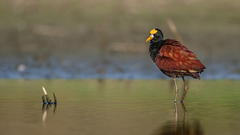
The northern jacana or northern jaçana (Jacana spinosa) is a wader which is known as a resident breeder from coastal Mexico to western Panama, and on Cuba, Jamaica and Hispaniola in the Caribbean. It is sometimes known to breed in Texas, United States, and has also been recorded on several occasions as a vagrant in Arizona. The jacanas are a group of wetland birds, which are identifiable by their huge feet and claws, which enable them to walk on floating vegetation in the shallow lakes that are their preferred habitat. In Jamaica, this bird is also known as the 'Jesus bird', as it appears to walk on water.

The northern jacana was formally described in 1758 by the Swedish naturalist Carl Linnaeus in the tenth edition of his Systema Naturae. He placed it with the coots in the genus Fulica and coined the binomial name Fulica spinosa. Linnaeus based his account on the "spur-winged water hen" that had been described and illustrated in 1743 by the English naturalist George Edwards in his A Natural History of Uncommon Birds. Edwards had borrowed a specimen from the collector Hans Sloane that had been preserved in alcohol. Edwards mistakenly believed his specimen had been collected... Wikipedia →

Sounds

Call0:09

Costa Rica · 2022

© Jerome Fischer · XC714502 · CC BY-NC-SA 4.0

Alarm call1:03

Mexico · 2021

© Manuel Grosselet · XC615058 · CC BY-NC-SA 4.0

Flight call0:13

Mexico · 2015

© Frank Lambert · XC352722 · CC BY-NC-ND 4.0

Global Distribution

Parks Where Found

# Park Country Daily sighting probability
1 Palo Verde National Park 🇨🇷 Costa Rica
~70%
2 Tortuguero National Park 🇨🇷 Costa Rica
~60%
3 Lago de Yojoa 🇭🇳 Honduras
~50%
4 Biotopo Cerro Cahuí 🇬🇹 Guatemala
~50%
5 Piedras Blancas National Park 🇨🇷 Costa Rica
~40%
6 Cerro Azul Meámbar National Park 🇭🇳 Honduras
~30%
7 Arrecifes de Cozumel National Park 🇲🇽 Mexico
~20%
8 Carara National Park 🇨🇷 Costa Rica
~20%
9 Manuel Antonio National Park 🇨🇷 Costa Rica
~20%
10 Saguaro National Park 🇺🇸 United States
~10%
11 Marino Ballena National Park 🇨🇷 Costa Rica
~10%
12 La Amistad International Park (Panama) 🇵🇦 Panama
~10%
13 Cahuita National Park 🇨🇷 Costa Rica
~10%
14 Bastimentos Island National Marine Park 🇵🇦 Panama
~10%
15 Rincón de la Vieja National Park 🇨🇷 Costa Rica
~10%
16 Gandoca-Manzanillo Wildlife Refuge 🇨🇷 Costa Rica
~10%
17 Montes Azules Biosphere Reserve 🇲🇽 Mexico
~10%
18 Calakmul Biosphere Reserve 🇲🇽 Mexico
~10%
19 Braulio Carrillo National Park 🇨🇷 Costa Rica
~10%
20 Celaque National Park 🇭🇳 Honduras
~10%
21 Tikal National Park 🇬🇹 Guatemala
~10%
22 Santa Rosa National Park 🇨🇷 Costa Rica
~10%
23 Las Baulas Marine National Park 🇨🇷 Costa Rica
<5%
24 Arenal Volcano National Park 🇨🇷 Costa Rica
<5%
25 Ostional Wildlife Refuge 🇨🇷 Costa Rica
<5%
26 Tenorio Volcano National Park 🇨🇷 Costa Rica
<5%
27 Ría Lagartos Biosphere Reserve 🇲🇽 Mexico
<5%
28 Ciénaga de Zapata 🇨🇺 Cuba
<5%
29 Poás Volcano National Park 🇨🇷 Costa Rica
<5%
30 Corcovado National Park 🇨🇷 Costa Rica
<5%
31 Celestún Biosphere Reserve 🇲🇽 Mexico
<5%
32 Sian Ka'an Biosphere Reserve 🇲🇽 Mexico
<5%

Cities Where Found

# City Country Daily sighting probability
1 San Pedro Sula 🇭🇳 Honduras
~10%
2 León 🇲🇽 México
~10%
3 San José 🇨🇷 Costa Rica
<5%
4 Guadalajara 🇲🇽 México
<5%
5 Managua 🇳🇮 Nicaragua
<5%

Zoos & Centres Where Found

# Zoo / Centre Country
1 San Diego Zoo 🇺🇸 United States In captivity

Before you go

What are the chances of seeing a Northern Jacana in Guadalajara?

Rare

Under 5% of wildlife watchers report a Northern Jacana sighting in Guadalajara on a given day, based on 7 verified sightings from GBIF citizen-science data. It is the 81st most-seen of the 184 birds we can rate there. Over three days the chance rises to about 10%, and over a week to about 30%, if each day is a fresh chance.

When is the best time to see a Northern Jacana in Guadalajara?

August–September and November–February

In those months about 10% of wildlife watchers report a Northern Jacana in Guadalajara on a given day, against under 5% in March–July and October, the lowest months.

What time of day is best to see a Northern Jacana?

Between 7 and 10 am

Across all the parks we cover, that three-hour window holds the most Northern Jacana sightings with a recorded time, and about 9 in 10 of them come between 6 am and 6 pm: it is a daytime animal.

Is Guadalajara the best place to see a Northern Jacana?

4th of 5

Of the 5 cities where we can rate Northern Jacana sightings, Guadalajara ranks 4th at under 5%. The best odds are in San Pedro Sula (Honduras, about 10%), León (México, about 10%) and San José (Costa Rica, under 5%).

Where does the Northern Jacana sighting chance come from?

GBIF citizen-science records

It is estimated from how often the Northern Jacana is recorded against all the birds logged in Guadalajara (7 verified sightings), calibrated against known sighting rates. Figures are rounded to the nearest 10% because citizen-science data supports honest approximations, not decimals, and months with records from fewer than five people show "—". How it works.

← Back to Guadalajara