About the Coppersmith Barbet
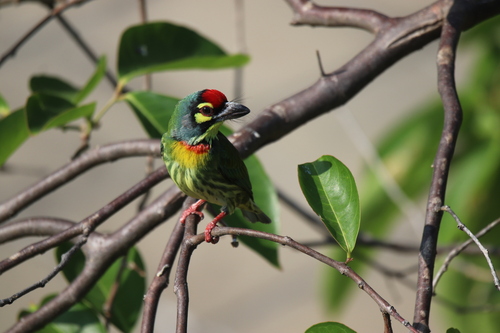
The coppersmith barbet (Psilopogon haemacephalus), also called crimson-breasted barbet and coppersmith, is an Asian barbet with crimson forehead and throat, known for its metronomic call that sounds similar to a coppersmith striking metal with a hammer. It is a resident bird in the Indian subcontinent and parts of Southeast Asia. It carves out holes inside a tree to build its nest. It is predominantly frugivorous, but has been observed eating insects, especially winged termites.
The coppersmith barbet is green with a red head, yellow cheeks and a yellow throat. Its underparts are streaked in grey and black. During the nesting season, the wear and tear on the feathers can cause the plumage of the upper back to appear bluish.
It is 15–17 cm (5.9–6.7 in) long and weighs 30–52.6 g (1.06–1.86 oz). Bucco haemacephalus was the scientific name proposed by Philipp Ludwig Statius Müller in 1776 for a barbet from the Philippines. Bucco indicus was proposed by John Latham in 1790 for a streaked barbet from India with a black head and red forehead.
Bucco roseus was proposed by Charles Dumont de Sainte-Croix in 1816. Asian barbets were placed in the genus Megalaima... Wikipedia →