


Completed

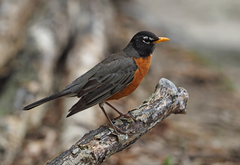



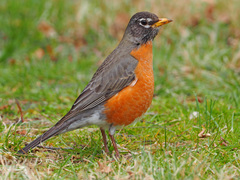
American Robin
Turdus migratorius
Silhouette: Sharon Wegner-Larsen · PhyloPic
- KingdomAnimalia (Animals)
- PhylumChordata (Chordates)
- ClassAves (Birds)
- OrderPasseriformes (Perching Birds)
- FamilyTurdidae (Thrushes)
- GenusTurdus (Typical Thrushes)
- SpeciesTurdus migratorius (American Robin)
In 3 days ~20% in a week ~30%
5 Verified sightings at León
93,175 In all 46 parks From 2019 to 2026
July Best month
☀️ Diurnal When it's spotted
About the American Robin
The American robin (Turdus migratorius) is a migratory bird of the true thrush genus and Turdidae, the wider thrush family. It is named after the European robin because of its reddish-orange breast, though the two species are not closely related, with the European robin belonging to the Old World flycatcher family. The American robin is widely distributed throughout North America, wintering from southern Canada to central Mexico and along the Pacific coast.
According to the Partners in Flight database (2019), the American robin is the most abundant landbird in North America (with 370 million individuals), ahead of red-winged blackbirds, introduced European starlings, mourning doves and house finches. It has seven subspecies.
The species is active mostly during the day and assembles in large flocks at night. Its diet consists of invertebrates (such as beetle grubs, earthworms, and caterpillars), fruits, and berries. It is one of the earliest bird species to lay its eggs, beginning to breed shortly after returning to its summer range from its winter range. The robin's nest consists of long coarse grass, twigs, paper, and feathers and is smeared with mud and often cushioned with grass or other soft materials. It is among the earliest birds to sing at dawn, and its song consists of several discrete units that are repeated.
The adult's main predator is the domestic cat; other predators include hawks and snakes. When feeding in flocks, it can be vigilant, watching other birds for reactions to predators. Brown-headed cowbirds (Molothrus ater) lay their eggs in robin nests (see brood parasite), but the robins usually reject the egg. Wikipedia →
Recent sightings of American Robin in León
LIVEiNaturalistGlobal Distribution
Parks Where Found
Cities Where Found
| # | City | Country | Daily sighting probability |
|---|---|---|---|
| 1 | Detroit | 🇺🇸 United States | |
| 2 | Philadelphia | 🇺🇸 United States | |
| 3 | Chicago | 🇺🇸 United States | |
| 4 | Boston | 🇺🇸 United States | |
| 5 | Toronto | 🇨🇦 Canada | |
| 6 | Minneapolis [Saint Paul] | 🇺🇸 United States | |
| 7 | New York City | 🇺🇸 United States | |
| 8 | Baltimore | 🇺🇸 United States | |
| 9 | Washington | 🇺🇸 United States | |
| 10 | Montreal | 🇨🇦 Canada |
Zoos & Centres Where Found
| # | Zoo / Centre | Country | |
|---|---|---|---|
| 1 | Columbus Zoo and Aquarium | 🇺🇸 United States | |
| 2 | Xcaret | 🇲🇽 Mexico | |
| 3 | Buin Zoo | 🇨🇱 Chile | |
| 4 | Ralph Perkins II Wildlife Center and Woods Garden | 🇺🇸 United States | |
| 5 | Virginia Aquarium | 🇺🇸 United States | |
| 6 | MAARS (Midwest Avian Adoption and Rescue Services) | 🇺🇸 United States | |
| 7 | Montreal Biodome | 🇨🇦 Canada | |
| 8 | Wild Bird Fund | 🇺🇸 United States |
Closest Relatives at León


Before you go
What are the chances of seeing an American Robin in León?
With luck
About 10% of wildlife watchers report an American Robin sighting in León on a given day, based on 5 verified sightings from GBIF citizen-science data. It is the 117th most-seen of the 124 birds we can rate there. Over three days the chance rises to about 20%, and over a week to about 30%, if each day is a fresh chance.
When is the best time to see an American Robin in León?
March, July and December
In those months about 10% of wildlife watchers report an American Robin in León on a given day, against under 5% in January–February, April–May and August–November, the lowest months. June has too few records to rate.
What time of day is best to see an American Robin?
Between 4 and 7 pm
Across all the parks we cover, that three-hour window holds the most American Robin sightings with a recorded time, and about 8 in 10 of them come between 6 am and 6 pm: it is a daytime animal.
Is León the best place to see an American Robin?
36th of 39
Of the 39 cities where we can rate American Robin sightings, León ranks 36th at about 10%. The best odds are in Detroit (United States, about 90%), Philadelphia (United States, about 90%) and Chicago (United States, about 80%).
Where does the American Robin sighting chance come from?
GBIF citizen-science records
It is estimated from how often the American Robin is recorded against all the birds logged in León (5 verified sightings), calibrated against known sighting rates. Figures are rounded to the nearest 10% because citizen-science data supports honest approximations, not decimals, and months with records from fewer than five people show "—". How it works.
