Pin-tailed Whydah

Pin-tailed Whydah

Vidua macroura

Silhouette: Alan Manson (photo), John E. McCormack, Michael G. Harvey, Brant C. Faircloth, Nicholas G. Crawford, Travis C. Glenn, Robb T. Brumfield & T. Michael Keesey · PhyloPic

LCLeast ConcernNTVUENCR
Daily sighting probability ~10% · With luck
at Los Angeles

In 3 days ~20% in a week ~50%

8,956 Verified sightings at Los Angeles
8,336 In all 51 parks From 2019 to 2026
September Best month
☀️ Diurnal When it's spotted

About the Pin-tailed Whydah

The pin-tailed whydah (Vidua macroura) is a small songbird with a conspicuous pennant-like tail in breeding males. It is a resident breeding bird in most of Africa south of the Sahara Desert. The pin-tailed whydah was first described by the German naturalist Peter Simon Pallas in 1764 and given the binomial name Fringilla macroura.

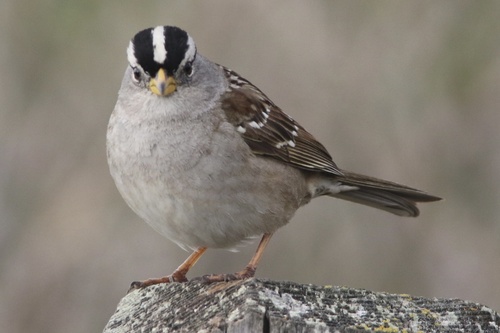
The pin-tailed whydah is 12–13 cm in length, although the breeding male's tail adds another 20 cm to this. The adult male has a black back and crown, and a very long black tail. The wings are dark brown with white patches, and the underparts and the head, apart from the crown, are white. The bill is bright red. The female and non-breeding male have streaked brown upperparts, whitish underparts with buff flanks, and a buff and black face pattern. They lack the long tail extension, but retain the red bill. Immature birds are like the female but plainer and with a greyish bill.

The pin-tailed whydah occurs in much of sub-Saharan Africa, favouring grassland, scrubs and savannah, also coming into parks and gardens. In Portugal it is established in the region around Aveiro, with observations occurring... Wikipedia →

Sounds

Song0:14

Namibia · 2025

© Filippo Ceccolini · XC1037320 · CC BY-NC-SA 4.0

Call0:33

Kenya · 2023

© Jarmo Pirhonen · XC853689 · CC BY-NC-SA 4.0

Recording0:07

South Africa · 2021

© Emmanuel Dufourq · XC618472 · CC BY-NC-SA 4.0

Global Distribution

Parks Where Found

# Park Country Daily sighting probability
1 Queen Elizabeth National Park 🇺🇬 Uganda
~50%
2 Volcanoes National Park 🇷🇼 Rwanda
~40%
3 Mkomazi National Park 🇹🇿 Tanzania
~30%
4 Nairobi National Park 🇰🇪 Kenya
~30%
5 Akagera National Park 🇷🇼 Rwanda
~30%
6 Kidepo Valley National Park 🇺🇬 Uganda
~30%
7 De Hoop Nature Reserve 🇿🇦 South Africa
~30%
8 Kibale National Park 🇺🇬 Uganda
~20%
9 Serengeti National Park 🇹🇿 Tanzania
~20%
10 Virunga National Park 🇨🇩 Democratic Republic of the Congo
~20%
11 Murchison Falls National Park 🇺🇬 Uganda
~20%
12 Golden Gate Highlands National Park 🇿🇦 South Africa
~20%
13 Mikumi National Park 🇹🇿 Tanzania
~20%
14 Ngorongoro Conservation Area 🇹🇿 Tanzania
~20%
15 Masai Mara National Reserve 🇰🇪 Kenya
~20%
16 Tarangire National Park 🇹🇿 Tanzania
~20%
17 Lake Mburo National Park 🇺🇬 Uganda
~20%
18 Hluhluwe-Imfolozi Park 🇿🇦 South Africa
~20%
19 Lake Nakuru National Park 🇰🇪 Kenya
~10%
20 Table Mountain National Park 🇿🇦 South Africa
~10%
21 Tsavo East National Park 🇰🇪 Kenya
~10%
22 Pilanesberg National Park 🇿🇦 South Africa
~10%
23 Gorongosa National Park 🇲🇿 Mozambique
~10%
24 Ruaha National Park 🇹🇿 Tanzania
~10%
25 Lower Zambezi National Park 🇿🇲 Zambia
~10%
26 Garden Route National Park 🇿🇦 South Africa
~10%
27 Meru National Park 🇰🇪 Kenya
~10%
28 Mana Pools National Park 🇿🇼 Zimbabwe
~10%
29 Tsavo West National Park 🇰🇪 Kenya
~10%
30 Samburu National Reserve 🇰🇪 Kenya
~10%
31 Liwonde National Park 🇲🇼 Malawi
~10%
32 Kruger National Park 🇿🇦 South Africa
~10%
33 Addo Elephant National Park 🇿🇦 South Africa
~10%
34 Bwindi Impenetrable National Park 🇺🇬 Uganda
~10%
35 uMkhuze Game Reserve 🇿🇦 South Africa
~10%
36 iSimangaliso Wetland Park 🇿🇦 South Africa
~10%
37 Awash National Park 🇪🇹 Ethiopia
~10%
38 Amboseli National Park 🇰🇪 Kenya
~10%
39 Lake Manyara National Park 🇹🇿 Tanzania
~10%
40 Aberdare National Park 🇰🇪 Kenya
~10%
41 Kafue National Park 🇿🇲 Zambia
<5%
42 Moremi Game Reserve 🇧🇼 Botswana
<5%
43 South Luangwa National Park 🇿🇲 Zambia
<5%
44 Semuliki National Park 🇺🇬 Uganda
<5%
45 Hwange National Park 🇿🇼 Zimbabwe
<5%
46 Chobe National Park 🇧🇼 Botswana
<5%
47 Nyungwe National Park 🇷🇼 Rwanda
<5%
48 Arusha National Park 🇹🇿 Tanzania
<5%
49 West Coast National Park 🇿🇦 South Africa
<5%
50 Niokolo-Koba National Park 🇸🇳 Senegal
<5%
51 Etosha National Park 🇳🇦 Namibia
<5%

Cities Where Found

# City Country Daily sighting probability
1 Brazzaville 🇨🇬 Republic of the Congo
~30%
2 Mombasa 🇰🇪 Kenya
~20%
3 Cape Town 🇿🇦 South Africa
~20%
4 Kigali 🇷🇼 Rwanda
~20%
5 Harare 🇿🇼 Zimbabwe
~20%
6 Dar es-Salaam 🇹🇿 Tanzania
~20%
7 Maputo 🇲🇿 Mozambique
~10%
8 Los Angeles 🇺🇸 United States
~10%
9 Johannesburg 🇿🇦 South Africa
~10%
10 Nairobi 🇰🇪 Kenya
~10%

Zoos & Centres Where Found

# Zoo / Centre Country
1 San Diego Zoo 🇺🇸 United States In captivity
2 Zoo Pilsen 🇨🇿 Czechia In captivity
3 Toledo Zoo 🇺🇸 United States In captivity
4 Bloedel Conservatory 🇨🇦 Canada In captivity

Before you go

What are the chances of seeing a Pin-tailed Whydah in Los Angeles?

With luck

About 10% of wildlife watchers report a Pin-tailed Whydah sighting in Los Angeles on a given day, based on 8,956 verified sightings from GBIF citizen-science data. It is the 99th most-seen of the 426 birds we can rate there. Over three days the chance rises to about 20%, and over a week to about 50%, if each day is a fresh chance.

When is the best time to see a Pin-tailed Whydah in Los Angeles?

August and September

In those months about 20% of wildlife watchers report a Pin-tailed Whydah in Los Angeles on a given day, against under 5% in December to March, the lowest months. Those are among Los Angeles's driest months, with almost no rain against 75 mm in February.

What time of day is best to see a Pin-tailed Whydah?

Between 9 am and noon

Across all the parks we cover, that three-hour window holds the most Pin-tailed Whydah sightings with a recorded time, and about 9 in 10 of them come between 6 am and 6 pm: it is a daytime animal.

Is Los Angeles the best place to see a Pin-tailed Whydah?

8th of 21

Of the 21 cities where we can rate Pin-tailed Whydah sightings, Los Angeles ranks 8th at about 10%. The best odds are in Brazzaville (Republic of the Congo, about 30%), Mombasa (Kenya, about 20%) and Cape Town (South Africa, about 20%).

Which relatives of the Pin-tailed Whydah live in Los Angeles?

Same order: Passeriformes

The closest relatives of the Pin-tailed Whydah that you can see in Los Angeles (order Passeriformes, Perching Birds) are House Finch (about 80%), Black Phoebe (about 80%) and American Crow (about 70%), with each one's daily chance of a sighting.

Where does the Pin-tailed Whydah sighting chance come from?

GBIF citizen-science records

It is estimated from how often the Pin-tailed Whydah is recorded against all the birds logged in Los Angeles (8,956 verified sightings), calibrated against known sighting rates. Figures are rounded to the nearest 10% because citizen-science data supports honest approximations, not decimals, and months with records from fewer than five people show "—". How it works.

← Back to Los Angeles