Greater Ani

Greater Ani

Crotophaga major

Silhouette: Andy Wilson · PhyloPic

LCLeast ConcernNTVUENCR
Daily sighting probability <5% · Rare
at Manaus

In 3 days ~10% in a week ~30%

20 Verified sightings at Manaus
9,086 In all 21 parks From 2019 to 2026
October Best month
☀️ Diurnal When it's spotted

About the Greater Ani

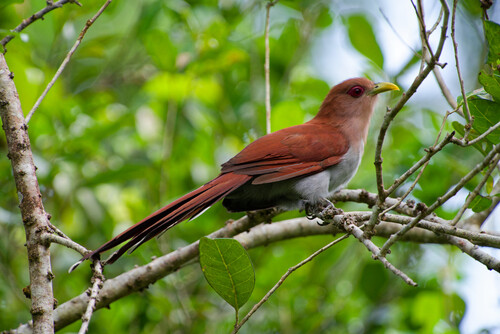
The greater ani (Crotophaga major) is a bird in the cuckoo family. It is sometimes referred to as the black cuckoo. It is found through tropical South America south to northern Argentina. In 1760 the French zoologist Mathurin Jacques Brisson included a description and an illustration of the greater ani in his Ornithologie based on a specimen collected in Cayenne, French Guiana. He used the French name Le grand Bout-de-Petun and the Latin name Crotophagus Major. Although Brisson coined Latin names, these do not conform to the binomial system and are not recognised by the International Commission on Zoological Nomenclature. The greater ani was also described and illustrated in 1779 by the French polymath Georges-Louis Leclerc, Comte de Buffon in his Histoire Naturelle des Oiseaux.

When in 1788 the German naturalist Johann Friedrich Gmelin revised and expanded Carl Linnaeus's Systema Naturae, he included the greater ani. He placed it with the smooth-billed ani in the genus Crotophaga, coined the binomial name Crotophaga major and cited the earlier authors. Gmelin specified the type locality as Cayenne. The genus name combines the Ancient Greek krotōn meaning "tick" with... Wikipedia →

Sounds

Call0:14

Argentina · 2024

© Marcos E. Sosa · XC1019099 · CC BY-NC-SA 4.0

Song0:04

Brazil · 2024

© JAYRSON ARAUJO DE OLIVEIRA · XC949484 · CC BY-NC-SA 4.0

Alarm call0:21

Brazil · 2022

© Nunes D´Acosta · XC712367 · CC BY-NC-SA 4.0

Global Distribution

Parks Where Found

# Park Country Daily sighting probability
1 Cuyabeno Wildlife Reserve 🇪🇨 Ecuador
~60%
2 Yasuní National Park 🇪🇨 Ecuador
~50%
3 Anavilhanas National Park 🇧🇷 Brazil
~40%
4 Soberanía National Park 🇵🇦 Panama
~30%
5 Parque Estadual Encontro das Águas 🇧🇷 Brazil
~30%
6 Amacayacu National Natural Park 🇨🇴 Colombia
~20%
7 Caroni Swamp 🇹🇹 Trinidad and Tobago
~20%
8 San Lorenzo Protected Forest 🇵🇦 Panama
~20%
9 Iguaçu National Park 🇧🇷 Brazil
~10%
10 Iguazú National Park 🇦🇷 Argentina
~10%
11 Manu National Park 🇵🇪 Peru
~10%
12 Tambopata National Reserve 🇵🇪 Peru
~10%
13 El Impenetrable National Park 🇦🇷 Argentina
~10%
14 Utría National Natural Park 🇨🇴 Colombia
~10%
15 Darién National Park 🇵🇦 Panama
<5%
16 Tayrona National Natural Park 🇨🇴 Colombia
<5%
17 Tortuguero National Park 🇨🇷 Costa Rica
<5%
18 Sierra de la Macarena National Park 🇨🇴 Colombia
<5%
19 Chagres National Park 🇵🇦 Panama
<5%
20 Iberá National Park 🇦🇷 Argentina
<5%
21 Parque Natural Metropolitano 🇵🇦 Panama
<5%

Cities Where Found

# City Country Daily sighting probability
1 São Luís 🇧🇷 Brazil
~30%
2 Fortaleza 🇧🇷 Brazil
~30%
3 Medellín 🇨🇴 Colombia
~10%
4 Cali 🇨🇴 Colombia
~10%
5 Bogota 🇨🇴 Colombia
<5%
6 Manaus 🇧🇷 Brazil
<5%
7 Santa Cruz de la Sierra 🇧🇴 Bolivia
<5%
8 Barranquilla 🇨🇴 Colombia
<5%
9 Campo Grande 🇧🇷 Brazil
<5%
10 Belém 🇧🇷 Brazil
<5%

Zoos & Centres Where Found

# Zoo / Centre Country
1 Parque de la Conservación 🇨🇴 Colombia In captivity

Before you go

What are the chances of seeing a Greater Ani in Manaus?

Rare

Under 5% of wildlife watchers report a Greater Ani sighting in Manaus on a given day, based on 20 verified sightings from GBIF citizen-science data. It is the 63rd most-seen of the 116 birds we can rate there. Over three days the chance rises to about 10%, and over a week to about 30%, if each day is a fresh chance.

When is the best time to see a Greater Ani in Manaus?

July and October

In those months about 20% of wildlife watchers report a Greater Ani in Manaus on a given day, against under 5% in August and November–June, the lowest months. Those are among Manaus's driest months, with about 90 mm of rain a month against 270 mm in March.

What time of day is best to see a Greater Ani?

Between 7 and 10 am

Across all the parks we cover, that three-hour window holds the most Greater Ani sightings with a recorded time, and about 9 in 10 of them come between 6 am and 6 pm: it is a daytime animal.

Is Manaus the best place to see a Greater Ani?

6th of 15

Of the 15 cities where we can rate Greater Ani sightings, Manaus ranks 6th at under 5%. The best odds are in São Luís (Brazil, about 30%), Fortaleza (Brazil, about 30%) and Medellín (Colombia, about 10%).

Where does the Greater Ani sighting chance come from?

GBIF citizen-science records

It is estimated from how often the Greater Ani is recorded against all the birds logged in Manaus (20 verified sightings), calibrated against known sighting rates. Figures are rounded to the nearest 10% because citizen-science data supports honest approximations, not decimals, and months with records from fewer than five people show "—". How it works.

← Back to Manaus