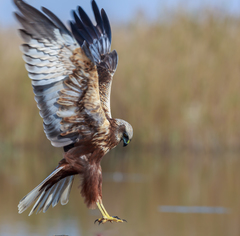



Western Marsh-Harrier

Western Marsh-Harrier

Circus aeruginosus

Silhouette: Mathieu Pélissié · PhyloPic

LCLeast ConcernNTVUENCR
Daily sighting probability <5% · Rare
at Serrekunda

In 3 days ~10%

16 Verified sightings at Serrekunda
12,925 In all 40 parks From 2019 to 2026
December Best month
☀️ Diurnal When it's spotted

About the Western Marsh-Harrier

The western marsh harrier (Circus aeruginosus) is a large harrier, a bird of prey from temperate and subtropical western Eurasia and adjacent Africa. It is also known as the Eurasian marsh harrier. Formerly, a number of relatives were included in C. aeruginosus, which was then known as "marsh harrier". The related taxa are now generally considered to be separate species: the eastern marsh harrier (C. spilonotus), the Papuan harrier (C. spilothorax) of eastern Asia and the Wallacea, the swamp harrier (C. approximans) of Australasia and the Madagascar marsh harrier (C. maillardi) of the western Indian Ocean islands.

The western marsh harrier was scientifically described by Carl Linnaeus in 1758 in the tenth edition of his Systema Naturae under the binomial name Falco aeruginosus. Linnaeus specified the locality as Europe but restricted this to Sweden in 1761. The western marsh harrier is now placed in the genus Circus that was introduced by Bernard Germain de Lacépède... Wikipedia →

Sounds

Call0:05

Sweden · 2026

© Lars Edenius · XC1133142 · CC BY-NC-SA 4.0

Alarm call0:25

Poland · 2022

© Jarek Matusiak · XC734779 · CC BY-NC-ND 4.0

Begging call0:37

Sweden · 2014

© Patrik Åberg · XC196976 · CC BY-NC-SA 4.0

Global Distribution

Parks Where Found

# Park Country Daily sighting probability
1 Hortobágy National Park 🇭🇺 Hungary
~80%
2 Kiskunság National Park 🇭🇺 Hungary
~70%
3 Fertő-Hanság National Park 🇭🇺 Hungary
~70%
4 Biebrza National Park 🇵🇱 Poland
~50%
5 Camargue 🇫🇷 France
~50%
6 Keoladeo National Park 🇮🇳 India
~40%
7 Doñana National Park 🇪🇸 Spain
~40%
8 Białowieża National Park 🇵🇱 Poland
~30%
9 Sierra Nevada National Park 🇪🇸 Spain
~30%
10 Wadden Sea National Park 🇩🇪 Germany
~30%
11 Monfragüe National Park 🇪🇸 Spain
~20%
12 Bavarian Forest National Park 🇩🇪 Germany
~10%
13 Ngorongoro Conservation Area 🇹🇿 Tanzania
~10%
14 Murchison Falls National Park 🇺🇬 Uganda
~10%
15 Niokolo-Koba National Park 🇸🇳 Senegal
~10%
16 Pyrénées National Park 🇫🇷 France
<5%
17 Amboseli National Park 🇰🇪 Kenya
<5%
18 Gauja National Park 🇱🇻 Latvia
<5%
19 Queen Elizabeth National Park 🇺🇬 Uganda
<5%
20 Cairngorms National Park 🇬🇧 United Kingdom
<5%
21 Akagera National Park 🇷🇼 Rwanda
<5%
22 Lake Mburo National Park 🇺🇬 Uganda
<5%
23 Tsavo East National Park 🇰🇪 Kenya
<5%
24 Lake Nakuru National Park 🇰🇪 Kenya
<5%
25 Nairobi National Park 🇰🇪 Kenya
<5%
26 Masai Mara National Reserve 🇰🇪 Kenya
<5%
27 Serengeti National Park 🇹🇿 Tanzania
<5%
28 Arusha National Park 🇹🇿 Tanzania
<5%
29 Ordesa y Monte Perdido National Park 🇪🇸 Spain
<5%
30 Snowdonia National Park 🇬🇧 United Kingdom
<5%
31 Aberdare National Park 🇰🇪 Kenya
<5%
32 Tarangire National Park 🇹🇿 Tanzania
<5%
33 Cévennes National Park 🇫🇷 France
<5%
34 Sierra de Guadarrama National Park 🇪🇸 Spain
<5%
35 Tsavo West National Park 🇰🇪 Kenya
<5%
36 Ranthambore National Park 🇮🇳 India
<5%
37 Nagarhole National Park 🇮🇳 India
<5%
38 Aigüestortes National Park 🇪🇸 Spain
<5%
39 Chitwan National Park 🇳🇵 Nepal
<5%
40 Bwindi Impenetrable National Park 🇺🇬 Uganda
<5%

Cities Where Found

# City Country Daily sighting probability
1 Vasai-Virar 🇮🇳 India
~50%
2 Rabat 🇲🇦 Morocco
~20%
3 Luxor 🇪🇬 Egypt
~20%
4 Cairo 🇪🇬 Egypt
~20%
5 Kalyan-Dombivli 🇮🇳 India
~20%
6 Indore 🇮🇳 India
~20%
7 Tunis 🇹🇳 Tunisia
~20%
8 Abu Dhabi 🇦🇪 United Arab Emirates
~20%
9 Surat 🇮🇳 India
~10%
10 Helsinki 🇫🇮 Finland
~10%

Zoos & Centres Where Found

# Zoo / Centre Country
1 ZooParc de Beauval 🇫🇷 France In captivity
2 Parc du Belvédère 🇹🇳 Tunisia In captivity
3 Tiergarten Halberstadt 🇩🇪 Germany In captivity
4 Hortobágyi Madárpark 🇭🇺 Hungary In captivity
5 Дендропарк ім. Бенедикта Дибовського 🇺🇦 Ukraine In captivity
6 akwarium warszawskiego ZOO 🇵🇱 Poland In captivity
7 hipopotamiarnia i akwarium morskie warszawskiego ZOO 🇵🇱 Poland In captivity

Before you go

What are the chances of seeing a Western Marsh-Harrier in Serrekunda?

Rare

Under 5% of wildlife watchers report a Western Marsh-Harrier sighting in Serrekunda on a given day, based on 16 verified sightings from GBIF citizen-science data. It is the 160th most-seen of the 213 birds we can rate there. Over three days the chance rises to about 10%, if each day is a fresh chance.

When is the best time to see a Western Marsh-Harrier in Serrekunda?

December

In that month about 10% of wildlife watchers report a Western Marsh-Harrier in Serrekunda on a given day, against under 5% in January to November, the lowest months. That is one of Serrekunda's driest months, with almost no rain against 290 mm in August.

What time of day is best to see a Western Marsh-Harrier?

Between 9 am and noon

Across all the parks we cover, that three-hour window holds the most Western Marsh-Harrier sightings with a recorded time, and nearly all of them come between 6 am and 6 pm: it is a daytime animal.

Is Serrekunda the best place to see a Western Marsh-Harrier?

42nd of 82

Of the 82 cities where we can rate Western Marsh-Harrier sightings, Serrekunda ranks 42nd at under 5%. The best odds are in Vasai-Virar (India, about 50%), Rabat (Morocco, about 20%) and Luxor (Egypt, about 20%).

Which relatives of the Western Marsh-Harrier live in Serrekunda?

Same family: Accipitridae

The closest relatives of the Western Marsh-Harrier that you can see in Serrekunda (family Accipitridae, Hawks, Eagles, and Kites) are Black Kite (about 90%), Hooded Vulture (about 90%) and Palmnut Vulture (about 10%), with each one's daily chance of a sighting.

Where does the Western Marsh-Harrier sighting chance come from?

GBIF citizen-science records

It is estimated from how often the Western Marsh-Harrier is recorded against all the birds logged in Serrekunda (16 verified sightings), calibrated against known sighting rates. Figures are rounded to the nearest 10% because citizen-science data supports honest approximations, not decimals, and months with records from fewer than five people show "—". How it works.

← Back to Serrekunda