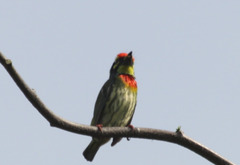
Coppersmith Barbet

Coppersmith Barbet

Psilopogon haemacephalus

Silhouette: Vijay Cavale (photo), John E. McCormack, Michael G. Harvey, Brant C. Faircloth, Nicholas G. Crawford, Travis C. Glenn, Robb T. Brumfield & T. Michael Keesey · PhyloPic

LCLeast ConcernNTVUENCR
Daily sighting probability ~20% · Possible
at Vasai-Virar

In 3 days ~50% in a week ~80%

479 Verified sightings at Vasai-Virar
20,123 In all 32 parks From 2019 to 2026
February Best month
🌅 Crepuscular When it's spotted

About the Coppersmith Barbet

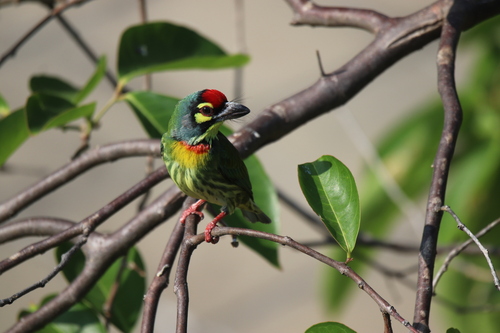
The coppersmith barbet (Psilopogon haemacephalus), also called crimson-breasted barbet and coppersmith, is an Asian barbet with crimson forehead and throat, known for its metronomic call that sounds similar to a coppersmith striking metal with a hammer. It is a resident bird in the Indian subcontinent and parts of Southeast Asia. It carves out holes inside a tree to build its nest. It is predominantly frugivorous, but has been observed eating insects, especially winged termites.

The coppersmith barbet is green with a red head, yellow cheeks and a yellow throat. Its underparts are streaked in grey and black. During the nesting season, the wear and tear on the feathers can cause the plumage of the upper back to appear bluish.

It is 15–17 cm (5.9–6.7 in) long and weighs 30–52.6 g (1.06–1.86 oz). Bucco haemacephalus was the scientific name proposed by Philipp Ludwig Statius Müller in 1776 for a barbet from the Philippines. Bucco indicus was proposed by John Latham in 1790 for a streaked barbet from India with a black head and red forehead.

Bucco roseus was proposed by Charles Dumont de Sainte-Croix in 1816. Asian barbets were placed in the genus Megalaima... Wikipedia →
Sounds

Song0:13

Singapore · 2026

© Joan Theng · XC1103040 · CC BY-NC-SA 4.0

Call0:20

Thailand · 2024

© Greg Irving · XC942721 · CC BY-NC-SA 4.0

Song1:25

Laos · 2024

© Bram Piot · XC914094 · CC BY-NC-SA 4.0

Global Distribution

Parks Where Found

# Park Country Daily sighting probability
1 Bali Barat National Park 🇮🇩 Indonesia
~70%
2 Kanha National Park 🇮🇳 India
~60%
3 Udawalawe National Park 🇱🇰 Sri Lanka
~60%
4 Gir National Park 🇮🇳 India
~50%
5 Mudumalai National Park 🇮🇳 India
~50%
6 Bandhavgarh National Park 🇮🇳 India
~50%
7 Minneriya National Park 🇱🇰 Sri Lanka
~40%
8 Wilpattu National Park 🇱🇰 Sri Lanka
~40%
9 Cat Tien National Park 🇻🇳 Vietnam
~40%
10 Yala National Park 🇱🇰 Sri Lanka
~40%
11 Satpura National Park 🇮🇳 India
~40%
12 Kaeng Krachan National Park 🇹🇭 Thailand
~30%
13 Ranthambore National Park 🇮🇳 India
~30%
14 Bandipur National Park 🇮🇳 India
~30%
15 Keoladeo National Park 🇮🇳 India
~20%
16 Kaziranga National Park 🇮🇳 India
~20%
17 Nagarhole National Park 🇮🇳 India
~20%
18 Chitwan National Park 🇳🇵 Nepal
~20%
19 Doi Inthanon National Park 🇹🇭 Thailand
~20%
20 Gunung Leuser National Park 🇮🇩 Indonesia
~20%
21 Jim Corbett National Park 🇮🇳 India
~10%
22 Khao Yai National Park 🇹🇭 Thailand
~10%
23 Periyar National Park 🇮🇳 India
~10%
24 Royal Bardia National Park 🇳🇵 Nepal
~10%
25 Khao Sok National Park 🇹🇭 Thailand
~10%
26 Sundarbans National Park 🇮🇳 India
~10%
27 Eravikulam National Park 🇮🇳 India
~10%
28 Khao Luang National Park 🇹🇭 Thailand
<5%
29 Manas National Park 🇮🇳 India
<5%
30 Kerinci Seblat National Park 🇮🇩 Indonesia
<5%
31 Taman Negara National Park 🇲🇾 Malaysia
<5%
32 Sinharaja Forest Reserve 🇱🇰 Sri Lanka
<5%

Cities Where Found

# City Country Daily sighting probability
1 Yangon 🇲🇲 Myanmar
~80%
2 Ho Chi Minh City 🇻🇳 Vietnam
~70%
3 Jabalpur 🇮🇳 India
~70%
4 Yogyakarta 🇮🇩 Indonesia
~70%
5 Bangkok 🇹🇭 Thailand
~70%
6 Asansol 🇮🇳 India
~60%
7 Indore 🇮🇳 India
~60%
8 Bhopal 🇮🇳 India
~60%
9 Ranchi 🇮🇳 India
~60%
10 Davao City 🇵🇭 Philippines
~50%

Zoos & Centres Where Found

# Zoo / Centre Country
1 Bandung Zoo 🇮🇩 Indonesia In captivity

Before you go

What are the chances of seeing a Coppersmith Barbet in Vasai-Virar?

Possible

About 20% of wildlife watchers report a Coppersmith Barbet sighting in Vasai-Virar on a given day, based on 479 verified sightings from GBIF citizen-science data. It is the 54th most-seen of the 217 birds we can rate there. Over three days the chance rises to about 50%, and over a week to about 80%, if each day is a fresh chance.

When is the best time to see a Coppersmith Barbet in Vasai-Virar?

February

In that month about 40% of wildlife watchers report a Coppersmith Barbet in Vasai-Virar on a given day, against under 5% in October, the lowest month. That is one of Vasai-Virar's driest months, with almost no rain against 840 mm in July.

What time of day is best to see a Coppersmith Barbet?

Between 2 and 5 am

Across all the parks we cover, that three-hour window holds the most Coppersmith Barbet sightings with a recorded time, and about 6 in 10 of them come between 6 pm and 6 am: it is most active around dawn and dusk.

Is Vasai-Virar the best place to see a Coppersmith Barbet?

50th of 85

Of the 85 cities where we can rate Coppersmith Barbet sightings, Vasai-Virar ranks 50th at about 20%. The best odds are in Yangon (Myanmar, about 80%), Ho Chi Minh City (Vietnam, about 70%) and Jabalpur (India, about 70%).

Where does the Coppersmith Barbet sighting chance come from?

GBIF citizen-science records

It is estimated from how often the Coppersmith Barbet is recorded against all the birds logged in Vasai-Virar (479 verified sightings), calibrated against known sighting rates. Figures are rounded to the nearest 10% because citizen-science data supports honest approximations, not decimals, and months with records from fewer than five people show "—". How it works.

← Back to Vasai-Virar