Black-faced Antthrush

Black-faced Antthrush

Formicarius analis

Silhouette: Abraão B. Leite · PhyloPic

LCLeast ConcernNTVUENCR
Daily sighting probability ~30% · Possible
at Corcovado National Park

In 3 days ~70% in a week ~90%

985 Verified sightings at Corcovado National Park From 2019 to 2026
8,534 In all 26 parks
April Best month
☀️ Diurnal When it's spotted

About the Black-faced Antthrush

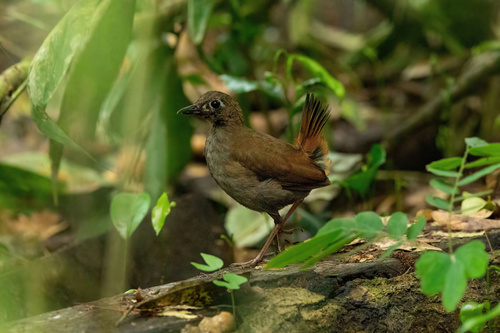
The black-faced antthrush (Formicarius analis) is a species of passerine bird in the family Formicariidae. It is found in Central America from Honduras through Panama, on Trinidad, and in every mainland South American country except Argentina, Chile, Paraguay, and Uruguay.

The black-faced antthrush was formally described in 1837 by the French naturalists Alcide d'Orbigny and Frédéric de Lafresnaye from a specimen collected in Bolivia. They coined the binomial name Myothera analis. The specific epithet is from the Modern Latin analis meaning "relating to the undertail-coverts of the vent". In 1858 it was moved to genus Formicarius that had been introduced by the Dutch naturalist Pieter Boddaert in 1783.

The black-faced antthrush has these 11 subspecies: The first five subspecies on the above list are treated... Wikipedia →

Sounds

Song1:28

French Guiana · 2024

© Tristan Guillebot de Nerville · XC1162549 · CC BY-NC-SA 4.0

Call0:21

Peru · 2024

© Richard E. Webster · XC961886 · CC BY-NC-SA 4.0

Alarm call0:10

Ecuador · 2004

© John V. Moore · XC258576 · CC BY-NC-SA 4.0

Global Distribution

Parks Where Found

# Park Country Daily sighting probability
1 Tambopata National Reserve 🇵🇪 Peru
~30%
2 Corcovado National Park 🇨🇷 Costa Rica
~30%
3 Soberanía National Park 🇵🇦 Panama
~30%
4 Brownsberg Nature Park 🇸🇷 Suriname
~30%
5 Henri Pittier National Park 🇻🇪 Venezuela
~30%
6 Piedras Blancas National Park 🇨🇷 Costa Rica
~20%
7 Darién National Park 🇵🇦 Panama
~20%
8 Manu National Park 🇵🇪 Peru
~20%
9 Carara National Park 🇨🇷 Costa Rica
~10%
10 San Lorenzo Protected Forest 🇵🇦 Panama
~10%
11 Chagres National Park 🇵🇦 Panama
~10%
12 Rincón de la Vieja National Park 🇨🇷 Costa Rica
<5%
13 Bastimentos Island National Marine Park 🇵🇦 Panama
<5%
14 Cahuita National Park 🇨🇷 Costa Rica
<5%
15 Braulio Carrillo National Park 🇨🇷 Costa Rica
<5%
16 Marino Ballena National Park 🇨🇷 Costa Rica
<5%
17 La Amistad International Park (Panama) 🇵🇦 Panama
<5%
18 Chirripó National Park 🇨🇷 Costa Rica
<5%
19 Yasuní National Park 🇪🇨 Ecuador
<5%
20 Gandoca-Manzanillo Wildlife Refuge 🇨🇷 Costa Rica
<5%
21 Manuel Antonio National Park 🇨🇷 Costa Rica
<5%
22 Arenal Volcano National Park 🇨🇷 Costa Rica
<5%
23 Tenorio Volcano National Park 🇨🇷 Costa Rica
<5%
24 Tortuguero National Park 🇨🇷 Costa Rica
<5%
25 Poás Volcano National Park 🇨🇷 Costa Rica
<5%
26 Tapantí-Macizo de la Muerte National Park 🇨🇷 Costa Rica
<5%

Before you go

What are the chances of seeing a Black-faced Antthrush in Corcovado National Park?

Possible

About 30% of wildlife watchers report a Black-faced Antthrush sighting in Corcovado National Park on a given day, based on 985 verified sightings from GBIF citizen-science data from 2019 to 2026. It is the 21st most-seen of the 332 birds we can rate there. Over three days the chance rises to about 70%, and over a week to about 90%, if each day is a fresh chance.

When is the best time to see a Black-faced Antthrush in Corcovado National Park?

February–April and June–July

In those months about 40% of wildlife watchers report a Black-faced Antthrush in Corcovado National Park on a given day, against about 10% in October, the lowest month.

What time of day is best to see a Black-faced Antthrush?

Between 7 and 10 am

Across all the parks we cover, that three-hour window holds the most Black-faced Antthrush sightings with a recorded time, and about 9 in 10 of them come between 6 am and 6 pm: it is a daytime animal.

Is Corcovado National Park the best place to see a Black-faced Antthrush?

Among the best

Of the 26 parks where we can rate Black-faced Antthrush sightings, Corcovado National Park ranks 2nd at about 30%, level with the leaders once rounded. The best odds are in Tambopata National Reserve (Peru, about 30%).

Which relatives of the Black-faced Antthrush live in Corcovado National Park?

Same order: Passeriformes

The closest relatives of the Black-faced Antthrush that you can see in Corcovado National Park (order Passeriformes, Perching Birds) are Chestnut-backed Antbird (about 60%), Black-hooded Antshrike (about 60%) and Riverside Wren (about 50%), with each one's daily chance of a sighting.

Where does the Black-faced Antthrush sighting chance come from?

GBIF citizen-science records

It is estimated from how often the Black-faced Antthrush is recorded against all the birds logged in Corcovado National Park (985 verified sightings from 2019 to 2026), calibrated against known sighting rates. Figures are rounded to the nearest 10% because citizen-science data supports honest approximations, not decimals, and months with records from fewer than five people show "—". How it works.
← Back to Corcovado National Park