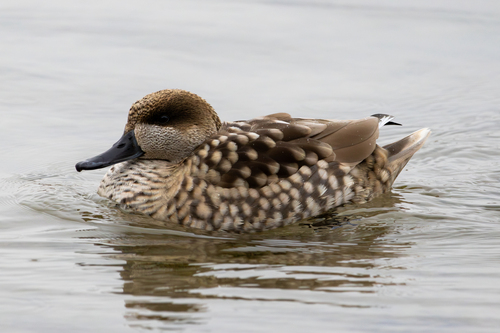
Garganey

Garganey

Spatula querquedula

Silhouette: Sheatherius · PhyloPic

LCLeast ConcernNTVUENCR
Daily sighting probability ~50% · Likely
at Djoudj National Bird Sanctuary

In 3 days ~80% in a week >90%

66 Verified sightings at Djoudj National Bird Sanctuary From 2019 to 2026
3,078 In all 27 parks
February Best month
☀️ Diurnal When it's spotted

About the Garganey

The garganey (Spatula querquedula) is a small dabbling duck. It breeds in much of Europe and across the Palearctic, but is strictly migratory, with the entire population moving to Africa, India (in particular Santragachi), Bangladesh (in the natural reservoirs of Sylhet district) and Australasia during the winter of the Northern hemisphere, where large flocks can occur. This species was first described by Carl Linnaeus in his landmark 1758 10th edition of Systema Naturae. Like other small ducks such as the Eurasian teal, this species rises easily from the water with a fast twisting wader-like flight.

Their breeding habitat is grassland adjacent to shallow marshes and steppe lakes. The first formal description of the garganey was by the Swedish naturalist Carl Linnaeus in 1758 in the tenth edition of his Systema Naturae. He introduced the binomial name Anas querquedula. A molecular phylogentic study comparing mitochondrial DNA sequences published in 2009 found that the genus Anas, as then defined, was non-monophyletic. The genus was subsequently split into four monophyletic genera with ten species including the garganey moved into the resurrected genus Spatula. This genus...

Wikipedia →

Sounds

Nocturnal flight call0:15

Netherlands · 2026

© Martin Fousert · XC1089520 · CC BY-NC-SA 4.0

Call0:13

France · 2026

© Thierry THOMAS · XC1089418 · CC BY-NC-SA 4.0

Flight call0:31

Russian Federation · 2025

© Albert Lastukhin · XC993449 · CC BY-NC-ND 4.0

Global Distribution

Parks Where Found

# Park Country Daily sighting probability
1 Djoudj National Bird Sanctuary 🇸🇳 Senegal
~50%
2 Keoladeo National Park 🇮🇳 India
~30%
3 Biebrza National Park 🇵🇱 Poland
~30%
4 Hortobágy National Park 🇭🇺 Hungary
~20%
5 Fertő-Hanság National Park 🇭🇺 Hungary
~20%
6 Kiskunság National Park 🇭🇺 Hungary
~20%
7 Camargue 🇫🇷 France
~10%
8 Białowieża National Park 🇵🇱 Poland
~10%
9 Kaziranga National Park 🇮🇳 India
~10%
10 Ranthambore National Park 🇮🇳 India
~10%
11 Bavarian Forest National Park 🇩🇪 Germany
~10%
12 Yala National Park 🇱🇰 Sri Lanka
~10%
13 Wadden Sea National Park 🇩🇪 Germany
<5%
14 Oosterschelde National Park 🇳🇱 Netherlands
<5%
15 Vatnajokull National Park 🇮🇸 Iceland
<5%
16 Doñana National Park 🇪🇸 Spain
<5%
17 Bandipur National Park 🇮🇳 India
<5%
18 Amboseli National Park 🇰🇪 Kenya
<5%
19 Nagarhole National Park 🇮🇳 India
<5%
20 Satpura National Park 🇮🇳 India
<5%
21 Snowdonia National Park 🇬🇧 United Kingdom
<5%
22 Lake Nakuru National Park 🇰🇪 Kenya
<5%
23 Chitwan National Park 🇳🇵 Nepal
<5%
24 Ngorongoro Conservation Area 🇹🇿 Tanzania
<5%
25 Sierra de Guadarrama National Park 🇪🇸 Spain
<5%
26 Monfragüe National Park 🇪🇸 Spain
<5%
27 Kanha National Park 🇮🇳 India
<5%

Cities Where Found

# City Country Daily sighting probability
1 Rajkot 🇮🇳 India
~10%
2 Tuen Mun 🇨🇳 China
~10%
3 Vasai-Virar 🇮🇳 India
~10%
4 Kochi 🇮🇳 India
~10%
5 Sacramento 🇺🇸 United States
~10%
6 Quanzhou 🇨🇳 China
~10%
7 Bucharest 🇷🇴 Romania
~10%
8 Indore 🇮🇳 India
~10%
9 Ponnani 🇮🇳 India
~10%
10 Tiruppur 🇮🇳 India
~10%

Zoos & Centres Where Found

# Zoo / Centre Country
1 Zoobotánico Jerez 🇪🇸 Spain In captivity
2 Slimbridge Wetland Centre 🇬🇧 United Kingdom In captivity
3 Budapest Zoo & Botanical Garden 🇭🇺 Hungary In captivity
4 Cleres Zoological Park 🇫🇷 France In captivity
5 Valencia Bioparc 🇪🇸 Spain In captivity
6 Inokashira Park Zoo 🇯🇵 Japan In captivity
7 Ogród Zoologiczny w Katowicach 🇵🇱 Poland In captivity

Before you go

What are the chances of seeing a Garganey in Djoudj National Bird Sanctuary?

Likely

About 50% of wildlife watchers report a Garganey sighting in Djoudj National Bird Sanctuary on a given day, based on 66 verified sightings from GBIF citizen-science data from 2019 to 2026. It is the 56th most-seen of the 173 birds we can rate there. Over three days the chance rises to about 80%, and over a week to over 90%, if each day is a fresh chance.

When is the best time to see a Garganey in Djoudj National Bird Sanctuary?

February

In that month about 60% of wildlife watchers report a Garganey in Djoudj National Bird Sanctuary on a given day, against about 30% in April, the lowest month. That is one of Djoudj National Bird Sanctuary's driest months, with almost no rain against 55 mm in August. May to October have too few records to rate.

What time of day is best to see a Garganey?

Between 9 am and noon

Across all the parks we cover, that three-hour window holds the most Garganey sightings with a recorded time, and about 9 in 10 of them come between 6 am and 6 pm: it is a daytime animal.

Is Djoudj National Bird Sanctuary the best place to see a Garganey?

Yes

Of the 27 parks where we can rate Garganey sightings, Djoudj National Bird Sanctuary has the highest daily chance: about 50%. Next come Keoladeo National Park (India, about 30%) and Biebrza National Park (Poland, about 30%). All parks ranked.

Where does the Garganey sighting chance come from?

GBIF citizen-science records

It is estimated from how often the Garganey is recorded against all the birds logged in Djoudj National Bird Sanctuary (66 verified sightings from 2019 to 2026), calibrated against known sighting rates. Figures are rounded to the nearest 10% because citizen-science data supports honest approximations, not decimals, and months with records from fewer than five people show "—". How it works.

← Back to Djoudj National Bird Sanctuary