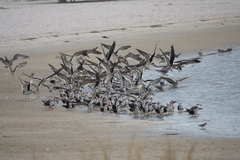
Black Skimmer

Black Skimmer

Rynchops niger

Silhouette: Daniel Nuñez-Leon · PhyloPic

LCLeast ConcernNTVUENCR
Daily sighting probability ~10% · With luck
at Everglades National Park

In 3 days ~20% in a week ~50%

845 Verified sightings at Everglades National Park From 2019 to 2026
8,839 In all 28 parks
January Best month
☀️ Diurnal When it's spotted

About the Black Skimmer

The black skimmer (Rynchops niger) is a tern-like seabird, one of three similar bird species in the skimmer genus Rynchops in the gull family Laridae. It breeds in North and South America. Northern populations winter in the warmer waters of the Caribbean and the tropical and subtropical Pacific and Atlantic coasts, but South American populations make only shorter movements in response to annual floods which extend their feeding areas in the river shallows.

The black skimmer was described by the Swedish naturalist Carl Linnaeus in 1755 in the tenth edition of his Systema Naturae and given the binomial name Rynchops niger. The genus name Rynchops is from the Ancient Greek ῥυvχος/rhunkhos meaning "bill" and κοπτω/koptō meaning "to cut off". The specific niger is the Latin word for "black". The black skimmer is one of three species in the genus Rynchops.

There are three subspecies: The black skimmer is the largest of the three skimmer species. It measures 40–50 cm (16–20 in) long with a 107–127 cm (42–50 in) wingspan. This species ranges from 212 to 447 g (7.5 to 15.8 oz), with males averaging about 349 g (12.3 oz), as compared to the smaller females 254... Wikipedia →

Sounds

Call0:23

Brazil · 2024

© JAYRSON ARAUJO DE OLIVEIRA · XC949473 · CC BY-NC-SA 4.0

Song0:52

Argentina · 2020

© Guillermo Treboux · XC630548 · CC BY-NC-SA 4.0

Alarm call0:05

Argentina · 2020

© Nicolás Urquiza · XC603138 · CC BY-NC-SA 4.0

Global Distribution

Parks Where Found

# Park Country Daily sighting probability
1 Parque Estadual Encontro das Águas 🇧🇷 Brazil
~60%
2 Ría Lagartos Biosphere Reserve 🇲🇽 Mexico
~50%
3 Merritt Island National Wildlife Refuge 🇺🇸 United States
~30%
4 Padre Island National Seashore 🇺🇸 United States
~20%
5 Ciénaga de Zapata 🇨🇺 Cuba
~20%
6 Tambopata National Reserve 🇵🇪 Peru
~10%
7 Manu National Park 🇵🇪 Peru
~10%
8 Celestún Biosphere Reserve 🇲🇽 Mexico
~10%
9 Cuyabeno Wildlife Reserve 🇪🇨 Ecuador
~10%
10 Everglades National Park 🇺🇸 United States
~10%
11 Caroni Swamp 🇹🇹 Trinidad and Tobago
~10%
12 El Impenetrable National Park 🇦🇷 Argentina
~10%
13 Yasuní National Park 🇪🇨 Ecuador
<5%
14 El Vizcaíno Biosphere Reserve 🇲🇽 Mexico
<5%
15 Anavilhanas National Park 🇧🇷 Brazil
<5%
16 Carara National Park 🇨🇷 Costa Rica
<5%
17 Iberá National Park 🇦🇷 Argentina
<5%
18 Channel Islands National Park 🇺🇸 United States
<5%
19 Bastimentos Island National Marine Park 🇵🇦 Panama
<5%
20 Sierra de la Macarena National Park 🇨🇴 Colombia
<5%
21 Santa Rosa National Park 🇨🇷 Costa Rica
<5%
22 La Amistad International Park (Panama) 🇵🇦 Panama
<5%
23 Tortuguero National Park 🇨🇷 Costa Rica
<5%
24 Iguaçu National Park 🇧🇷 Brazil
<5%
25 Iguazú National Park 🇦🇷 Argentina
<5%
26 Big Cypress National Preserve 🇺🇸 United States
<5%
27 Gandoca-Manzanillo Wildlife Refuge 🇨🇷 Costa Rica
<5%
28 Arrecifes de Cozumel National Park 🇲🇽 Mexico
<5%

Cities Where Found

# City Country Daily sighting probability
1 Lima 🇵🇪 Peru
~20%
2 São Luís 🇧🇷 Brazil
~10%
3 Havana 🇨🇺 Cuba
~10%
4 San Diego 🇺🇸 United States
~10%
5 Panama City 🇵🇦 Panama
~10%
6 Los Angeles 🇺🇸 United States
~10%
7 Barranquilla 🇨🇴 Colombia
<5%
8 Rio de Janeiro 🇧🇷 Brazil
<5%
9 Montevideo 🇺🇾 Uruguay
<5%
10 San Francisco 🇺🇸 United States
<5%

Before you go

What are the chances of seeing a Black Skimmer in Everglades National Park?

With luck

About 10% of wildlife watchers report a Black Skimmer sighting in Everglades National Park on a given day, based on 845 verified sightings from GBIF citizen-science data from 2019 to 2026. It is the 84th most-seen of the 273 birds we can rate there. Over three days the chance rises to about 20%, and over a week to about 50%, if each day is a fresh chance.

When is the best time to see a Black Skimmer in Everglades National Park?

January

In that month about 20% of wildlife watchers report a Black Skimmer in Everglades National Park on a given day, against under 5% in April to July, the lowest months. That is one of Everglades National Park's driest months, with about 55 mm of rain against 240 mm in June.

What time of day is best to see a Black Skimmer?

Between noon and 3 pm

Across all the parks we cover, that three-hour window holds the most Black Skimmer sightings with a recorded time, and about 9 in 10 of them come between 6 am and 6 pm: it is a daytime animal.

Which relatives of the Black Skimmer live in Everglades National Park?

Same family: Laridae

The closest relatives of the Black Skimmer that you can see in Everglades National Park (family Laridae, Gulls, Terns, and Skimmers) are Laughing Gull (about 30%), Royal Tern (about 20%) and Caspian Tern (about 10%), with each one's daily chance of a sighting.

Where does the Black Skimmer sighting chance come from?

GBIF citizen-science records

It is estimated from how often the Black Skimmer is recorded against all the birds logged in Everglades National Park (845 verified sightings from 2019 to 2026), calibrated against known sighting rates. Figures are rounded to the nearest 10% because citizen-science data supports honest approximations, not decimals, and months with records from fewer than five people show "—". How it works.

← Back to Everglades National Park