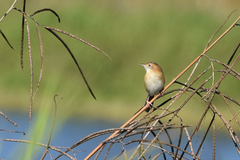
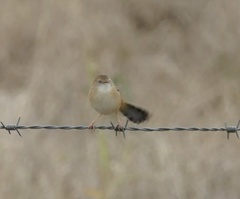

Golden-headed Cisticola

Golden-headed Cisticola

Cisticola exilis

Silhouette: Sheatherius · PhyloPic

LCLeast ConcernNTVUENCR
Daily sighting probability <5% · Rare
at Great Otway National Park

In 3 days <5%

20 Verified sightings at Great Otway National Park From 2019 to 2026
952 In all 17 parks
May Best month
☀️ Diurnal When it's spotted

About the Golden-headed Cisticola

The golden-headed cisticola (Cisticola exilis), also known as the bright-capped cisticola, is a species of warbler in the family Cisticolidae, found in Australia and thirteen Asian countries. Growing to 9–11.5 cm (3.5–4.5 in) long, it is usually brown and cream in colour, but has a different appearance during the mating season, with a gold-coloured body and a much shorter tail. It is an omnivore and frequently makes a variety of vocalizations. Known as the "finest tailor of all birds", it constructs nests out of plants and spider threads. It mates in the rainy season. It has a very large range and population, which is thought to be increasing.

The golden-headed cisticola was described by the naturalists Nicholas Vigors and Thomas Horsfield in 1827 and given the binomial name Malurus exilis. The specific epithet exilis is the Latin word for "small", "slender" or "thin". It is now placed in the genus Cisticola, which was erected by the German naturalist Johann Jakob Kaup in 1829. This species has been known by several English names in addition to the golden-headed cisticola, including bright-capped cisticola, bright-headed cisticola, bright-crowned cisticola, gold-capped... Wikipedia →

Sounds

Flight song1:12

Indonesia · 2025

© Richard E. Webster · XC1075124 · CC BY-NC-SA 4.0

Song0:34

Australia · 2025

© Peter Boesman · XC1066467 · CC BY-NC-ND 4.0

Call0:39

Laos · 2024

© Bram Piot · XC918641 · CC BY-NC-SA 4.0

Global Distribution

Parks Where Found

# Park Country Daily sighting probability
1 Khao Yai National Park 🇹🇭 Thailand
~10%
2 Kakadu National Park 🇦🇺 Australia
~10%
3 Manas National Park 🇮🇳 India
~10%
4 Litchfield National Park 🇦🇺 Australia
~10%
5 Daintree National Park 🇦🇺 Australia
<5%
6 Nitmiluk National Park 🇦🇺 Australia
<5%
7 Bali Barat National Park 🇮🇩 Indonesia
<5%
8 Kaziranga National Park 🇮🇳 India
<5%
9 Chitwan National Park 🇳🇵 Nepal
<5%
10 Blue Mountains National Park 🇦🇺 Australia
<5%
11 Grampians National Park 🇦🇺 Australia
<5%
12 Jim Corbett National Park 🇮🇳 India
<5%
13 Great Otway National Park 🇦🇺 Australia
<5%
14 Lamington National Park 🇦🇺 Australia
<5%
15 Cat Tien National Park 🇻🇳 Vietnam
<5%
16 Kaeng Krachan National Park 🇹🇭 Thailand
<5%
17 Doi Inthanon National Park 🇹🇭 Thailand
<5%

Cities Where Found

# City Country Daily sighting probability
1 Cebu City 🇵🇭 Philippines
~20%
2 Phnom Penh 🇰🇭 Cambodia
~10%
3 Brisbane 🇦🇺 Australia
~10%
4 Davao City 🇵🇭 Philippines
~10%
5 Manila 🇵🇭 Philippines
~10%
6 Melbourne 🇦🇺 Australia
~10%
7 Makassar 🇮🇩 Indonesia
~10%
8 Jakarta 🇮🇩 Indonesia
~10%
9 Taichung 🇹🇼 Taiwan
~10%
10 Denpasar 🇮🇩 Indonesia
~10%

Before you go

What are the chances of seeing a Golden-headed Cisticola in Great Otway National Park?

Rare

Under 5% of wildlife watchers report a Golden-headed Cisticola sighting in Great Otway National Park on a given day, based on 20 verified sightings from GBIF citizen-science data from 2019 to 2026. It is the 153rd most-seen of the 175 birds we can rate there. Over three days the chance rises to under 5%, if each day is a fresh chance.

When is the best time to see a Golden-headed Cisticola in Great Otway National Park?

Any time of year

In every month with enough records, under 5% of wildlife watchers report a Golden-headed Cisticola in Great Otway National Park on a given day, so our monthly data shows no clear season.

What time of day is best to see a Golden-headed Cisticola?

Between 7 and 10 am

Across all the parks we cover, that three-hour window holds the most Golden-headed Cisticola sightings with a recorded time, and nearly all of them come between 6 am and 6 pm: it is a daytime animal.

Is Great Otway National Park the best place to see a Golden-headed Cisticola?

13th of 17

Of the 17 parks where we can rate Golden-headed Cisticola sightings, Great Otway National Park ranks 13th at under 5%. The best odds are in Khao Yai National Park (Thailand, about 10%), Kakadu National Park (Australia, about 10%) and Manas National Park (India, about 10%).

Which relatives of the Golden-headed Cisticola live in Great Otway National Park?

Same order: Passeriformes

The closest relatives of the Golden-headed Cisticola that you can see in Great Otway National Park (order Passeriformes, Perching Birds) are Superb Fairywren (about 90%), Red Wattlebird (about 70%) and Brown Thornbill (about 70%), with each one's daily chance of a sighting.

Where does the Golden-headed Cisticola sighting chance come from?

GBIF citizen-science records

It is estimated from how often the Golden-headed Cisticola is recorded against all the birds logged in Great Otway National Park (20 verified sightings from 2019 to 2026), calibrated against known sighting rates. Figures are rounded to the nearest 10% because citizen-science data supports honest approximations, not decimals, and months with records from fewer than five people show "—". How it works.

← Back to Great Otway National Park