


Completed




Green Sea Turtle
Chelonia mydas
Silhouette: James R. Spotila and Ray Chatterji · PhyloPic
- KingdomAnimalia (Animals)
- PhylumChordata (Chordates)
- ClassTestudines
- FamilyCheloniidae (Typical Sea Turtles)
- GenusChelonia (Green Sea Turtles)
- SpeciesChelonia mydas (Green Sea Turtle)
In 3 days >90%
116 Verified sightings at Komodo National Park From 2019 to 2026
3,788 In all 30 parks
June Best month
☀️ Diurnal When it's spotted
Completed


Completed


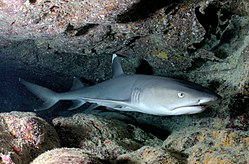
Completed
About the Green Sea Turtle
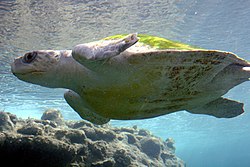
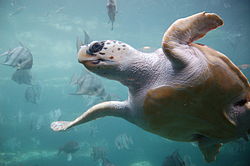
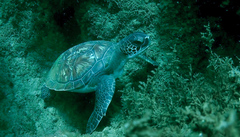
The green sea turtle (Chelonia mydas), also known as the green turtle, black sea turtle, and Pacific green turtle, is a species of large sea turtle of the family Cheloniidae. It is the only species in the genus Chelonia. Its range extends throughout tropical and subtropical seas around the world, with two distinct populations in the Atlantic and Pacific Oceans, but it is also found in the Indian Ocean. The common name refers to the usually green fat found beneath its carapace, due to its diet strictly being seagrass, not to the color of its carapace, which is olive to black.
The dorsoventrally flattened body of C. mydas is covered by a large, teardrop-shaped carapace; it has a pair of large, paddle-like flippers. It is usually lightly colored, although in the eastern Pacific populations, parts of the carapace can be almost black. Unlike other members of its family, such as the hawksbill sea turtle, C. mydas is mostly herbivorous. The adults usually inhabit shallow lagoons, feeding mostly on various species of seagrasses. The green sea turtle is the only aquatic turtle species which is herbivorous when fully grown.
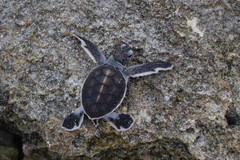
Like other sea turtles, green sea turtles migrate long distances between feeding grounds and hatching beaches. Many islands worldwide are known as Turtle Island due to green sea turtles nesting on their beaches. Females crawl out on beaches, dig nests, and lay eggs during the night. Later, hatchlings emerge, and scramble into the water. Those that reach maturity may live to 90 years in the wild.
C. mydas was listed as endangered by the IUCN and CITES until 2025 and is protected from exploitation in most countries. It is illegal to collect, harm, or kill them. In addition, many countries have laws and ordinances to protect nesting areas. However, turtles are still in danger due to human activity. In some countries, turtles and their eggs are still hunted for food. Pollution indirectly harms turtles at both population and individual scales. Many turtles die after being caught in fishing nets. In addition, real estate development often causes habitat loss by eliminating nesting beaches. Wikipedia →
Recent sightings of Green Sea Turtle in Komodo National Park
LIVEiNaturalistGlobal Distribution
Parks Where Found
Zoos & Centres Where Found
| # | Zoo / Centre | Country | |
|---|---|---|---|
| 1 | Disney's Animal Kingdom | 🇺🇸 United States | |
| 2 | Zhuhai Chimelong Ocean Kingdom | 🇨🇳 China | |
| 3 | Chimelong Spaceship | 🇨🇳 China | |
| 4 | SeaWorld San Diego | 🇺🇸 United States | |
| 5 | San Diego Zoo | 🇺🇸 United States | |
| 6 | Aquarium of Genoa | 🇮🇹 Italy | |
| 7 | Toba Aquarium | 🇯🇵 Japan | |
| 8 | Australia Zoo | 🇦🇺 Australia | |
| 9 | Nausicaà Centre National de la Mer | 🇫🇷 France | |
| 10 | Kélonia | 🇫🇷 France | |
| 11 | Aquarium de la Réunion | 🇫🇷 France | |
| 12 | Gulf Specimen Public Aquarium | 🇺🇸 United States | |
| 13 | Zoo Miami | 🇺🇸 United States | |
| 14 | Bronx Zoo | 🇺🇸 United States | |
| 15 | Kadoorie Farm and Botanic Garden | 🇭🇰 Hong Kong SAR China | |
| 16 | SeaWorld San Antonio | 🇺🇸 United States | |
| 17 | Safari Park Open Zoo | 🇹🇭 Thailand | |
| 18 | Beijing Zoo | 🇨🇳 China | |
| 19 | 西霞口神雕山野生動物世界 | 🇨🇳 China | |
| 20 | Omaha’s Henry Doorly Zoo and Aquarium | 🇺🇸 United States | |
| 21 | Parque y Zoológico Nacional Arquitecto Manuel Valverde Podestá | 🇩🇴 Dominican Republic | |
| 22 | Safari World | 🇹🇭 Thailand | |
| 23 | The Maryland Zoo | 🇺🇸 United States | |
| 24 | Toledo Zoo | 🇺🇸 United States | |
| 25 | Detroit Zoo | 🇺🇸 United States | |
| 26 | Xcaret | 🇲🇽 Mexico | |
| 27 | Guadalajara Zoo | 🇲🇽 Mexico | |
| 28 | Audubon Zoo | 🇺🇸 United States | |
| 29 | Nanning Zoo | 🇨🇳 China | |
| 30 | Zoológico de San Juan de Aragón | 🇲🇽 Mexico | |
| 31 | Guangzhou Zoo | 🇨🇳 China | |
| 32 | Franklin Park Zoo | 🇺🇸 United States | |
| 33 | Fort Worth Zoo | 🇺🇸 United States | |
| 34 | Gatorland | 🇺🇸 United States | |
| 35 | Sea World | 🇦🇺 Australia | |
| 36 | Wildlands | 🇳🇱 Netherlands | |
| 37 | Zoológico Benito Juárez | 🇲🇽 Mexico | |
| 38 | Cleland Wildlife Park | 🇦🇺 Australia | |
| 39 | Houston Zoo | 🇺🇸 United States | |
| 40 | Zoológico la pastroa | 🇲🇽 Mexico | |
| 41 | Neo Park Okinawa | 🇯🇵 Japan | |
| 42 | Zoo Atlanta | 🇺🇸 United States | |
| 43 | Surabaya Zoo | 🇮🇩 Indonesia | |
| 44 | Point Defiance Zoo & Aquarium | 🇺🇸 United States | |
| 45 | Riverbanks Zoo | 🇺🇸 United States | |
| 46 | Lincoln Park Zoo | 🇺🇸 United States | |
| 47 | Turtle Back Zoo | 🇺🇸 United States | |
| 48 | Sea Life Park Hawaii | 🇺🇸 United States | |
| 49 | Kazan Zoo & Botanical Garden | 🇷🇺 Russia | |
| 50 | Kuala Lumpur Bird Park | 🇲🇾 Malaysia |
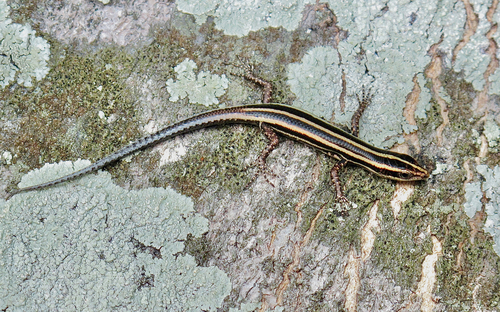
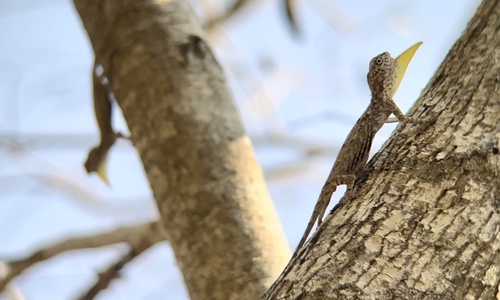
Closest Relatives at Komodo National Park





Before you go
What are the chances of seeing a Green Sea Turtle in Komodo National Park?
Very likely
About 70% of wildlife watchers report a Green Sea Turtle sighting in Komodo National Park on a given day, based on 116 verified sightings from GBIF citizen-science data from 2019 to 2026. It is the 3rd most-seen of the 19 reptiles we can rate there. Over three days the chance rises to over 90%, if each day is a fresh chance.
When is the best time to see a Green Sea Turtle in Komodo National Park?
June and July
In those months about 80% of wildlife watchers report a Green Sea Turtle in Komodo National Park on a given day, against about 50% in March and May, the lowest months. Those are among Komodo National Park's driest months, with about 20 mm of rain a month against 200 mm in January.
What time of day is best to see a Green Sea Turtle?
Between 3 and 6 pm
Across all the parks we cover, that three-hour window holds the most Green Sea Turtle sightings with a recorded time, and about 9 in 10 of them come between 6 am and 6 pm: it is a daytime animal.
Is Komodo National Park the best place to see a Green Sea Turtle?
3rd of 30
Of the 30 parks where we can rate Green Sea Turtle sightings, Komodo National Park ranks 3rd at about 70%. The best odds are in Coiba National Park (Panama, about 80%) and Cape Range (Australia, about 70%). All parks ranked.
Where does the Green Sea Turtle sighting chance come from?
GBIF citizen-science records
It is estimated from how often the Green Sea Turtle is recorded against all the reptiles logged in Komodo National Park (116 verified sightings from 2019 to 2026), calibrated against known sighting rates. Figures are rounded to the nearest 10% because citizen-science data supports honest approximations, not decimals, and months with records from fewer than five people show "—". How it works.
