Hadada

Hadada

Bostrychia hagedash

Silhouette: Sheatherius · PhyloPic

LCLeast ConcernNTVUENCR
Daily sighting probability ~50% · Likely
at Mana Pools National Park

In 3 days ~80% in a week >90%

241 Verified sightings at Mana Pools National Park From 2019 to 2026
26,187 In all 52 parks
August Best month
☀️ Diurnal When it's spotted

About the Hadada

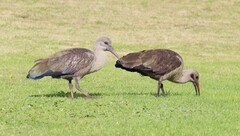
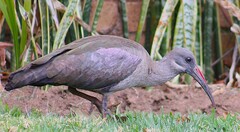
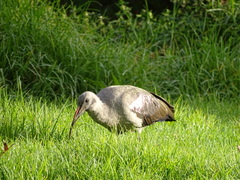
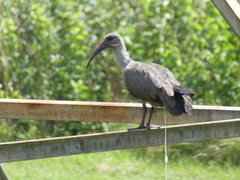
The hadada ibis (Bostrychia hagedash) or hadeda is an ibis native to Sub-Saharan Africa. It is named for its loud three to four note calls uttered in flight especially in the mornings and evenings when they fly out or return to their roost trees. Although not as dependent on water as some ibises, they are found near wetlands and often live in close proximity to humans, foraging in cultivated land and gardens. A medium-sized ibis with stout legs and a typical down-curved bill, the wing coverts are iridescent with a green or purple sheen. They are non-migratory but are known to make nomadic movements in response to rain particularly during droughts. Their ranges in southern Africa have increased with an increase in tree cover and irrigation in human-altered habitats.

Tantalus hagedash was the scientific name proposed by John Latham in 1790 who described it from a specimen that had been collected at "Houteniquas", due north of Mossel Bay, by Anders Sparrman who also recorded that it was onomatopoeically "called by the colonists hagedash, and also hadelde." It was later placed in a monotypic genus as Hagedashia hagedash but has since been placed... Wikipedia →

Sounds

Flight call0:24

Kenya · 2026

© Ding Li Yong · XC1177162 · CC BY-NC-ND 4.0

Call0:40

Botswana · 2023

© Marc Anderson · XC1004826 · CC BY-NC-ND 4.0

Dawn song1:15

South Africa · 2022

© Lynette Rudman · XC708908 · CC BY-NC-SA 4.0

Global Distribution

Parks Where Found

# Park Country Daily sighting probability
1 Niokolo-Koba National Park 🇸🇳 Senegal
~70%
2 Nairobi National Park 🇰🇪 Kenya
~70%
3 Addo Elephant National Park 🇿🇦 South Africa
~70%
4 South Luangwa National Park 🇿🇲 Zambia
~70%
5 Gonarezhou National Park 🇿🇼 Zimbabwe
~70%
6 Table Mountain National Park 🇿🇦 South Africa
~70%
7 Arusha National Park 🇹🇿 Tanzania
~60%
8 De Hoop Nature Reserve 🇿🇦 South Africa
~60%
9 Liwonde National Park 🇲🇼 Malawi
~60%
10 Kafue National Park 🇿🇲 Zambia
~60%
11 iSimangaliso Wetland Park 🇿🇦 South Africa
~60%
12 Akagera National Park 🇷🇼 Rwanda
~50%
13 Lake Nakuru National Park 🇰🇪 Kenya
~50%
14 Lower Zambezi National Park 🇿🇲 Zambia
~50%
15 Golden Gate Highlands National Park 🇿🇦 South Africa
~50%
16 Lake Mburo National Park 🇺🇬 Uganda
~50%
17 Kruger National Park 🇿🇦 South Africa
~50%
18 Garden Route National Park 🇿🇦 South Africa
~50%
19 uMkhuze Game Reserve 🇿🇦 South Africa
~50%
20 Hluhluwe-Imfolozi Park 🇿🇦 South Africa
~50%
21 Murchison Falls National Park 🇺🇬 Uganda
~50%
22 Mana Pools National Park 🇿🇼 Zimbabwe
~50%
23 Queen Elizabeth National Park 🇺🇬 Uganda
~40%
24 Ruaha National Park 🇹🇿 Tanzania
~40%
25 Pilanesberg National Park 🇿🇦 South Africa
~40%
26 Gorongosa National Park 🇲🇿 Mozambique
~40%
27 Meru National Park 🇰🇪 Kenya
~40%
28 Volcanoes National Park 🇷🇼 Rwanda
~30%
29 Kibale National Park 🇺🇬 Uganda
~30%
30 Tarangire National Park 🇹🇿 Tanzania
~30%
31 Virunga National Park 🇨🇩 Democratic Republic of the Congo
~30%
32 Amboseli National Park 🇰🇪 Kenya
~30%
33 Odzala-Kokoua National Park 🇨🇬 Republic of the Congo
~30%
34 Aberdare National Park 🇰🇪 Kenya
~30%
35 Masai Mara National Reserve 🇰🇪 Kenya
~30%
36 West Coast National Park 🇿🇦 South Africa
~30%
37 Moremi Game Reserve 🇧🇼 Botswana
~30%
38 Tsavo West National Park 🇰🇪 Kenya
~20%
39 Samburu National Reserve 🇰🇪 Kenya
~20%
40 Mikumi National Park 🇹🇿 Tanzania
~20%
41 Taï National Park 🇨🇮 Ivory Coast
~20%
42 Kidepo Valley National Park 🇺🇬 Uganda
~20%
43 Semuliki National Park 🇺🇬 Uganda
~20%
44 Lake Manyara National Park 🇹🇿 Tanzania
~10%
45 Bwindi Impenetrable National Park 🇺🇬 Uganda
~10%
46 Nyungwe National Park 🇷🇼 Rwanda
~10%
47 Mkomazi National Park 🇹🇿 Tanzania
~10%
48 Chobe National Park 🇧🇼 Botswana
~10%
49 Awash National Park 🇪🇹 Ethiopia
~10%
50 Ngorongoro Conservation Area 🇹🇿 Tanzania
~10%
51 Serengeti National Park 🇹🇿 Tanzania
~10%
52 Tsavo East National Park 🇰🇪 Kenya
~10%

Cities Where Found

# City Country Daily sighting probability
1 Durban 🇿🇦 South Africa
~90%
2 Johannesburg 🇿🇦 South Africa
~90%
3 Pretoria 🇿🇦 South Africa
~80%
4 Kampala 🇺🇬 Uganda
~80%
5 Nairobi 🇰🇪 Kenya
~70%
6 Cape Town 🇿🇦 South Africa
~60%
7 Kigali 🇷🇼 Rwanda
~60%
8 Mombasa 🇰🇪 Kenya
~60%
9 Addis Ababa 🇪🇹 Ethiopia
~50%
10 Bujumbura 🇧🇮 Burundi
~20%

Zoos & Centres Where Found

# Zoo / Centre Country
1 SeaWorld Orlando 🇺🇸 United States In captivity
2 Prague Zoo 🇨🇿 Czechia In captivity
3 Tierpark Berlin 🇩🇪 Germany In captivity
4 Antwerp Zoo 🇧🇪 Belgium In captivity
5 North Carolina Zoo 🇺🇸 United States In captivity
6 Parc des oiseaux 🇫🇷 France In captivity
7 San Diego Zoo Safari Park 🇺🇸 United States In captivity
8 Safaripark Beekse Bergen 🇳🇱 Netherlands In captivity
9 Living Desert Zoo and Gardens 🇺🇸 United States In captivity
10 Columbus Zoo and Aquarium 🇺🇸 United States In captivity
11 Bronx Zoo 🇺🇸 United States In captivity
12 Kansas City Zoo 🇺🇸 United States In captivity
13 Omaha’s Henry Doorly Zoo and Aquarium 🇺🇸 United States In captivity
14 Oakland Zoo 🇺🇸 United States In captivity
15 The Maryland Zoo 🇺🇸 United States In captivity
16 Jacksonville Zoo and Gardens 🇺🇸 United States In captivity
17 Wildlife World Zoo 🇺🇸 United States In captivity
18 Wrocław Zoological Garden 🇵🇱 Poland In captivity
19 Calgary Zoo 🇨🇦 Canada In captivity
20 Moody Gardens 🇺🇸 United States In captivity
21 Franklin Park Zoo 🇺🇸 United States In captivity
22 Indianapolis Zoo 🇺🇸 United States In captivity
23 Oregon Zoo 🇺🇸 United States In captivity
24 San Antonio Zoo 🇺🇸 United States In captivity
25 Cologne Zoological Garden 🇩🇪 Germany In captivity
26 Philadelphia Zoo 🇺🇸 United States In captivity
27 Lincoln Park Zoo 🇺🇸 United States In captivity
28 Little Rock Zoo 🇺🇸 United States In captivity
29 NaturZoo Rheine 🇩🇪 Germany In captivity
30 Le Cornelle 🇮🇹 Italy In captivity
31 Van Blanckendaell Park 🇳🇱 Netherlands In captivity
32 Discovery Cove 🇺🇸 United States In captivity
33 Kuala Lumpur Bird Park 🇲🇾 Malaysia In captivity
34 Santillana Zoo 🇪🇸 Spain In captivity
35 World of Birds Wildlife Sanctuary and Monkey Park 🇿🇦 South Africa In captivity
36 Tracy Aviary 🇺🇸 United States In captivity
37 Birds of Eden 🇿🇦 South Africa In captivity
38 National Aviary 🇺🇸 United States In captivity
39 Africarium 🇵🇱 Poland In captivity
40 Sobela Ocean Aquarium 🇺🇸 United States In captivity
41 Rákosův pavilon 🇨🇿 Czechia In captivity
42 Velemlokárium 🇨🇿 Czechia In captivity
43 Aquatopia 🇧🇪 Belgium In captivity
44 Cologne Zoo Aquarium 🇩🇪 Germany In captivity
45 Sweetwaters Chimpanzee Sanctuary 🇰🇪 Kenya In captivity
46 terrarium ogrodu zoologicznego we Wrocławiu 🇵🇱 Poland In captivity

Before you go

What are the chances of seeing a Hadada in Mana Pools National Park?

Likely

About 50% of wildlife watchers report a Hadada sighting in Mana Pools National Park on a given day, based on 241 verified sightings from GBIF citizen-science data from 2019 to 2026. It is the 25th most-seen of the 275 birds we can rate there. Over three days the chance rises to about 80%, and over a week to over 90%, if each day is a fresh chance.

When is the best time to see a Hadada in Mana Pools National Park?

August

In that month about 60% of wildlife watchers report a Hadada in Mana Pools National Park on a given day, against about 30% in February, the lowest month. That is one of Mana Pools National Park's driest months, with almost no rain against 290 mm in January. March has too few records to rate.

What time of day is best to see a Hadada?

Between 7 and 10 am

Across all the parks we cover, that three-hour window holds the most Hadada sightings with a recorded time, and about 9 in 10 of them come between 6 am and 6 pm: it is a daytime animal.

Which relatives of the Hadada live in Mana Pools National Park?

Same family: Threskiornithidae

The closest relatives of the Hadada that you can see in Mana Pools National Park (family Threskiornithidae, Ibises and Spoonbills) are Glossy Ibis (about 40%), African Sacred Ibis (about 40%) and African Spoonbill (about 20%), with each one's daily chance of a sighting.

Where does the Hadada sighting chance come from?

GBIF citizen-science records

It is estimated from how often the Hadada is recorded against all the birds logged in Mana Pools National Park (241 verified sightings from 2019 to 2026), calibrated against known sighting rates. Figures are rounded to the nearest 10% because citizen-science data supports honest approximations, not decimals, and months with records from fewer than five people show "—". How it works.

← Back to Mana Pools National Park