



Completed


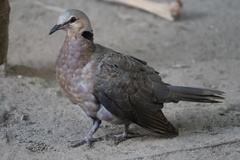
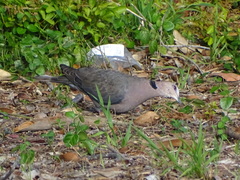
Red-eyed Dove
Streptopelia semitorquata
Silhouette: Andy Wilson · PhyloPic
- KingdomAnimalia (Animals)
- PhylumChordata (Chordates)
- ClassAves (Birds)
- OrderColumbiformes (Pigeons and Doves)
- FamilyColumbidae (Pigeons and Doves)
- GenusStreptopelia (Turtle-Doves and Collared-Doves)
- SpeciesStreptopelia semitorquata (Red-eyed Dove)
In 3 days ~90% in a week >90%
865 Verified sightings at Nairobi National Park From 2019 to 2026
22,026 In all 53 parks
May Best month
☀️ Diurnal When it's spotted
About the Red-eyed Dove
The red-eyed dove (Streptopelia semitorquata) is a dove that is widespread and common in Sub-Saharan Africa. It has been listed as Least Concern on the IUCN Red List since 2004. The red-eyed dove was formally described by the German naturalist Eduard Rüppell in 1835 from birds seen in the Taranta Mountains of Eritrea. He coined the binomial name Columba semitorquata. The specific epithet is combines the Latin semi- meaning "half-" or "small" and torquatus meaning "collared". The species is monotypic, with no subspecies being recognised.
The red-eyed dove's pale bluish grey forehead merges into a darker hue on the crown. The neck, breast, and underparts, are dark mauve-pink to wine-red, upperparts are greyish brown, and primaries are black. Outer wing-coverts are dark slaty blue. Flanks, sides of rump, and underwing-coverts are bluish-grey. Rectrices are dark grey basally, light brownish grey on the terminal half. Neck has a black half-collar. Iris varies from yellowish to orange to red or orange-brown. Orbital skin is purplish red. Bill is black. Legs are purplish red. Most of the feathers have reddish buff or reddish brown edges and indistinct dark... Wikipedia →
Recent sightings of Red-eyed Dove in Nairobi National Park
LIVEiNaturalistGlobal Distribution
Parks Where Found
Cities Where Found
| # | City | Country | Daily sighting probability |
|---|---|---|---|
| 1 | Serrekunda | 🇬🇲 Gambia | |
| 2 | Durban | 🇿🇦 South Africa | |
| 3 | Abidjan | 🇨🇮 Côte d'Ivoire | |
| 4 | Abuja | 🇳🇬 Nigeria | |
| 5 | Lusaka | 🇿🇲 Zambia | |
| 6 | Harare | 🇿🇼 Zimbabwe | |
| 7 | Pretoria | 🇿🇦 South Africa | |
| 8 | Cape Town | 🇿🇦 South Africa | |
| 9 | Yaoundé | 🇨🇲 Cameroon | |
| 10 | Johannesburg | 🇿🇦 South Africa |
Zoos & Centres Where Found
| # | Zoo / Centre | Country | |
|---|---|---|---|
| 1 | Monkeyland | 🇿🇦 South Africa | |
| 2 | World of Birds Wildlife Sanctuary and Monkey Park | 🇿🇦 South Africa | |
| 3 | Birds of Eden | 🇿🇦 South Africa |
Closest Relatives at Nairobi National Park





Before you go
What are the chances of seeing a Red-eyed Dove in Nairobi National Park?
Likely
About 50% of wildlife watchers report a Red-eyed Dove sighting in Nairobi National Park on a given day, based on 865 verified sightings from GBIF citizen-science data from 2019 to 2026. It is the 33rd most-seen of the 371 birds we can rate there. Over three days the chance rises to about 90%, and over a week to over 90%, if each day is a fresh chance.
When is the best time to see a Red-eyed Dove in Nairobi National Park?
April to June
In those months about 60% of wildlife watchers report a Red-eyed Dove in Nairobi National Park on a given day, against about 30% in January and November, the lowest months. Those are among Nairobi National Park's wettest months, with about 100 mm of rain a month against 15 mm in July.
What time of day is best to see a Red-eyed Dove?
Between 6 and 9 am
Across all the parks we cover, that three-hour window holds the most Red-eyed Dove sightings with a recorded time, and nearly all of them come between 6 am and 6 pm: it is a daytime animal.
Is Nairobi National Park the best place to see a Red-eyed Dove?
11th of 53
Of the 53 parks where we can rate Red-eyed Dove sightings, Nairobi National Park ranks 11th at about 50%. The best odds are in Gonarezhou National Park (Zimbabwe, about 60%), Volcanoes National Park (Rwanda, about 60%) and Table Mountain National Park (South Africa, about 60%). All parks ranked.
Which relatives of the Red-eyed Dove live in Nairobi National Park?
Same genus: Streptopelia
The closest relatives of the Red-eyed Dove that you can see in Nairobi National Park (genus Streptopelia, Turtle-Doves and Collared-Doves) are Cape Turtle Dove (about 60%) and Dusky Turtle Dove (about 40%), with each one's daily chance of a sighting.
Where does the Red-eyed Dove sighting chance come from?
GBIF citizen-science records
It is estimated from how often the Red-eyed Dove is recorded against all the birds logged in Nairobi National Park (865 verified sightings from 2019 to 2026), calibrated against known sighting rates. Figures are rounded to the nearest 10% because citizen-science data supports honest approximations, not decimals, and months with records from fewer than five people show "—". How it works.
