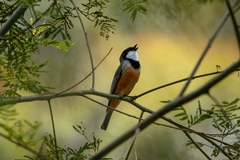
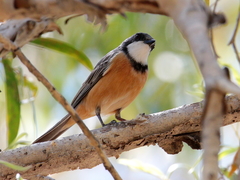
Rufous Whistler

Rufous Whistler

Pachycephala rufiventris

Silhouette: Sheatherius · PhyloPic

LCLeast ConcernNTVUENCR
Daily sighting probability <5% · Rare
at Phillip Island Nature Park

In 3 days <5% in a week ~10%

18 Verified sightings at Phillip Island Nature Park From 2019 to 2026
4,298 In all 20 parks
October Best month
☀️ Diurnal When it's spotted

About the Rufous Whistler

The rufous whistler (Pachycephala rufiventris) is a species of whistler found in New Caledonia and Australia. Predominantly a reddish-brown and grey bird, it makes up for its subdued plumage with its song-making ability. Like many other members of the Pachycephalidae, it has a variety of musical calls.

The rufous whistler was originally described in the genus Sylvia by the English ornithologist John Latham in 1801. It was subsequently classified within the genera Turdus, Laniarius, and Lanius before being classified in its present genus, Pachycephala. Alternate names for the rufous whistler include the rufous-bellied whistler and white-bellied whistler. The latter name should not be confused with the species of the same name, Pachycephala leucogastra. Some authorities have considered the black-headed, drab, and cinnamon-breasted whistlers to be subspecies of the rufous whistler.

Found in northern Australia

Wikipedia →

Sounds

Call0:16

Australia · 2024

© Romuald Mikusek · XC1173775 · CC BY-NC-SA 4.0

Song0:50

Australia · 2025

© Étienne Leroy · XC1069709 · CC BY-NC-SA 4.0

Song and call0:58

Australia · 2025

© Peter Boesman · XC1066809 · CC BY-NC-ND 4.0

Global Distribution

Parks Where Found

# Park Country Daily sighting probability
1 Flinders Ranges National Park 🇦🇺 Australia
~50%
2 Kosciuszko National Park 🇦🇺 Australia
~40%
3 Hattah-Kulkyne National Park 🇦🇺 Australia
~30%
4 Kakadu National Park 🇦🇺 Australia
~30%
5 Pilliga National Park 🇦🇺 Australia
~30%
6 Uluru-Kata Tjuta National Park 🇦🇺 Australia
~30%
7 Grampians National Park 🇦🇺 Australia
~20%
8 Nitmiluk National Park 🇦🇺 Australia
~20%
9 Litchfield National Park 🇦🇺 Australia
~20%
10 Blue Mountains National Park 🇦🇺 Australia
~20%
11 Great Otway National Park 🇦🇺 Australia
~20%
12 Booderee National Park 🇦🇺 Australia
~20%
13 Springbrook National Park 🇦🇺 Australia
~20%
14 Royal National Park 🇦🇺 Australia
~10%
15 Noosa National Park 🇦🇺 Australia
~10%
16 Wilsons Promontory National Park 🇦🇺 Australia
~10%
17 Lamington National Park 🇦🇺 Australia
<5%
18 Rottnest Island 🇦🇺 Australia
<5%
19 Phillip Island Nature Park 🇦🇺 Australia
<5%
20 Daintree National Park 🇦🇺 Australia
<5%

Cities Where Found

# City Country Daily sighting probability
1 Brisbane 🇦🇺 Australia
~20%
2 Perth 🇦🇺 Australia
~20%
3 Melbourne 🇦🇺 Australia
<5%
4 Sydney 🇦🇺 Australia
<5%

Zoos & Centres Where Found

# Zoo / Centre Country
1 Alice Springs Desert Park 🇦🇺 Australia In captivity

Before you go

What are the chances of seeing a Rufous Whistler in Phillip Island Nature Park?

Rare

Under 5% of wildlife watchers report a Rufous Whistler sighting in Phillip Island Nature Park on a given day, based on 18 verified sightings from GBIF citizen-science data from 2019 to 2026. It is the 123rd most-seen of the 149 birds we can rate there. Over three days the chance rises to under 5%, and over a week to about 10%, if each day is a fresh chance.

When is the best time to see a Rufous Whistler in Phillip Island Nature Park?

Any time of year

In every month with enough records, under 5% of wildlife watchers report a Rufous Whistler in Phillip Island Nature Park on a given day, so our monthly data shows no clear season.

What time of day is best to see a Rufous Whistler?

Between 9 am and noon

Across all the parks we cover, that three-hour window holds the most Rufous Whistler sightings with a recorded time, and nearly all of them come between 6 am and 6 pm: it is a daytime animal.

Where does the Rufous Whistler sighting chance come from?

GBIF citizen-science records

It is estimated from how often the Rufous Whistler is recorded against all the birds logged in Phillip Island Nature Park (18 verified sightings from 2019 to 2026), calibrated against known sighting rates. Figures are rounded to the nearest 10% because citizen-science data supports honest approximations, not decimals, and months with records from fewer than five people show "—". How it works.

← Back to Phillip Island Nature Park