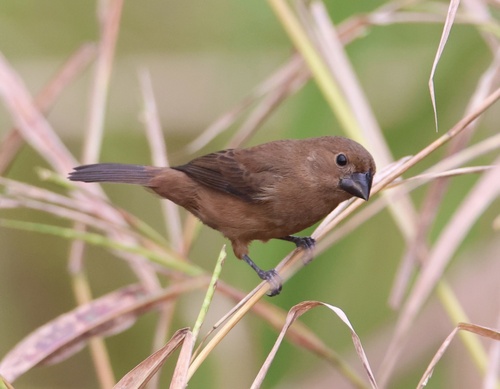
Shining Honeycreeper

Shining Honeycreeper

Cyanerpes lucidus

Silhouette: Sheatherius · PhyloPic

LCLeast ConcernNTVUENCR
Daily sighting probability ~10% · With luck
at San Lorenzo Protected Forest

In 3 days ~30% in a week ~60%

22 Verified sightings at San Lorenzo Protected Forest From 2019 to 2026
7,683 In all 25 parks
November Best month
☀️ Diurnal When it's spotted

About the Shining Honeycreeper

The shining honeycreeper (Cyanerpes lucidus) is a species of bird in the family Thraupidae, the tanagers and allies. It is found in Mexico, every Central American country except El Salvador, and Colombia. The shining honeycreeper was formally described in 1859 with the binomial Coereba lucida, as a member of a genus now occupied solely by the bananaquit (C. flaveola). It now shares genus Cyanerpes with three other species. Some early twentieth century authors considered it and the purple honeycreeper (C. caeruleus) to be conspecific but they are sympatric in Panama and Colombia.

The shining honeycreeper is 10 to 11 cm (3.9 to 4.3 in) long and weighs an average of about 11 g (0.39 oz). It has a slender, decurved, longish bill and a short tail. The species is sexually dimorphic. Adult males of the nominate subspecies are mostly ultramarine blue. They have a lighter, more azure head with a small black mask from the lores to just past the eye, a black throat and upper breast, and black wings and tail. Adult... Wikipedia →

Sounds

Song0:16

Costa Rica · 2019

© Johan Chaves · XC484687 · CC BY-NC-SA 4.0

Call0:21

Costa Rica · 2010

© Scott Olmstead · XC45133 · CC BY-NC-ND 2.5

Call0:12

Panama · 2021

© Daniel Errichetti · XC641735 · CC BY-NC-SA 4.0

Global Distribution

Parks Where Found

# Park Country Daily sighting probability
1 Chagres National Park 🇵🇦 Panama
~50%
2 Bastimentos Island National Marine Park 🇵🇦 Panama
~30%
3 Braulio Carrillo National Park 🇨🇷 Costa Rica
~20%
4 Piedras Blancas National Park 🇨🇷 Costa Rica
~10%
5 Darién National Park 🇵🇦 Panama
~10%
6 San Lorenzo Protected Forest 🇵🇦 Panama
~10%
7 La Amistad International Park (Panama) 🇵🇦 Panama
~10%
8 Tenorio Volcano National Park 🇨🇷 Costa Rica
~10%
9 Pico Bonito National Park 🇭🇳 Honduras
~10%
10 Gandoca-Manzanillo Wildlife Refuge 🇨🇷 Costa Rica
~10%
11 Arenal Volcano National Park 🇨🇷 Costa Rica
~10%
12 Cahuita National Park 🇨🇷 Costa Rica
~10%
13 Corcovado National Park 🇨🇷 Costa Rica
~10%
14 Chirripó National Park 🇨🇷 Costa Rica
~10%
15 Marino Ballena National Park 🇨🇷 Costa Rica
<5%
16 Soberanía National Park 🇵🇦 Panama
<5%
17 Carara National Park 🇨🇷 Costa Rica
<5%
18 Tortuguero National Park 🇨🇷 Costa Rica
<5%
19 Manuel Antonio National Park 🇨🇷 Costa Rica
<5%
20 Cockscomb Basin Wildlife Sanctuary 🇧🇿 Belize
<5%
21 Rincón de la Vieja National Park 🇨🇷 Costa Rica
<5%
22 Poás Volcano National Park 🇨🇷 Costa Rica
<5%
23 Tapantí-Macizo de la Muerte National Park 🇨🇷 Costa Rica
<5%
24 Parque Natural Metropolitano 🇵🇦 Panama
<5%
25 Monteverde Cloud Forest Reserve 🇨🇷 Costa Rica
<5%

Zoos & Centres Where Found

# Zoo / Centre Country
1 Leipzig Zoological Garden 🇩🇪 Germany In captivity
2 Zürich Zoo 🇨🇭 Switzerland In captivity
3 Zoologischer Garten Leipzig 🇩🇪 Germany In captivity

Before you go

What are the chances of seeing a Shining Honeycreeper in San Lorenzo Protected Forest?

With luck

About 10% of wildlife watchers report a Shining Honeycreeper sighting in San Lorenzo Protected Forest on a given day, based on 22 verified sightings from GBIF citizen-science data from 2019 to 2026. It is the 135th most-seen of the 249 birds we can rate there. Over three days the chance rises to about 30%, and over a week to about 60%, if each day is a fresh chance.

When is the best time to see a Shining Honeycreeper in San Lorenzo Protected Forest?

November

In that month about 30% of wildlife watchers report a Shining Honeycreeper in San Lorenzo Protected Forest on a given day, against under 5% in February and December, the lowest months. That is one of San Lorenzo Protected Forest's wettest months, with about 380 mm of rain against 65 mm in February.

What time of day is best to see a Shining Honeycreeper?

Between noon and 3 pm

Across all the parks we cover, that three-hour window holds the most Shining Honeycreeper sightings with a recorded time, and about 9 in 10 of them come between 6 am and 6 pm: it is a daytime animal.

Where does the Shining Honeycreeper sighting chance come from?

GBIF citizen-science records

It is estimated from how often the Shining Honeycreeper is recorded against all the birds logged in San Lorenzo Protected Forest (22 verified sightings from 2019 to 2026), calibrated against known sighting rates. Figures are rounded to the nearest 10% because citizen-science data supports honest approximations, not decimals, and months with records from fewer than five people show "—". How it works.

← Back to San Lorenzo Protected Forest