
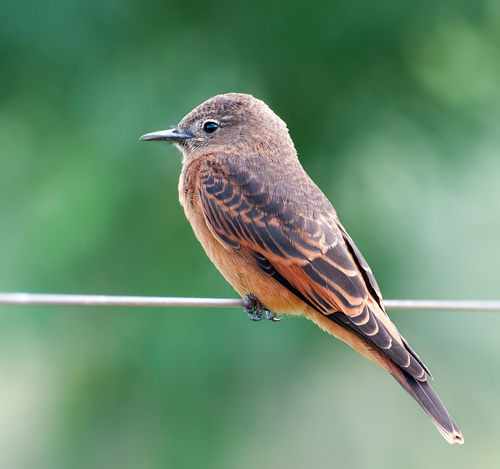
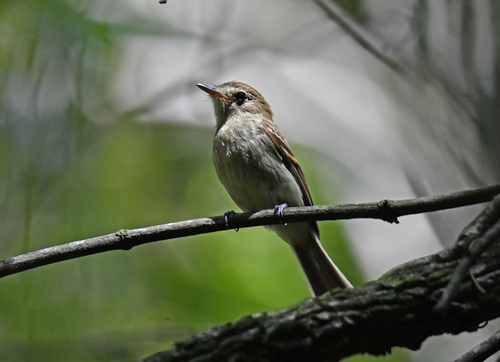
Sulphur-rumped Flycatcher

Sulphur-rumped Flycatcher

Myiobius barbatus

Silhouette: Sheatherius · PhyloPic

LCLeast ConcernNTVUENCR
Daily sighting probability ~20% · Possible
at Serra dos Órgãos National Park

In 3 days ~50% in a week ~80%

142 Verified sightings at Serra dos Órgãos National Park From 2019 to 2026
4,546 In all 27 parks
September Best month
☀️ Diurnal When it's spotted

About the Sulphur-rumped Flycatcher

The whiskered myiobius or bearded flycatcher (Myiobius barbatus) is a species of bird in the family Onychorhynchidae, having previously been included in Tyrannidae and Tityridae. Some taxonomic authorities continue to place them with the flycatchers or tityras. The whiskered myiobius is found in Brazil, Colombia, Ecuador, French Guiana, Guyana, Peru, Suriname, and Venezuela. Its natural habitats are subtropical or tropical moist lowland forests and heavily degraded former forest.

The whiskered myiobius was formally described in 1789 by the German naturalist Johann Friedrich Gmelin in his revised and expanded edition of Carl Linnaeus's Systema Naturae. He placed it with the flycatcher in the genus Muscicapa and coined the binomial name Muscicapa barbata. The specific epithet is from the Latin barbatus meaning "bearded". Gmelin based his description on "Le barbichon de Cayenne" that had been described in 1778 by the French polymath the Comte de Buffon and illustrated with a hand-coloured engraving by François-Nicolas Martinet. The whiskered myiobius is now one of four species placed in the genus Myiobius that was erected in 1839 by George Gray.

Five subspecies are recognised... Wikipedia →

Sounds

Call0:49

Brazil · 2024

© Douglas Meyer · XC890028 · CC BY-NC-SA 4.0

Song?0:11

Peru · 2008

© Peter Boesman · XC225984 · CC BY-NC-ND 4.0

Canto0:20

Brazil · 2018

© Caio Brito · XC556418 · CC BY-NC-SA 4.0

Global Distribution

Parks Where Found

# Park Country Daily sighting probability
1 Serra dos Órgãos National Park 🇧🇷 Brazil
~20%
2 Cockscomb Basin Wildlife Sanctuary 🇧🇿 Belize
~20%
3 Carara National Park 🇨🇷 Costa Rica
~20%
4 Arenal Volcano National Park 🇨🇷 Costa Rica
~10%
5 Corcovado National Park 🇨🇷 Costa Rica
~10%
6 Piedras Blancas National Park 🇨🇷 Costa Rica
~10%
7 Darién National Park 🇵🇦 Panama
~10%
8 Montes Azules Biosphere Reserve 🇲🇽 Mexico
<5%
9 Tikal National Park 🇬🇹 Guatemala
<5%
10 Farallones de Cali National Natural Park 🇨🇴 Colombia
<5%
11 Tapantí-Macizo de la Muerte National Park 🇨🇷 Costa Rica
<5%
12 Tenorio Volcano National Park 🇨🇷 Costa Rica
<5%
13 Machalilla National Park 🇪🇨 Ecuador
<5%
14 Braulio Carrillo National Park 🇨🇷 Costa Rica
<5%
15 Yasuní National Park 🇪🇨 Ecuador
<5%
16 Rincón de la Vieja National Park 🇨🇷 Costa Rica
<5%
17 Itatiaia National Park 🇧🇷 Brazil
<5%
18 Amacayacu National Natural Park 🇨🇴 Colombia
<5%
19 Chirripó National Park 🇨🇷 Costa Rica
<5%
20 Tijuca National Park 🇧🇷 Brazil
<5%
21 La Amistad International Park (Panama) 🇵🇦 Panama
<5%
22 Pico Bonito National Park 🇭🇳 Honduras
<5%
23 Chagres National Park 🇵🇦 Panama
<5%
24 Marino Ballena National Park 🇨🇷 Costa Rica
<5%
25 Soberanía National Park 🇵🇦 Panama
<5%
26 Monteverde Cloud Forest Reserve 🇨🇷 Costa Rica
<5%
27 Parque Natural Metropolitano 🇵🇦 Panama
<5%

Cities Where Found

# City Country Daily sighting probability
1 Rio de Janeiro 🇧🇷 Brazil
<5%
2 Panama City 🇵🇦 Panama
<5%

Before you go

What are the chances of seeing a Sulphur-rumped Flycatcher in Serra dos Órgãos National Park?

Possible

About 20% of wildlife watchers report a Sulphur-rumped Flycatcher sighting in Serra dos Órgãos National Park on a given day, based on 142 verified sightings from GBIF citizen-science data from 2019 to 2026. It is the 101st most-seen of the 336 birds we can rate there. Over three days the chance rises to about 50%, and over a week to about 80%, if each day is a fresh chance.

When is the best time to see a Sulphur-rumped Flycatcher in Serra dos Órgãos National Park?

September

In that month about 40% of wildlife watchers report a Sulphur-rumped Flycatcher in Serra dos Órgãos National Park on a given day, against about 10% in January and March–April, the lowest months.

What time of day is best to see a Sulphur-rumped Flycatcher?

Between 9 am and noon

Across all the parks we cover, that three-hour window holds the most Sulphur-rumped Flycatcher sightings with a recorded time, and about 9 in 10 of them come between 6 am and 6 pm: it is a daytime animal.

Is Serra dos Órgãos National Park the best place to see a Sulphur-rumped Flycatcher?

Yes

Of the 27 parks where we can rate Sulphur-rumped Flycatcher sightings, Serra dos Órgãos National Park has the highest daily chance: about 20%. Next come Cockscomb Basin Wildlife Sanctuary (Belize, about 20%) and Carara National Park (Costa Rica, about 20%).

Where does the Sulphur-rumped Flycatcher sighting chance come from?

GBIF citizen-science records

It is estimated from how often the Sulphur-rumped Flycatcher is recorded against all the birds logged in Serra dos Órgãos National Park (142 verified sightings from 2019 to 2026), calibrated against known sighting rates. Figures are rounded to the nearest 10% because citizen-science data supports honest approximations, not decimals, and months with records from fewer than five people show "—". How it works.

← Back to Serra dos Órgãos National Park