Silvereye

Silvereye

Zosterops lateralis

Silhouette: Ferran Sayol · PhyloPic

LCLeast ConcernNTVUENCR
Daily sighting probability ~30% · Possible
at Springbrook National Park

In 3 days ~60% in a week ~90%

123 Verified sightings at Springbrook National Park From 2019 to 2026
10,682 In all 24 parks
July Best month
☀️ Diurnal When it's spotted

About the Silvereye

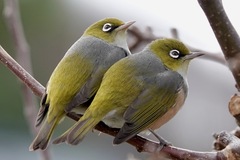
The silvereye or wax-eye (Zosterops lateralis), also known by its Māori name tauhou, is a very small omnivorous passerine bird of the south-west Pacific. In Australia and New Zealand its common name is sometimes white-eye, but this name is more commonly used to refer to all members of the genus Zosterops, or the entire family Zosteropidae.

In New Zealand, the silvereye was first recorded in 1832. It arrived in greater numbers in 1856, and it is assumed that a migrating flock was swept eastwards by a storm. As an apparently self-introduced bird it is protected as a native New Zealand species. Its Māori name, tauhou, means "stranger" or more literally, "new arrival".

The silvereye was first described by the English ornithologist John Latham in 1801 under the binomial name Sylvia lateralis. Wikipedia →

Sounds

Song0:15

Australia · 2023

© Romuald Mikusek · XC1166620 · CC BY-NC-SA 4.0

Call0:38

Australia · 2025

© Marc Anderson · XC1088980 · CC BY-NC-ND 4.0

Flight call1:23

Australia · 2022

© Eddy Smith · XC748850 · CC BY-NC-SA 4.0

Global Distribution

Parks Where Found

# Park Country Daily sighting probability
1 Aoraki Mount Cook National Park 🇳🇿 New Zealand
~80%
2 Egmont National Park 🇳🇿 New Zealand
~70%
3 Flinders Chase 🇦🇺 Australia
~70%
4 Arthur's Pass National Park 🇳🇿 New Zealand
~70%
5 Abel Tasman National Park 🇳🇿 New Zealand
~60%
6 Rottnest Island 🇦🇺 Australia
~60%
7 Great Otway National Park 🇦🇺 Australia
~50%
8 Wilsons Promontory National Park 🇦🇺 Australia
~50%
9 Maria Island National Park 🇦🇺 Australia
~50%
10 Fiordland National Park 🇳🇿 New Zealand
~40%
11 Kosciuszko National Park 🇦🇺 Australia
~40%
12 Freycinet National Park 🇦🇺 Australia
~40%
13 Cradle Mountain-Lake St Clair National Park 🇦🇺 Australia
~30%
14 Booderee National Park 🇦🇺 Australia
~30%
15 Rakiura National Park 🇳🇿 New Zealand
~30%
16 Springbrook National Park 🇦🇺 Australia
~30%
17 Royal National Park 🇦🇺 Australia
~30%
18 Lamington National Park 🇦🇺 Australia
~20%
19 Blue Mountains National Park 🇦🇺 Australia
~20%
20 Grampians National Park 🇦🇺 Australia
~20%
21 Flinders Ranges National Park 🇦🇺 Australia
~20%
22 Noosa National Park 🇦🇺 Australia
~20%
23 Daintree National Park 🇦🇺 Australia
~10%
24 Hattah-Kulkyne National Park 🇦🇺 Australia
<5%

Cities Where Found

# City Country Daily sighting probability
1 Hobart 🇦🇺 Australia
~70%
2 Auckland 🇳🇿 New Zealand
~60%
3 Perth 🇦🇺 Australia
~40%
4 Brisbane 🇦🇺 Australia
~20%
5 Melbourne 🇦🇺 Australia
~20%
6 Sydney 🇦🇺 Australia
~20%

Zoos & Centres Where Found

# Zoo / Centre Country
1 Taronga Zoo 🇦🇺 Australia In captivity
2 Auckland Zoo 🇳🇿 New Zealand In captivity
3 Hong Kong Zoological and Botanical Gardens 🇨🇳 China In captivity
4 Featherdale Sydney Wildlife Park 🇦🇺 Australia In captivity
5 Edward Youde Aviary 🇭🇰 Hong Kong SAR China In captivity

Before you go

What are the chances of seeing a Silvereye in Springbrook National Park?

Possible

About 30% of wildlife watchers report a Silvereye sighting in Springbrook National Park on a given day, based on 123 verified sightings from GBIF citizen-science data from 2019 to 2026. It is the 25th most-seen of the 136 birds we can rate there. Over three days the chance rises to about 60%, and over a week to about 90%, if each day is a fresh chance.

When is the best time to see a Silvereye in Springbrook National Park?

May–July and November

In those months about 40% of wildlife watchers report a Silvereye in Springbrook National Park on a given day, against about 10% in September and December, the lowest months.

What time of day is best to see a Silvereye?

Between 10 am and 1 pm

Across all the parks we cover, that three-hour window holds the most Silvereye sightings with a recorded time, and nearly all of them come between 6 am and 6 pm: it is a daytime animal.

Which relatives of the Silvereye live in Springbrook National Park?

Same order: Passeriformes

The closest relatives of the Silvereye that you can see in Springbrook National Park (order Passeriformes, Perching Birds) are Lewin's Honeyeater (about 80%), Eastern Whipbird (about 80%) and Pied Currawong (about 70%), with each one's daily chance of a sighting.

Where does the Silvereye sighting chance come from?

GBIF citizen-science records

It is estimated from how often the Silvereye is recorded against all the birds logged in Springbrook National Park (123 verified sightings from 2019 to 2026), calibrated against known sighting rates. Figures are rounded to the nearest 10% because citizen-science data supports honest approximations, not decimals, and months with records from fewer than five people show "—". How it works.

← Back to Springbrook National Park