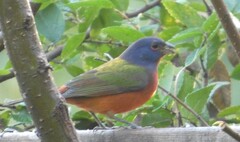
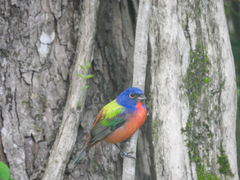
Painted Bunting

Painted Bunting

Passerina ciris

Silhouette: Jonah Duckles · PhyloPic

LCLeast ConcernNTVUENCR
Daily sighting probability <5% · Rare
at Tenorio Volcano National Park

In 3 days <5%

13 Verified sightings at Tenorio Volcano National Park From 2019 to 2026
3,275 In all 36 parks
November Best month
☀️ Diurnal When it's spotted

About the Painted Bunting

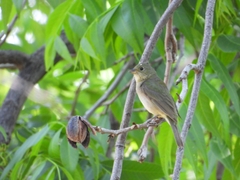
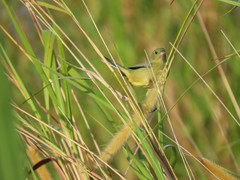
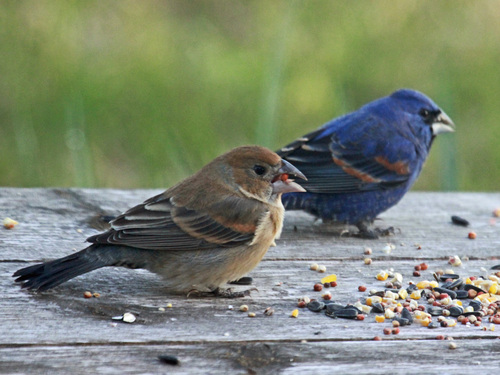
The painted bunting (Passerina ciris) is a species of bird in the cardinal family, Cardinalidae. It is native to North America. The bright plumage of the male develops beginning in the second year of life; in the first year, they can be distinguished from the female only by close inspection.

The painted bunting was formally described in 1758 by the Swedish naturalist Carl Linnaeus in the tenth edition of his Systema Naturae under the binomial name Emberiza ciris. Linnaeus based his account mainly on the "Painted Finch" that had been described and illustrated in 1730 by the English naturalist Mark Catesby in his book The Natural History of Carolina, Florida and the Bahama Islands. Linnaeus specified the type locality as America but this was restricted to the state of South Carolina by the American Ornithologists' Union in 1931. The specific epithet ciris is the Latin name for a mythical bird, from Ancient Greek κειρις/keiris for an unidentified bird. The painted bunting is now one of seven species placed in the genus Passerina that was introduced in 1816 by the French ornithologist Louis Pierre Vieillot.

Two subspecies are recognised: Wikipedia →

Sounds

Song0:42

United States · 2023

© Sue Riffe · XC1087845 · CC BY-NC-SA 4.0

Recording0:39

United States · 2021

© Russ Wigh · XC653211 · CC BY-NC-SA 4.0

Alarm call0:27

Mexico · 2019

© Isain Contreras Rodríguez · XC499367 · CC BY-NC-SA 4.0

Global Distribution

Parks Where Found

# Park Country Daily sighting probability
1 Big Bend National Park 🇺🇸 United States
~20%
2 Arrecifes de Cozumel National Park 🇲🇽 Mexico
~20%
3 El Triunfo 🇲🇽 Mexico
~10%
4 Cerro Azul Meámbar National Park 🇭🇳 Honduras
~10%
5 Santa Rosa National Park 🇨🇷 Costa Rica
~10%
6 Cañón del Sumidero National Park 🇲🇽 Mexico
~10%
7 Las Baulas Marine National Park 🇨🇷 Costa Rica
<5%
8 Lago de Yojoa 🇭🇳 Honduras
<5%
9 Congaree National Park 🇺🇸 United States
<5%
10 Cabo Blanco Absolute Nature Reserve 🇨🇷 Costa Rica
<5%
11 Pico Bonito National Park 🇭🇳 Honduras
<5%
12 Celestún Biosphere Reserve 🇲🇽 Mexico
<5%
13 Carara National Park 🇨🇷 Costa Rica
<5%
14 Ostional Wildlife Refuge 🇨🇷 Costa Rica
<5%
15 Calakmul Biosphere Reserve 🇲🇽 Mexico
<5%
16 Palo Verde National Park 🇨🇷 Costa Rica
<5%
17 Rincón de la Vieja National Park 🇨🇷 Costa Rica
<5%
18 Tikal National Park 🇬🇹 Guatemala
<5%
19 Guadalupe Mountains National Park 🇺🇸 United States
<5%
20 Biotopo Cerro Cahuí 🇬🇹 Guatemala
<5%
21 Everglades National Park 🇺🇸 United States
<5%
22 Cumbres de Monterrey National Park 🇲🇽 Mexico
<5%
23 Masaya Volcano National Park 🇳🇮 Nicaragua
<5%
24 Padre Island National Seashore 🇺🇸 United States
<5%
25 El Vizcaíno Biosphere Reserve 🇲🇽 Mexico
<5%
26 Manuel Antonio National Park 🇨🇷 Costa Rica
<5%
27 Ría Lagartos Biosphere Reserve 🇲🇽 Mexico
<5%
28 Sian Ka'an Biosphere Reserve 🇲🇽 Mexico
<5%
29 Merritt Island National Wildlife Refuge 🇺🇸 United States
<5%
30 La Amistad International Park (Panama) 🇵🇦 Panama
<5%
31 Big Cypress National Preserve 🇺🇸 United States
<5%
32 Soberanía National Park 🇵🇦 Panama
<5%
33 Tenorio Volcano National Park 🇨🇷 Costa Rica
<5%
34 Braulio Carrillo National Park 🇨🇷 Costa Rica
<5%
35 Monteverde Cloud Forest Reserve 🇨🇷 Costa Rica
<5%
36 Arenal Volcano National Park 🇨🇷 Costa Rica
<5%

Cities Where Found

# City Country Daily sighting probability
1 León 🇲🇽 México
~10%
2 San Antonio 🇺🇸 United States
~10%
3 Austin 🇺🇸 United States
~10%
4 Dallas 🇺🇸 United States
<5%
5 Guadalajara 🇲🇽 México
<5%
6 Guatemala City 🇬🇹 Guatemala
<5%
7 San Pedro Sula 🇭🇳 Honduras
<5%
8 Orlando 🇺🇸 United States
<5%
9 San Salvador 🇸🇻 El Salvador
<5%
10 Houston 🇺🇸 United States
<5%

Zoos & Centres Where Found

# Zoo / Centre Country
1 National Zoological Park 🇺🇸 United States In captivity
2 ZooParc de Beauval 🇫🇷 France In captivity
3 Xcaret 🇲🇽 Mexico In captivity
4 Chapultepec Zoo 🇲🇽 Mexico In captivity
5 La Paz Waterfall Gardens 🇨🇷 Costa Rica In captivity
6 Parque museo La Venta 🇲🇽 Mexico In captivity

Before you go

What are the chances of seeing a Painted Bunting in Tenorio Volcano National Park?

Rare

Under 5% of wildlife watchers report a Painted Bunting sighting in Tenorio Volcano National Park on a given day, based on 13 verified sightings from GBIF citizen-science data from 2019 to 2026. It is the 403rd most-seen of the 444 birds we can rate there. Over three days the chance rises to under 5%, if each day is a fresh chance.

When is the best time to see a Painted Bunting in Tenorio Volcano National Park?

Any time of year

In every month with enough records, under 5% of wildlife watchers report a Painted Bunting in Tenorio Volcano National Park on a given day, so our monthly data shows no clear season.

What time of day is best to see a Painted Bunting?

Between 8 and 11 am

Across all the parks we cover, that three-hour window holds the most Painted Bunting sightings with a recorded time, and about 9 in 10 of them come between 6 am and 6 pm: it is a daytime animal.

Is Tenorio Volcano National Park the best place to see a Painted Bunting?

33rd of 36

Of the 36 parks where we can rate Painted Bunting sightings, Tenorio Volcano National Park ranks 33rd at under 5%. The best odds are in Big Bend National Park (United States, about 20%), Arrecifes de Cozumel National Park (Mexico, about 20%) and El Triunfo (Mexico, about 10%).

Where does the Painted Bunting sighting chance come from?

GBIF citizen-science records

It is estimated from how often the Painted Bunting is recorded against all the birds logged in Tenorio Volcano National Park (13 verified sightings from 2019 to 2026), calibrated against known sighting rates. Figures are rounded to the nearest 10% because citizen-science data supports honest approximations, not decimals, and months with records from fewer than five people show "—". How it works.

← Back to Tenorio Volcano National Park