Purple Martin

Purple Martin

Progne subis

Silhouette: Andy Wilson · PhyloPic

LCLeast ConcernNTVUENCR
Daily sighting probability <5% · Rare
at Tikal National Park

In 3 days <5%

12 Verified sightings at Tikal National Park From 2019 to 2026
7,092 In all 37 parks
September Best month
☀️ Diurnal When it's spotted

About the Purple Martin

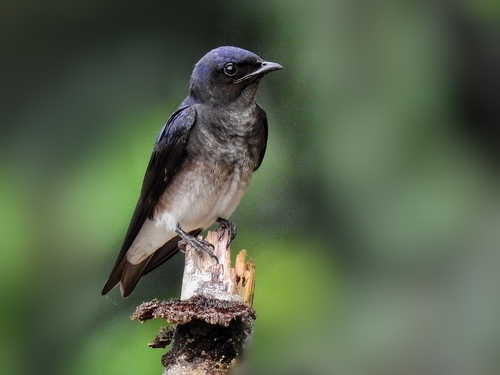
The purple martin (Progne subis) is a passerine bird in the swallow family Hirundinidae. It is the largest swallow in North America. Despite its name, the purple martin is not truly purple. The dark blackish-blue feathers have an iridescent sheen caused by the diffraction of incident light giving them a bright blue to navy blue or deep purple appearance. In some light, they may even appear green in color.

They are migratory, with their breeding range including all of the eastern United States and southeastern Canada, as well as the coastal Pacific Northwest, Baja California, Arizona, and New Mexico. Most make a brief stopover in the Yucatán Peninsula or Cuba during pre-breeding migration to North America and during post-breeding migration before reaching their overwintering site in South America.

They are known for their speed, agility, and their characteristic mix of rapid, flapping, and gliding flight patterns. When approaching their nesting site, they will dive from the sky at great speeds with their wings tucked, just like the peregrine falcon does when hunting smaller birds.

In 1750 the English naturalist George Edwards included an illustration and a description... Wikipedia →

Sounds

Call0:05

United States · 2017

© Pat Goltz · XC1157433 · CC BY-NC-SA 4.0

Song0:21

United States · 2024

© Sue Riffe · XC941309 · CC BY-NC-SA 4.0

Begging call0:14

United States · 2022

© Scott Olmstead · XC776394 · CC BY-NC-SA 4.0

Global Distribution

Parks Where Found

# Park Country Daily sighting probability
1 Isla del Coco National Park 🇨🇷 Costa Rica
~40%
2 Point Pelee National Park 🇨🇦 Canada
~20%
3 Saguaro National Park 🇺🇸 United States
~20%
4 Big Cypress National Preserve 🇺🇸 United States
~10%
5 Sian Ka'an Biosphere Reserve 🇲🇽 Mexico
~10%
6 Celestún Biosphere Reserve 🇲🇽 Mexico
~10%
7 Calakmul Biosphere Reserve 🇲🇽 Mexico
~10%
8 Great Bear Rainforest 🇨🇦 Canada
~10%
9 Gandoca-Manzanillo Wildlife Refuge 🇨🇷 Costa Rica
<5%
10 Everglades National Park 🇺🇸 United States
<5%
11 Padre Island National Seashore 🇺🇸 United States
<5%
12 Redwood National Park 🇺🇸 United States
<5%
13 Elk Island National Park 🇨🇦 Canada
<5%
14 Arrecifes de Cozumel National Park 🇲🇽 Mexico
<5%
15 Cahuita National Park 🇨🇷 Costa Rica
<5%
16 Ría Lagartos Biosphere Reserve 🇲🇽 Mexico
<5%
17 Biotopo Cerro Cahuí 🇬🇹 Guatemala
<5%
18 Bastimentos Island National Marine Park 🇵🇦 Panama
<5%
19 Pacific Rim National Park Reserve 🇨🇦 Canada
<5%
20 El Vizcaíno Biosphere Reserve 🇲🇽 Mexico
<5%
21 Grand Canyon National Park 🇺🇸 United States
<5%
22 Tortuguero National Park 🇨🇷 Costa Rica
<5%
23 Riding Mountain National Park 🇨🇦 Canada
<5%
24 Merritt Island National Wildlife Refuge 🇺🇸 United States
<5%
25 Shenandoah National Park 🇺🇸 United States
<5%
26 Lago de Yojoa 🇭🇳 Honduras
<5%
27 Soberanía National Park 🇵🇦 Panama
<5%
28 Great Smoky Mountains National Park 🇺🇸 United States
<5%
29 La Amistad International Park (Panama) 🇵🇦 Panama
<5%
30 Tikal National Park 🇬🇹 Guatemala
<5%
31 Cerro Azul Meámbar National Park 🇭🇳 Honduras
<5%
32 Congaree National Park 🇺🇸 United States
<5%
33 Chagres National Park 🇵🇦 Panama
<5%
34 Olympic National Park 🇺🇸 United States
<5%
35 Parque Natural Metropolitano 🇵🇦 Panama
<5%
36 Carara National Park 🇨🇷 Costa Rica
<5%
37 Arenal Volcano National Park 🇨🇷 Costa Rica
<5%

Cities Where Found

# City Country Daily sighting probability
1 San Antonio 🇺🇸 United States
~20%
2 Austin 🇺🇸 United States
~20%
3 Houston 🇺🇸 United States
~10%
4 Miami 🇺🇸 United States
~10%
5 Chicago 🇺🇸 United States
~10%
6 Dallas 🇺🇸 United States
~10%
7 Seattle 🇺🇸 United States
~10%
8 Orlando 🇺🇸 United States
<5%
9 Vancouver 🇨🇦 Canada
<5%
10 Toronto 🇨🇦 Canada
<5%

Before you go

What are the chances of seeing a Purple Martin in Tikal National Park?

Rare

Under 5% of wildlife watchers report a Purple Martin sighting in Tikal National Park on a given day, based on 12 verified sightings from GBIF citizen-science data from 2019 to 2026. It is the 257th most-seen of the 300 birds we can rate there. Over three days the chance rises to under 5%, if each day is a fresh chance.

When is the best time to see a Purple Martin in Tikal National Park?

Any time of year

In every month with enough records, under 5% of wildlife watchers report a Purple Martin in Tikal National Park on a given day, so our monthly data shows no clear season.

What time of day is best to see a Purple Martin?

Between 7 and 10 am

Across all the parks we cover, that three-hour window holds the most Purple Martin sightings with a recorded time, and about 9 in 10 of them come between 6 am and 6 pm: it is a daytime animal.

Where does the Purple Martin sighting chance come from?

GBIF citizen-science records

It is estimated from how often the Purple Martin is recorded against all the birds logged in Tikal National Park (12 verified sightings from 2019 to 2026), calibrated against known sighting rates. Figures are rounded to the nearest 10% because citizen-science data supports honest approximations, not decimals, and months with records from fewer than five people show "—". How it works.

← Back to Tikal National Park