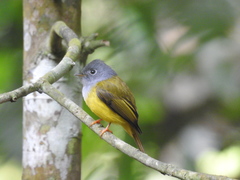
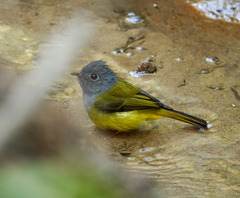
Grey-headed Canary-Flycatcher

Grey-headed Canary-Flycatcher

Culicicapa ceylonensis

Silhouette: Sheatherius · PhyloPic

LCLeast ConcernNTVUENCR
Daily sighting probability ~10% · With luck
at Bandhavgarh National Park

In 3 days ~30% in a week ~50%

202 Verified sightings at Bandhavgarh National Park From 2019 to 2026
10,013 In all 33 parks
January Best month
🌅 Crepuscular When it's spotted

About the Grey-headed Canary-Flycatcher

The grey-headed canary-flycatcher (Culicicapa ceylonensis), sometimes known as the grey-headed flycatcher, is a species of small flycatcher-like bird found in tropical Asia. It has a square crest, a grey hood and yellow underparts. They are found mainly in forested habitats where they often join other birds in mixed-species foraging flocks. Pairs are often seen as they forage for insects by making flycatcher-like sallies and calling aloud. Several subspecies are recognized within their wide distribution range. In the past the genus Culicicapa was considered to be an Old World flycatcher but studies have found them to belong to a new family designated as the Stenostiridae or fairy flycatchers that include the African genera Stenostira and Elminia.

The grey-headed canary-flycatcher is about 12–13 cm (4.7–5.1 in) long with a squarish grey head, a canary yellow belly and yellowish-green upperparts. They forage actively like flycatchers and perches in a very upright posture. The sexes are indistinguishable in plumage. They have a very flat bill (which gave it the earlier genus name of Platyrhynchus) which when seen from above look like an equilateral triangle and is fringed... Wikipedia →

Sounds

Call0:12

China · 2026

© Bo Shunqi 薄顺奇 · XC1173427 · CC BY-NC-SA 4.0

Song0:41

Malaysia · 2026

© Ding Li Yong · XC1153558 · CC BY-NC-ND 4.0

Alarm call0:40

China · 2024

© Xingyu Li 李兴宇 · XC908428 · CC BY-NC-SA 4.0

Global Distribution

Parks Where Found

# Park Country Daily sighting probability
1 Kerinci Seblat National Park 🇮🇩 Indonesia
~70%
2 Cuc Phuong National Park 🇻🇳 Vietnam
~50%
3 Horton Plains National Park 🇱🇰 Sri Lanka
~50%
4 Khao Yai National Park 🇹🇭 Thailand
~40%
5 Namdapha National Park 🇮🇳 India
~40%
6 Eravikulam National Park 🇮🇳 India
~40%
7 Kaeng Krachan National Park 🇹🇭 Thailand
~40%
8 Royal Manas National Park 🇧🇹 Bhutan
~30%
9 Khao Luang National Park 🇹🇭 Thailand
~30%
10 Kaziranga National Park 🇮🇳 India
~20%
11 Langtang National Park 🇳🇵 Nepal
~20%
12 Doi Inthanon National Park 🇹🇭 Thailand
~20%
13 Jim Corbett National Park 🇮🇳 India
~20%
14 Satpura National Park 🇮🇳 India
~20%
15 Royal Bardia National Park 🇳🇵 Nepal
~20%
16 Manas National Park 🇮🇳 India
~20%
17 Chitwan National Park 🇳🇵 Nepal
~20%
18 Keoladeo National Park 🇮🇳 India
~20%
19 Khao Sok National Park 🇹🇭 Thailand
~10%
20 Danum Valley Conservation Area 🇲🇾 Malaysia
~10%
21 Ranthambore National Park 🇮🇳 India
~10%
22 Bandhavgarh National Park 🇮🇳 India
~10%
23 Taman Negara National Park 🇲🇾 Malaysia
~10%
24 Jiuzhaigou National Park 🇨🇳 China
~10%
25 Kanha National Park 🇮🇳 India
~10%
26 Periyar National Park 🇮🇳 India
~10%
27 Gir National Park 🇮🇳 India
<5%
28 Sinharaja Forest Reserve 🇱🇰 Sri Lanka
<5%
29 Cat Tien National Park 🇻🇳 Vietnam
<5%
30 Mudumalai National Park 🇮🇳 India
<5%
31 Gunung Leuser National Park 🇮🇩 Indonesia
<5%
32 Kinabalu Park 🇲🇾 Malaysia
<5%
33 Sepilok 🇲🇾 Malaysia
<5%

Cities Where Found

# City Country Daily sighting probability
1 Kathmandu 🇳🇵 Nepal
~20%
2 Dehradun 🇮🇳 India
~20%
3 Jabalpur 🇮🇳 India
~20%
4 Guiyang 🇨🇳 China
~20%
5 Hanoi 🇻🇳 Vietnam
~10%
6 Guwahati 🇮🇳 India
~10%
7 Kunming 🇨🇳 China
~10%
8 Gwalior 🇮🇳 India
~10%
9 Chongqing 🇨🇳 China
~10%
10 Chandigarh 🇮🇳 India
~10%

Before you go

What are the chances of seeing a Grey-headed Canary-Flycatcher in Bandhavgarh National Park?

With luck

About 10% of wildlife watchers report a Grey-headed Canary-Flycatcher sighting in Bandhavgarh National Park on a given day, based on 202 verified sightings from GBIF citizen-science data from 2019 to 2026. It is the 105th most-seen of the 241 birds we can rate there. Over three days the chance rises to about 30%, and over a week to about 50%, if each day is a fresh chance.

When is the best time to see a Grey-headed Canary-Flycatcher in Bandhavgarh National Park?

January

In that month about 30% of wildlife watchers report a Grey-headed Canary-Flycatcher in Bandhavgarh National Park on a given day, against under 5% in March–July and September–October, the lowest months. That is one of Bandhavgarh National Park's driest months, with about 15 mm of rain against 400 mm in August.

What time of day is best to see a Grey-headed Canary-Flycatcher?

Between 5 and 8 am

Across all the parks we cover, that three-hour window holds the most Grey-headed Canary-Flycatcher sightings with a recorded time, and about 6 in 10 of them come between 6 am and 6 pm: it is most active around dawn and dusk.

Which relatives of the Grey-headed Canary-Flycatcher live in Bandhavgarh National Park?

Same order: Passeriformes

The closest relatives of the Grey-headed Canary-Flycatcher that you can see in Bandhavgarh National Park (order Passeriformes, Perching Birds) are Jungle Babbler (about 70%), Oriental Magpie-Robin (about 70%) and Large-billed Crow (about 70%), with each one's daily chance of a sighting.

Where does the Grey-headed Canary-Flycatcher sighting chance come from?

GBIF citizen-science records

It is estimated from how often the Grey-headed Canary-Flycatcher is recorded against all the birds logged in Bandhavgarh National Park (202 verified sightings from 2019 to 2026), calibrated against known sighting rates. Figures are rounded to the nearest 10% because citizen-science data supports honest approximations, not decimals, and months with records from fewer than five people show "—". How it works.

← Back to Bandhavgarh National Park