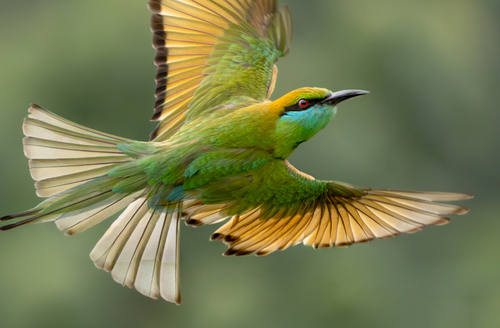
Blue-tailed Bee-eater

Blue-tailed Bee-eater

Merops philippinus

Silhouette: Sheatherius · PhyloPic

LCLeast ConcernNTVUENCR
Daily sighting probability ~30% · Possible
at Bhubaneshwar

In 3 days ~70% in a week ~90%

364 Verified sightings at Bhubaneshwar
5,036 In all 30 parks From 2019 to 2026
January Best month
🌅 Crepuscular When it's spotted

About the Blue-tailed Bee-eater

The blue-tailed bee-eater (Merops philippinus) is a bee-eater species mostly seen in open habitats close to water. It is widely distributed across South and Southeast Asia where many populations are strongly migratory, and seen seasonally in many parts but breeding colonially in small areas across their range, mostly in river valleys, where they nest by tunneling into loamy sand banks.

This species, like other bee-eaters, is a richly coloured, slender bird. It is predominantly green; its face has a narrow blue patch with a black eye stripe, and a yellow and brown throat; the tail is blue and the beak is black. The three outer toes are united around their bases. It is around 29 cm long excluding the elongated central tail feathers, which are an additional 7 cm long, and a weight of around 29–43 grams. Sexes are alike. The juveniles are drabber, and lack the elongated central tail feathers. This species is usually found near water and like other bee-eaters it predominantly eats flying insects, especially bees (as large as the Xylocopa sp.), wasps and hornets, which are caught in the air by sorties from an open perch. They may also forage in flight over estuaries, backwaters... Wikipedia →

Sounds

Call0:26

India · 2025

© Peter Boesman · XC1030641 · CC BY-NC-ND 4.0

Flight call0:18

Singapore · 2021

© Yeo SB · XC702038 · CC BY-NC-SA 4.0

Call0:19

Thailand · 2024

© Greg Irving · XC937372 · CC BY-NC-SA 4.0

Global Distribution

Parks Where Found

# Park Country Daily sighting probability
1 Udawalawe National Park 🇱🇰 Sri Lanka
~60%
2 Yala National Park 🇱🇰 Sri Lanka
~60%
3 Wilpattu National Park 🇱🇰 Sri Lanka
~50%
4 Komodo National Park 🇮🇩 Indonesia
~40%
5 Sinharaja Forest Reserve 🇱🇰 Sri Lanka
~40%
6 Horton Plains National Park 🇱🇰 Sri Lanka
~40%
7 Bali Barat National Park 🇮🇩 Indonesia
~30%
8 Sundarbans National Park 🇮🇳 India
~30%
9 Minneriya National Park 🇱🇰 Sri Lanka
~20%
10 Royal Bardia National Park 🇳🇵 Nepal
~20%
11 Way Kambas National Park 🇮🇩 Indonesia
~10%
12 Kaziranga National Park 🇮🇳 India
~10%
13 Chitwan National Park 🇳🇵 Nepal
~10%
14 Jim Corbett National Park 🇮🇳 India
~10%
15 Nagarhole National Park 🇮🇳 India
~10%
16 Keoladeo National Park 🇮🇳 India
~10%
17 Bandipur National Park 🇮🇳 India
~10%
18 Manas National Park 🇮🇳 India
<5%
19 Kaeng Krachan National Park 🇹🇭 Thailand
<5%
20 Khao Sok National Park 🇹🇭 Thailand
<5%
21 Khao Yai National Park 🇹🇭 Thailand
<5%
22 Khao Luang National Park 🇹🇭 Thailand
<5%
23 Periyar National Park 🇮🇳 India
<5%
24 Ranthambore National Park 🇮🇳 India
<5%
25 Bandhavgarh National Park 🇮🇳 India
<5%
26 Cat Tien National Park 🇻🇳 Vietnam
<5%
27 Satpura National Park 🇮🇳 India
<5%
28 Taman Negara National Park 🇲🇾 Malaysia
<5%
29 Kanha National Park 🇮🇳 India
<5%
30 Doi Inthanon National Park 🇹🇭 Thailand
<5%

Cities Where Found

# City Country Daily sighting probability
1 Phnom Penh 🇰🇭 Cambodia
~40%
2 Ponnani 🇮🇳 India
~40%
3 Kochi 🇮🇳 India
~40%
4 Denpasar 🇮🇩 Indonesia
~40%
5 Chennai 🇮🇳 India
~40%
6 Tiruchirappalli 🇮🇳 India
~40%
7 Colombo [Sri Jayawardenepura Kotte] 🇱🇰 Sri Lanka
~40%
8 Bangkok 🇹🇭 Thailand
~40%
9 Cebu City 🇵🇭 Philippines
~40%
10 Kollam 🇮🇳 India
~40%

Zoos & Centres Where Found

# Zoo / Centre Country
1 Taipei Zoo 🇹🇼 Taiwan In captivity

Before you go

What are the chances of seeing a Blue-tailed Bee-eater in Bhubaneshwar?

Possible

About 30% of wildlife watchers report a Blue-tailed Bee-eater sighting in Bhubaneshwar on a given day, based on 364 verified sightings from GBIF citizen-science data. It is the 30th most-seen of the 148 birds we can rate there. Over three days the chance rises to about 70%, and over a week to about 90%, if each day is a fresh chance.

When is the best time to see a Blue-tailed Bee-eater in Bhubaneshwar?

January–March and August

In those months about 40% of wildlife watchers report a Blue-tailed Bee-eater in Bhubaneshwar on a given day, against about 10% in April, the lowest month.

What time of day is best to see a Blue-tailed Bee-eater?

Between 3 and 6 am

Across all the parks we cover, that three-hour window holds the most Blue-tailed Bee-eater sightings with a recorded time, and about 6 in 10 of them come between 6 am and 6 pm: it is most active around dawn and dusk.

Is Bhubaneshwar the best place to see a Blue-tailed Bee-eater?

16th of 59

Of the 59 cities where we can rate Blue-tailed Bee-eater sightings, Bhubaneshwar ranks 16th at about 30%. The best odds are in Phnom Penh (Cambodia, about 40%), Ponnani (India, about 40%) and Kochi (India, about 40%).

Where does the Blue-tailed Bee-eater sighting chance come from?

GBIF citizen-science records

It is estimated from how often the Blue-tailed Bee-eater is recorded against all the birds logged in Bhubaneshwar (364 verified sightings), calibrated against known sighting rates. Figures are rounded to the nearest 10% because citizen-science data supports honest approximations, not decimals, and months with records from fewer than five people show "—". How it works.

← Back to Bhubaneshwar