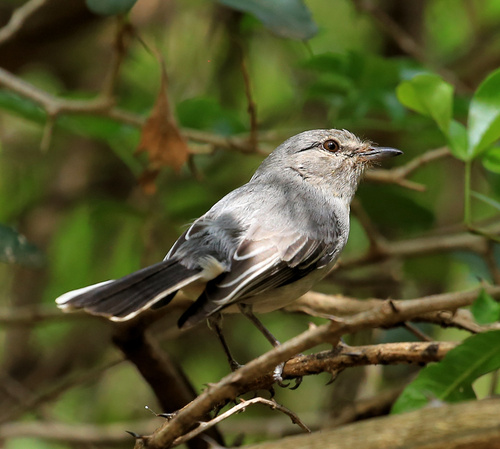
Whinchat

Whinchat

Saxicola rubetra

Silhouette: Caroline Legg · PhyloPic

LCLeast ConcernNTVUENCR
Daily sighting probability <5% · Rare
at Kampala

In 3 days ~10%

39 Verified sightings at Kampala
3,517 In all 43 parks From 2019 to 2026
March Best month
☀️ Diurnal When it's spotted

About the Whinchat

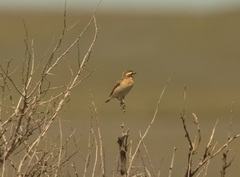
The whinchat (Saxicola rubetra) is a small migratory passerine bird breeding in Europe and western Asia and wintering in central Africa. At one time considered to be in the thrush family, Turdidae, it is now placed in the Old World flycatcher family, Muscicapidae. Both sexes have a strong supercilium, brownish upper parts mottled darker, a pale throat and breast, a pale buff to whitish belly, and a blackish tail with white bases to the outer tail feathers, but in the breeding season, the male has an orange-buff throat and breast.

The whinchat is a solitary species, favouring open grassy country with rough vegetation and scattered small shrubs. It perches in elevated locations ready to pounce on the insects and other small invertebrates that form its diet. The nest is built by the female on the ground in coarse vegetation, with a clutch of four to seven eggs being laid. The hen incubates the eggs for about thirteen days and then both parents feed the nestlings. Fledging takes place about eighteen days after hatching and the parents continue to feed the young for another fortnight. Moulting takes place in late summer before the migration southwards, and again on the wintering grounds in Africa before the migration northwards in spring. The whinchat is a common species with a wide range and the International Union for Conservation of Nature has classified it as being of "least concern". Wikipedia →

Sounds

Song0:59

Sweden · 2026

© Lars Edenius · XC1146804 · CC BY-NC-SA 4.0

Aberrant1:27

Poland · 2024

© Romuald Mikusek · XC930410 · CC BY-NC-SA 4.0

Call0:38

Belgium · 2021

© Hans Matheve · XC732132 · CC BY-NC-ND 4.0

Global Distribution

Parks Where Found

# Park Country Daily sighting probability
1 Mercantour National Park 🇫🇷 France
~40%
2 Vanoise National Park 🇫🇷 France
~40%
3 Kidepo Valley National Park 🇺🇬 Uganda
~30%
4 Biebrza National Park 🇵🇱 Poland
~30%
5 Ecrins National Park 🇫🇷 France
~30%
6 Białowieża National Park 🇵🇱 Poland
~20%
7 Kiskunság National Park 🇭🇺 Hungary
~20%
8 Murchison Falls National Park 🇺🇬 Uganda
~20%
9 Arusha National Park 🇹🇿 Tanzania
~10%
10 Queen Elizabeth National Park 🇺🇬 Uganda
~10%
11 Fertő-Hanság National Park 🇭🇺 Hungary
~10%
12 Hortobágy National Park 🇭🇺 Hungary
~10%
13 Nairobi National Park 🇰🇪 Kenya
~10%
14 Lake Nakuru National Park 🇰🇪 Kenya
~10%
15 Awash National Park 🇪🇹 Ethiopia
~10%
16 Aigüestortes National Park 🇪🇸 Spain
~10%
17 Plitvice Lakes National Park 🇭🇷 Croatia
<5%
18 Pyrénées National Park 🇫🇷 France
<5%
19 Akagera National Park 🇷🇼 Rwanda
<5%
20 Serengeti National Park 🇹🇿 Tanzania
<5%
21 Ordesa y Monte Perdido National Park 🇪🇸 Spain
<5%
22 Lake Mburo National Park 🇺🇬 Uganda
<5%
23 Masai Mara National Reserve 🇰🇪 Kenya
<5%
24 Bavarian Forest National Park 🇩🇪 Germany
<5%
25 Ngorongoro Conservation Area 🇹🇿 Tanzania
<5%
26 Sierra de Guadarrama National Park 🇪🇸 Spain
<5%
27 Doñana National Park 🇪🇸 Spain
<5%
28 Cairngorms National Park 🇬🇧 United Kingdom
<5%
29 Camargue 🇫🇷 France
<5%
30 Semuliki National Park 🇺🇬 Uganda
<5%
31 Wadden Sea National Park 🇩🇪 Germany
<5%
32 Sierra Nevada National Park 🇪🇸 Spain
<5%
33 Triglav National Park 🇸🇮 Slovenia
<5%
34 Virunga National Park 🇨🇩 Democratic Republic of the Congo
<5%
35 Gauja National Park 🇱🇻 Latvia
<5%
36 Picos de Europa National Park 🇪🇸 Spain
<5%
37 Aberdare National Park 🇰🇪 Kenya
<5%
38 Snowdonia National Park 🇬🇧 United Kingdom
<5%
39 Monfragüe National Park 🇪🇸 Spain
<5%
40 Tarangire National Park 🇹🇿 Tanzania
<5%
41 iSimangaliso Wetland Park 🇿🇦 South Africa
<5%
42 Amboseli National Park 🇰🇪 Kenya
<5%
43 Kibale National Park 🇺🇬 Uganda
<5%

Cities Where Found

# City Country Daily sighting probability
1 Sincan 🇹🇷 Turkey
~10%
2 Bucharest 🇷🇴 Romania
~10%
3 Riyadh 🇸🇦 Saudi Arabia
~10%
4 Yekaterinburg 🇷🇺 Russia
~10%
5 Istanbul 🇹🇷 Turkey
~10%
6 Manama 🇧🇭 Bahrain
<5%
7 Tel Aviv 🇮🇱 Israel
<5%
8 Saint Petersburg 🇷🇺 Russia
<5%
9 Ramallah 🇵🇸 Palestine
<5%
10 Beirut 🇱🇧 Lebanon
<5%

Before you go

What are the chances of seeing a Whinchat in Kampala?

Rare

Under 5% of wildlife watchers report a Whinchat sighting in Kampala on a given day, based on 39 verified sightings from GBIF citizen-science data. It is the 176th most-seen of the 332 birds we can rate there. Over three days the chance rises to about 10%, if each day is a fresh chance.

When is the best time to see a Whinchat in Kampala?

March and October

In those months about 10% of wildlife watchers report a Whinchat in Kampala on a given day, against under 5% in April–September and November–February, the lowest months.

What time of day is best to see a Whinchat?

Between 2 and 5 pm

Across all the parks we cover, that three-hour window holds the most Whinchat sightings with a recorded time, and about 9 in 10 of them come between 6 am and 6 pm: it is a daytime animal.

Is Kampala the best place to see a Whinchat?

19th of 39

Of the 39 cities where we can rate Whinchat sightings, Kampala ranks 19th at under 5%. The best odds are in Sincan (Turkey, about 10%), Bucharest (Romania, about 10%) and Riyadh (Saudi Arabia, about 10%).

Where does the Whinchat sighting chance come from?

GBIF citizen-science records

It is estimated from how often the Whinchat is recorded against all the birds logged in Kampala (39 verified sightings), calibrated against known sighting rates. Figures are rounded to the nearest 10% because citizen-science data supports honest approximations, not decimals, and months with records from fewer than five people show "—". How it works.

← Back to Kampala