Indian Paradise-Flycatcher

Indian Paradise-Flycatcher

Terpsiphone paradisi

Silhouette: PhyloPic

LCLeast ConcernNTVUENCR
Daily sighting probability ~20% · Possible
at Surat

In 3 days ~60% in a week ~90%

39 Verified sightings at Surat
7,471 In all 38 parks From 2019 to 2026
December Best month
☀️ Diurnal When it's spotted

About the Indian Paradise-Flycatcher

The Indian paradise flycatcher (Terpsiphone paradisi) is a medium-sized passerine bird in the monarch flycatcher family, Monarchidae. As the global population is considered stable, it has been listed as Least Concern on the IUCN Red List since 2004. It is native to the Indian subcontinent, with resident and breeding populations in most of Bangladesh, India and Sri Lanka, as well as parts of Afghanistan, Bhutan, China, Myanmar, Nepal, Pakistan, Tajikistan and Turkmenistan.

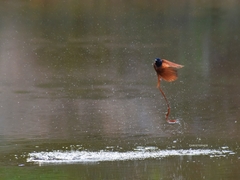
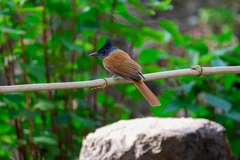
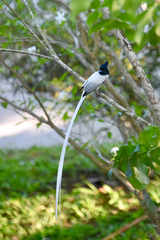
The Indian paradise flycatcher has a length of 20–50 cm (7.9–19.7 in) from beak to tail. Males have elongated central tail feathers, and a black and rufous plumage in some populations, while others have white plumage. Females are short-tailed with rufous wings and a black head. Indian paradise flycatchers feed on insects, including grasshoppers, butterflies and praying mantises, as well as flies. The Indian paradise flycatcher typically captures prey in the air, kills it by hitting it on a rock, and then extracts the inner parts. often below a densely canopied tree.

The Indian paradise flycatcher was formally described in 1758 by the Swedish naturalist Carl Linnaeus in the tenth edition of his Systema... Wikipedia →

Sounds

Uncertain0:55

India · 2025

© Darshan Dudhane · XC1017257 · CC BY-NC-SA 4.0

Alarm call0:31

India · 2021

© [email protected] · XC825018 · CC BY-NC-ND 4.0

Begging call1:12

Tajikistan · 2022

© Ding Li Yong · XC744148 · CC BY-NC-ND 4.0

Global Distribution

Parks Where Found

# Park Country Daily sighting probability
1 Wilpattu National Park 🇱🇰 Sri Lanka
~60%
2 Yala National Park 🇱🇰 Sri Lanka
~50%
3 Udawalawe National Park 🇱🇰 Sri Lanka
~50%
4 Gir National Park 🇮🇳 India
~40%
5 Sinharaja Forest Reserve 🇱🇰 Sri Lanka
~30%
6 Khao Luang National Park 🇹🇭 Thailand
~30%
7 Minneriya National Park 🇱🇰 Sri Lanka
~30%
8 Bandhavgarh National Park 🇮🇳 India
~30%
9 Danum Valley Conservation Area 🇲🇾 Malaysia
~30%
10 Jim Corbett National Park 🇮🇳 India
~20%
11 Taman Negara National Park 🇲🇾 Malaysia
~20%
12 Mudumalai National Park 🇮🇳 India
~20%
13 Periyar National Park 🇮🇳 India
~20%
14 Nagarhole National Park 🇮🇳 India
~20%
15 Khao Sok National Park 🇹🇭 Thailand
~20%
16 Ranthambore National Park 🇮🇳 India
~20%
17 Royal Bardia National Park 🇳🇵 Nepal
~20%
18 Bandipur National Park 🇮🇳 India
~10%
19 Gunung Leuser National Park 🇮🇩 Indonesia
~10%
20 Satpura National Park 🇮🇳 India
~10%
21 Tanjung Puting National Park 🇮🇩 Indonesia
~10%
22 Kaeng Krachan National Park 🇹🇭 Thailand
~10%
23 Manas National Park 🇮🇳 India
~10%
24 Way Kambas National Park 🇮🇩 Indonesia
~10%
25 Chitwan National Park 🇳🇵 Nepal
~10%
26 Cat Tien National Park 🇻🇳 Vietnam
~10%
27 Kanha National Park 🇮🇳 India
~10%
28 Sundarbans National Park 🇮🇳 India
~10%
29 Khao Yai National Park 🇹🇭 Thailand
<5%
30 Doi Inthanon National Park 🇹🇭 Thailand
<5%
31 Keoladeo National Park 🇮🇳 India
<5%
32 Cuc Phuong National Park 🇻🇳 Vietnam
<5%
33 Eravikulam National Park 🇮🇳 India
<5%
34 Royal Manas National Park 🇧🇹 Bhutan
<5%
35 Namdapha National Park 🇮🇳 India
<5%
36 Kinabatangan Wildlife Sanctuary 🇲🇾 Malaysia
<5%
37 Sepilok 🇲🇾 Malaysia
<5%
38 Kinabalu Park 🇲🇾 Malaysia
<5%

Cities Where Found

# City Country Daily sighting probability
1 Jabalpur 🇮🇳 India
~60%
2 Raipur 🇮🇳 India
~30%
3 Surat 🇮🇳 India
~20%
4 Dushanbe 🇹🇯 Tajikistan
~20%
5 Chhatrapati Sambhajinagar 🇮🇳 India
~20%
6 Thrissur 🇮🇳 India
~20%
7 Colombo [Sri Jayawardenepura Kotte] 🇱🇰 Sri Lanka
~10%
8 Bhopal 🇮🇳 India
~10%
9 Srinagar 🇮🇳 India
~10%
10 Kozhikode 🇮🇳 India
~10%

Before you go

What are the chances of seeing an Indian Paradise-Flycatcher in Surat?

Possible

About 20% of wildlife watchers report an Indian Paradise-Flycatcher sighting in Surat on a given day, based on 39 verified sightings from GBIF citizen-science data. It is the 33rd most-seen of the 114 birds we can rate there. Over three days the chance rises to about 60%, and over a week to about 90%, if each day is a fresh chance.

When is the best time to see an Indian Paradise-Flycatcher in Surat?

December

In that month about 50% of wildlife watchers report an Indian Paradise-Flycatcher in Surat on a given day, against about 10% in May and October, the lowest months. That is one of Surat's driest months, with almost no rain against 450 mm in July.

What time of day is best to see an Indian Paradise-Flycatcher?

Between 7 and 10 am

Across all the parks we cover, that three-hour window holds the most Indian Paradise-Flycatcher sightings with a recorded time, and about 9 in 10 of them come between 6 am and 6 pm: it is a daytime animal.

Is Surat the best place to see an Indian Paradise-Flycatcher?

3rd of 69

Of the 69 cities where we can rate Indian Paradise-Flycatcher sightings, Surat ranks 3rd at about 20%. The best odds are in Jabalpur (India, about 60%) and Raipur (India, about 30%).

Which relatives of the Indian Paradise-Flycatcher live in Surat?

Same order: Passeriformes

The closest relatives of the Indian Paradise-Flycatcher that you can see in Surat (order Passeriformes, Perching Birds) are Red-whiskered Bulbul (about 70%), House Crow (about 60%) and Black Drongo (about 60%), with each one's daily chance of a sighting.

Where does the Indian Paradise-Flycatcher sighting chance come from?

GBIF citizen-science records

It is estimated from how often the Indian Paradise-Flycatcher is recorded against all the birds logged in Surat (39 verified sightings), calibrated against known sighting rates. Figures are rounded to the nearest 10% because citizen-science data supports honest approximations, not decimals, and months with records from fewer than five people show "—". How it works.

← Back to Surat