Bar-tailed Godwit

Bar-tailed Godwit

Limosa lapponica

Silhouette: Alexandre Vong · PhyloPic

LCNTNear ThreatenedVUENCR
Daily sighting probability ~10% · With luck
at Djoudj National Bird Sanctuary

In 3 days ~20% in a week ~40%

10 Verified sightings at Djoudj National Bird Sanctuary From 2019 to 2026
3,758 In all 24 parks
February Best month
☀️ Diurnal When it's spotted

About the Bar-tailed Godwit

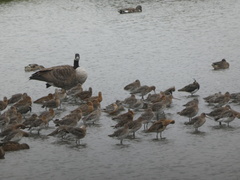
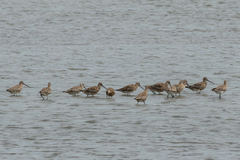
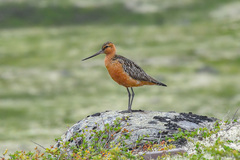
The bar-tailed godwit (Limosa lapponica) is a large and strongly migratory wader in the family Scolopacidae, which feeds on bristle-worms and shellfish on coastal mudflats and estuaries. It has distinctive red breeding plumage, long legs, and a long upturned bill. Bar-tailed godwits breed on Arctic coasts and tundra from Scandinavia to Alaska, and overwinter on coasts in temperate and tropical regions of Australia and New Zealand. The migration of the subspecies Limosa lapponica baueri across the Pacific Ocean from Alaska to New Zealand is the longest known non-stop flight of any bird, and also the longest journey without pausing to feed by any animal. The round-trip migration for this subspecies is over 29,000 km (18,020 mi).

The bar-tailed godwit was formally described by the Swedish naturalist Carl Linnaeus in 1758 in the tenth edition of his Systema Naturae under the binomial name Scolopax limosa. It is now placed with three other godwits in the genus Limosa that was introduced by the French zoologist Mathurin Jacques Brisson in 1760. The genus name Limosa is from Latin and means "muddy", from limus, "mud", referring to its preferred habitat. The specific name lapponica...

Wikipedia →

Sounds

Call0:37

Norway · 2026

© bert de bruin · XC1182319 · CC BY-NC-SA 4.0

Song0:51

Sweden · 2025

© Dag Österlund · XC1005464 · CC BY-NC-SA 4.0

Nocturnal flight call0:15

Spain · 2024

© Marcos Prada Arias · XC930213 · CC BY-NC-SA 4.0

Global Distribution

Parks Where Found

# Park Country Daily sighting probability
1 West Coast National Park 🇿🇦 South Africa
~40%
2 Wadden Sea National Park 🇩🇪 Germany
~30%
3 Cape Range 🇦🇺 Australia
~20%
4 Oosterschelde National Park 🇳🇱 Netherlands
~20%
5 Phillip Island Nature Park 🇦🇺 Australia
~10%
6 Abel Tasman National Park 🇳🇿 New Zealand
~10%
7 Noosa National Park 🇦🇺 Australia
~10%
8 Djoudj National Bird Sanctuary 🇸🇳 Senegal
~10%
9 Rottnest Island 🇦🇺 Australia
~10%
10 Snowdonia National Park 🇬🇧 United Kingdom
<5%
11 Doñana National Park 🇪🇸 Spain
<5%
12 iSimangaliso Wetland Park 🇿🇦 South Africa
<5%
13 Royal National Park 🇦🇺 Australia
<5%
14 Garden Route National Park 🇿🇦 South Africa
<5%
15 Camargue 🇫🇷 France
<5%
16 Wilsons Promontory National Park 🇦🇺 Australia
<5%
17 Hortobágy National Park 🇭🇺 Hungary
<5%
18 Paracas National Reserve 🇵🇪 Peru
<5%
19 Wilpattu National Park 🇱🇰 Sri Lanka
<5%
20 Yala National Park 🇱🇰 Sri Lanka
<5%
21 Rakiura National Park 🇳🇿 New Zealand
<5%
22 Białowieża National Park 🇵🇱 Poland
<5%
23 Bali Barat National Park 🇮🇩 Indonesia
<5%
24 Table Mountain National Park 🇿🇦 South Africa
<5%

Cities Where Found

# City Country Daily sighting probability
1 Liverpool 🇬🇧 United Kingdom
~40%
2 Auckland 🇳🇿 New Zealand
~20%
3 Dammam 🇸🇦 Saudi Arabia
~10%
4 Kuwait City 🇰🇼 Kuwait
~10%
5 Manama 🇧🇭 Bahrain
~10%
6 Dublin 🇮🇪 Ireland
~10%
7 Dakar 🇸🇳 Senegal
~10%
8 Maputo 🇲🇿 Mozambique
~10%
9 Karachi 🇵🇰 Pakistan
<5%
10 Sydney 🇦🇺 Australia
<5%

Zoos & Centres Where Found

# Zoo / Centre Country
1 Ōtorohanga Kiwi House 🇳🇿 New Zealand In captivity

Before you go

What are the chances of seeing a Bar-tailed Godwit in Djoudj National Bird Sanctuary?

With luck

About 10% of wildlife watchers report a Bar-tailed Godwit sighting in Djoudj National Bird Sanctuary on a given day, based on 10 verified sightings from GBIF citizen-science data from 2019 to 2026. It is the 146th most-seen of the 173 birds we can rate there. Over three days the chance rises to about 20%, and over a week to about 40%, if each day is a fresh chance.

When is the best time to see a Bar-tailed Godwit in Djoudj National Bird Sanctuary?

December to February

In those months about 10% of wildlife watchers report a Bar-tailed Godwit in Djoudj National Bird Sanctuary on a given day, against under 5% in March–April and November, the lowest months. Those are among Djoudj National Bird Sanctuary's driest months, with almost no rain against 55 mm in August. May to October have too few records to rate.

What time of day is best to see a Bar-tailed Godwit?

Between 9 am and noon

Across all the parks we cover, that three-hour window holds the most Bar-tailed Godwit sightings with a recorded time, and about 8 in 10 of them come between 6 am and 6 pm: it is a daytime animal.

Is Djoudj National Bird Sanctuary the best place to see a Bar-tailed Godwit?

8th of 24

Of the 24 parks where we can rate Bar-tailed Godwit sightings, Djoudj National Bird Sanctuary ranks 8th at about 10%. The best odds are in West Coast National Park (South Africa, about 40%), Wadden Sea National Park (Germany, about 30%) and Cape Range (Australia, about 20%).

Where does the Bar-tailed Godwit sighting chance come from?

GBIF citizen-science records

It is estimated from how often the Bar-tailed Godwit is recorded against all the birds logged in Djoudj National Bird Sanctuary (10 verified sightings from 2019 to 2026), calibrated against known sighting rates. Figures are rounded to the nearest 10% because citizen-science data supports honest approximations, not decimals, and months with records from fewer than five people show "—". How it works.

← Back to Djoudj National Bird Sanctuary