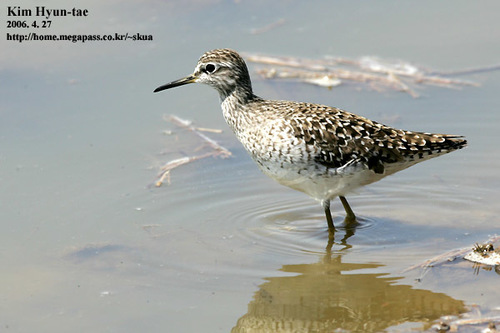
Marsh Sandpiper

Marsh Sandpiper

Tringa stagnatilis

Silhouette: Andy Wilson · PhyloPic

LCLeast ConcernNTVUENCR
Daily sighting probability ~10% · With luck
at Keoladeo National Park

In 3 days ~40% in a week ~70%

319 Verified sightings at Keoladeo National Park From 2019 to 2026
4,070 In all 51 parks
February Best month
☀️ Diurnal When it's spotted

About the Marsh Sandpiper

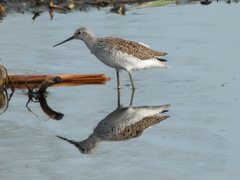
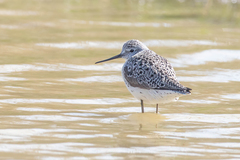
The marsh sandpiper (Tringa stagnatilis) is a small wader. It is a rather small shank, and breeds in open grassy steppe and taiga wetlands from easternmost Europe to the Russian Far East. The genus name Tringa is the Neo-Latin name given to the green sandpiper by Aldrovandus in 1599 based on Ancient Greek trungas, a thrush-sized, white-rumped, tail-bobbing wading bird mentioned by Aristotle. The specific stagnatilis is from Latin stagnum, "swamp".

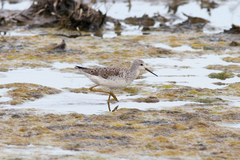
The marsh sandpiper resembles a small elegant greenshank, with a long fine bill and very long yellowish legs. Like the greenshank, it is greyish brown in breeding plumage, paler in winter, and has a white wedge up its back that is visible in flight. However, it is more closely related to the common redshank and the wood sandpiper. Together, they form a group of smallish shanks which tend to have red or reddish legs, and in breeding plumage are generally a subdued, light brown above with some darker mottling, with a pattern of somewhat diffuse small brownish spots on the breast and neck. The length is 22–26 cm (8.7–10.2 in), wingspan is 55–59 cm (22–23 in) and weight is 45–120 g (1.6–4.2 oz).

The marsh sandpiper... Wikipedia →

Sounds

Call0:06

China · 2026

© Peter Boesman · XC1147839 · CC BY-NC-ND 4.0

Song0:27

Sweden · 2019

© Lars Edenius · XC915491 · CC BY-NC-SA 4.0

Alarm call0:22

Russian Federation · 2023

© Mikhail Nevsky · XC805107 · CC BY-NC-SA 4.0

Global Distribution

Parks Where Found

# Park Country Daily sighting probability
1 Yala National Park 🇱🇰 Sri Lanka
~30%
2 Lake Nakuru National Park 🇰🇪 Kenya
~20%
3 Amboseli National Park 🇰🇪 Kenya
~20%
4 Wilpattu National Park 🇱🇰 Sri Lanka
~20%
5 West Coast National Park 🇿🇦 South Africa
~20%
6 Ngorongoro Conservation Area 🇹🇿 Tanzania
~20%
7 Keoladeo National Park 🇮🇳 India
~10%
8 Arusha National Park 🇹🇿 Tanzania
~10%
9 Serengeti National Park 🇹🇿 Tanzania
~10%
10 Tarangire National Park 🇹🇿 Tanzania
~10%
11 Lake Manyara National Park 🇹🇿 Tanzania
~10%
12 Udawalawe National Park 🇱🇰 Sri Lanka
~10%
13 Ranthambore National Park 🇮🇳 India
~10%
14 Queen Elizabeth National Park 🇺🇬 Uganda
~10%
15 Moremi Game Reserve 🇧🇼 Botswana
~10%
16 Nairobi National Park 🇰🇪 Kenya
~10%
17 Gonarezhou National Park 🇿🇼 Zimbabwe
~10%
18 Kaziranga National Park 🇮🇳 India
~10%
19 South Luangwa National Park 🇿🇲 Zambia
~10%
20 Bali Barat National Park 🇮🇩 Indonesia
~10%
21 Lower Zambezi National Park 🇿🇲 Zambia
~10%
22 Mana Pools National Park 🇿🇼 Zimbabwe
~10%
23 Liwonde National Park 🇲🇼 Malawi
<5%
24 Murchison Falls National Park 🇺🇬 Uganda
<5%
25 Kafue National Park 🇿🇲 Zambia
<5%
26 Etosha National Park 🇳🇦 Namibia
<5%
27 Mikumi National Park 🇹🇿 Tanzania
<5%
28 Tsavo East National Park 🇰🇪 Kenya
<5%
29 iSimangaliso Wetland Park 🇿🇦 South Africa
<5%
30 Kiskunság National Park 🇭🇺 Hungary
<5%
31 Chobe National Park 🇧🇼 Botswana
<5%
32 Semuliki National Park 🇺🇬 Uganda
<5%
33 Kruger National Park 🇿🇦 South Africa
<5%
34 Akagera National Park 🇷🇼 Rwanda
<5%
35 Hwange National Park 🇿🇼 Zimbabwe
<5%
36 Tsavo West National Park 🇰🇪 Kenya
<5%
37 Garden Route National Park 🇿🇦 South Africa
<5%
38 Kakadu National Park 🇦🇺 Australia
<5%
39 Camargue 🇫🇷 France
<5%
40 Satpura National Park 🇮🇳 India
<5%
41 Hortobágy National Park 🇭🇺 Hungary
<5%
42 Fertő-Hanság National Park 🇭🇺 Hungary
<5%
43 Masai Mara National Reserve 🇰🇪 Kenya
<5%
44 Lake Mburo National Park 🇺🇬 Uganda
<5%
45 Bandhavgarh National Park 🇮🇳 India
<5%
46 Nagarhole National Park 🇮🇳 India
<5%
47 Samburu National Reserve 🇰🇪 Kenya
<5%
48 Kanha National Park 🇮🇳 India
<5%
49 Jim Corbett National Park 🇮🇳 India
<5%
50 Bandipur National Park 🇮🇳 India
<5%
51 Wadden Sea National Park 🇩🇪 Germany
<5%

Cities Where Found

# City Country Daily sighting probability
1 Quanzhou 🇨🇳 China
~30%
2 Karachi 🇵🇰 Pakistan
~30%
3 Zanzibar City 🇹🇿 Tanzania
~20%
4 Kuwait City 🇰🇼 Kuwait
~20%
5 Agra 🇮🇳 India
~20%
6 Dar es-Salaam 🇹🇿 Tanzania
~20%
7 Tuen Mun 🇨🇳 China
~10%
8 Vasai-Virar 🇮🇳 India
~10%
9 Mumbai 🇮🇳 India
~10%
10 Prayagraj 🇮🇳 India
~10%

Before you go

What are the chances of seeing a Marsh Sandpiper in Keoladeo National Park?

With luck

About 10% of wildlife watchers report a Marsh Sandpiper sighting in Keoladeo National Park on a given day, based on 319 verified sightings from GBIF citizen-science data from 2019 to 2026. It is the 129th most-seen of the 278 birds we can rate there. Over three days the chance rises to about 40%, and over a week to about 70%, if each day is a fresh chance.

When is the best time to see a Marsh Sandpiper in Keoladeo National Park?

January to March

In those months about 20% of wildlife watchers report a Marsh Sandpiper in Keoladeo National Park on a given day, against under 5% in May–June and August–September, the lowest months. Those are among Keoladeo National Park's driest months, with about 20 mm of rain a month against 240 mm in July.

What time of day is best to see a Marsh Sandpiper?

Between 10 am and 1 pm

Across all the parks we cover, that three-hour window holds the most Marsh Sandpiper sightings with a recorded time, and about 9 in 10 of them come between 6 am and 6 pm: it is a daytime animal.

Is Keoladeo National Park the best place to see a Marsh Sandpiper?

7th of 51

Of the 51 parks where we can rate Marsh Sandpiper sightings, Keoladeo National Park ranks 7th at about 10%. The best odds are in Yala National Park (Sri Lanka, about 30%), Lake Nakuru National Park (Kenya, about 20%) and Amboseli National Park (Kenya, about 20%).

Which relatives of the Marsh Sandpiper live in Keoladeo National Park?

Same genus: Tringa

The closest relatives of the Marsh Sandpiper that you can see in Keoladeo National Park (genus Tringa, Shanks, Tattlers, and Allies) are Wood Sandpiper (about 50%), Green Sandpiper (about 40%) and Common Greenshank (about 30%), with each one's daily chance of a sighting.

Where does the Marsh Sandpiper sighting chance come from?

GBIF citizen-science records

It is estimated from how often the Marsh Sandpiper is recorded against all the birds logged in Keoladeo National Park (319 verified sightings from 2019 to 2026), calibrated against known sighting rates. Figures are rounded to the nearest 10% because citizen-science data supports honest approximations, not decimals, and months with records from fewer than five people show "—". How it works.

← Back to Keoladeo National Park