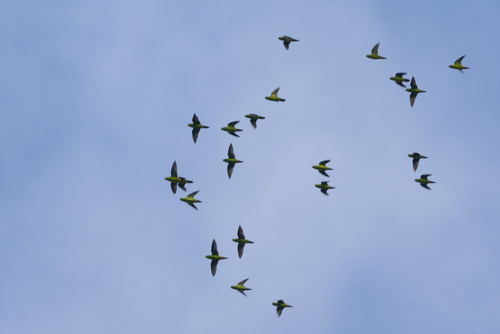
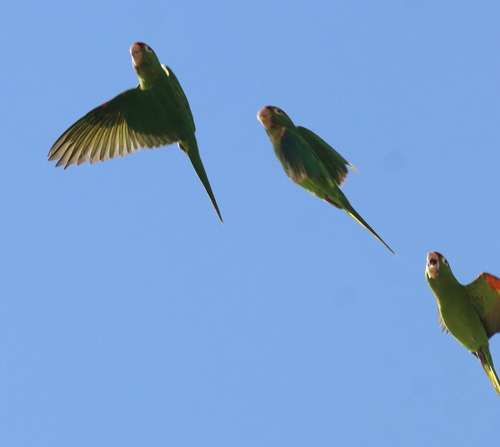
White-crowned Parrot

White-crowned Parrot

Pionus senilis

Silhouette: Sheatherius · PhyloPic

LCLeast ConcernNTVUENCR
Daily sighting probability <5% · Rare
at Los Quetzales National Park

In 3 days <5%

19 Verified sightings at Los Quetzales National Park From 2019 to 2026
11,056 In all 31 parks
September Best month
☀️ Diurnal When it's spotted

About the White-crowned Parrot

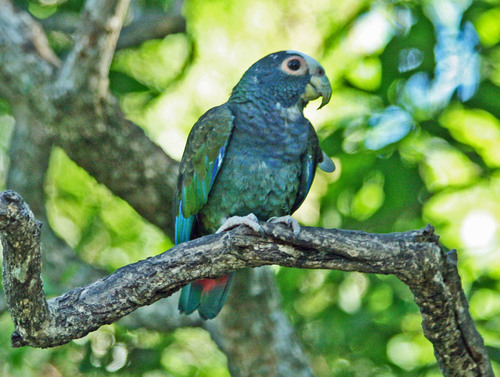
The white-crowned parrot (Pionus senilis), also known as the white-crowned pionus in aviculture, is a small parrot which is a resident breeding species ranging from eastern Mexico to western Panama. It is found in lowlands and foothills locally up to 1600 m altitude in forest canopy and edges, and adjacent semi-open woodland and second growth. The 3 to 6 white eggs are laid in an unlined nest, usually a natural cavity in a tree or a hollow palm stub.

The white-crowned parrot is 24 cm long and weighs 220 g. The adult male has a white forehead and crown, the feature which, likened to an old man's white hair, gave rise to the specific name senilis. The throat is white, and the rest of the head, neck and breast are dull dark blue. The belly is light green, and the upper parts are dark green, with a yellow-olive shoulder patch. In flight, the blue underwings and red vent are conspicuous features. The female white-crowned parrot is similar to the male, but the blue plumage fades into scaling on the lower breast and the shoulder patch is duller. Young birds have little blue on the head and neck or red on the undertail, and the crown feathers are green edged with white. The extent of the area of white on the head gives no indication of sex, as there can be considerable variance in individuals.

The white-crowned parrot feeds in social flocks of 10–50 birds, which may wander outside the breeding range once nesting has finished. It feeds on various seeds, nuts and fruits, and can be a pest in crops of corn or sorghum, and commercial fruit plantations. It can be unobtrusive when feeding since they are usually silent, keeping to the canopy. However, at rest it often perches conspicuously at the top of an unopened palm frond. Wikipedia →
Sounds

Flight call0:10

Costa Rica · 2017

© Albert Lastukhin · XC375512 · CC BY-NC-SA 4.0

Call0:07

Costa Rica · 2010

© Peter Boesman · XC274486 · CC BY-NC-ND 4.0

Call0:11

Costa Rica · 2011

© Andrew Spencer · XC72431 · CC BY-NC-ND 2.5

Global Distribution

Parks Where Found

# Park Country Daily sighting probability
1 Cusuco National Park 🇭🇳 Honduras
~50%
2 Tikal National Park 🇬🇹 Guatemala
~30%
3 Pico Bonito National Park 🇭🇳 Honduras
~30%
4 Tortuguero National Park 🇨🇷 Costa Rica
~30%
5 Chirripó National Park 🇨🇷 Costa Rica
~30%
6 Cockscomb Basin Wildlife Sanctuary 🇧🇿 Belize
~20%
7 Corcovado National Park 🇨🇷 Costa Rica
~20%
8 Piedras Blancas National Park 🇨🇷 Costa Rica
~20%
9 Braulio Carrillo National Park 🇨🇷 Costa Rica
~20%
10 Arenal Volcano National Park 🇨🇷 Costa Rica
~20%
11 Montes Azules Biosphere Reserve 🇲🇽 Mexico
~10%
12 Cahuita National Park 🇨🇷 Costa Rica
~10%
13 Calakmul Biosphere Reserve 🇲🇽 Mexico
~10%
14 Marino Ballena National Park 🇨🇷 Costa Rica
~10%
15 Gandoca-Manzanillo Wildlife Refuge 🇨🇷 Costa Rica
~10%
16 Tapantí-Macizo de la Muerte National Park 🇨🇷 Costa Rica
~10%
17 Biotopo Cerro Cahuí 🇬🇹 Guatemala
~10%
18 Tenorio Volcano National Park 🇨🇷 Costa Rica
~10%
19 Carara National Park 🇨🇷 Costa Rica
~10%
20 Manuel Antonio National Park 🇨🇷 Costa Rica
~10%
21 Rincón de la Vieja National Park 🇨🇷 Costa Rica
~10%
22 La Amistad International Park (Panama) 🇵🇦 Panama
<5%
23 Monteverde Cloud Forest Reserve 🇨🇷 Costa Rica
<5%
24 Cerro Azul Meámbar National Park 🇭🇳 Honduras
<5%
25 Poás Volcano National Park 🇨🇷 Costa Rica
<5%
26 Lago de Yojoa 🇭🇳 Honduras
<5%
27 Cañón del Sumidero National Park 🇲🇽 Mexico
<5%
28 Sian Ka'an Biosphere Reserve 🇲🇽 Mexico
<5%
29 Bastimentos Island National Marine Park 🇵🇦 Panama
<5%
30 Masaya Volcano National Park 🇳🇮 Nicaragua
<5%
31 Los Quetzales National Park 🇨🇷 Costa Rica
<5%

Cities Where Found

# City Country Daily sighting probability
1 San José 🇨🇷 Costa Rica
<5%
2 San Pedro Sula 🇭🇳 Honduras
<5%

Zoos & Centres Where Found

# Zoo / Centre Country
1 Parc zoologique de Montpellier 🇫🇷 France In captivity
2 Cape May County Park & Zoo 🇺🇸 United States In captivity
3 Zoológico de San Juan de Aragón 🇲🇽 Mexico In captivity
4 Terra Natura Benidorm 🇪🇸 Spain In captivity
5 Zoológico Benito Juárez 🇲🇽 Mexico In captivity
6 Zoológico la pastroa 🇲🇽 Mexico In captivity
7 Loro Parque 🇪🇸 Spain In captivity
8 Monkeyland 🇿🇦 South Africa In captivity
9 Parque del pueblo 🇲🇽 Mexico In captivity
10 Wamerú zoo 🇲🇽 Mexico In captivity
11 Macaw mountain bird park 🇭🇳 Honduras In captivity
12 Birds of Eden 🇿🇦 South Africa In captivity
13 Castellar Zoo 🇪🇸 Spain In captivity
14 Centro de Rescate Las Pumas 🇨🇷 Costa Rica In captivity
15 Zoológico Miguél Álvarez del Toro 🇲🇽 Mexico In captivity

Before you go

What are the chances of seeing a White-crowned Parrot in Los Quetzales National Park?

Rare

Under 5% of wildlife watchers report a White-crowned Parrot sighting in Los Quetzales National Park on a given day, based on 19 verified sightings from GBIF citizen-science data from 2019 to 2026. It is the 195th most-seen of the 252 birds we can rate there. Over three days the chance rises to under 5%, if each day is a fresh chance.

When is the best time to see a White-crowned Parrot in Los Quetzales National Park?

Any time of year

In every month with enough records, under 5% of wildlife watchers report a White-crowned Parrot in Los Quetzales National Park on a given day, so our monthly data shows no clear season.

What time of day is best to see a White-crowned Parrot?

Between 6 and 9 am

Across all the parks we cover, that three-hour window holds the most White-crowned Parrot sightings with a recorded time, and about 9 in 10 of them come between 6 am and 6 pm: it is a daytime animal.

Which relatives of the White-crowned Parrot live in Los Quetzales National Park?

Same family: Psittacidae

The closest relatives of the White-crowned Parrot that you can see in Los Quetzales National Park (family Psittacidae, New World and African Parrots) are Sulphur-winged Parakeet (about 40%) and Barred Parakeet (about 10%), with each one's daily chance of a sighting.

Where does the White-crowned Parrot sighting chance come from?

GBIF citizen-science records

It is estimated from how often the White-crowned Parrot is recorded against all the birds logged in Los Quetzales National Park (19 verified sightings from 2019 to 2026), calibrated against known sighting rates. Figures are rounded to the nearest 10% because citizen-science data supports honest approximations, not decimals, and months with records from fewer than five people show "—". How it works.

← Back to Los Quetzales National Park