Sunbittern

Sunbittern

Eurypyga helias

Silhouette: Unknown (photo), John E. McCormack, Michael G. Harvey, Brant C. Faircloth, Nicholas G. Crawford, Travis C. Glenn, Robb T. Brumfield & T. Michael Keesey · PhyloPic

LCLeast ConcernNTVUENCR
Daily sighting probability ~10% · With luck
at Manu National Park

In 3 days ~30% in a week ~50%

384 Verified sightings at Manu National Park From 2019 to 2026
2,449 In all 24 parks
July Best month
☀️ Diurnal When it's spotted

About the Sunbittern

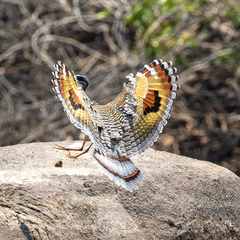
The sunbittern (Eurypyga helias) is a bittern-like bird of tropical regions of the Americas, and the sole member of the family Eurypygidae (sometimes spelled Eurypigidae) and genus Eurypyga. It is found in Central and South America, and has three subspecies. The sunbittern shows both morphological and molecular similarities with the kagu (Rhynochetos jubatus) of New Caledonia, indicating a Gondwanan origin, both species being placed in the clade Eurypygiformes.

The sunbittern was traditionally placed in the Gruiformes, but this was always considered preliminary. Altogether, the bird is most similar to another bird that was provisionally placed in the Gruiformes, the kagu (Rhynochetos jubatus). Molecular studies seem to confirm that the kagu and sunbittern are each other's closest living relatives and have a similar wing display. They are probably not Gruiformes (though the proposed Metaves are just as weakly supported). Altogether, the two species seem to form a minor Gondwanan lineage which could also include the extinct adzebills and/or the mesites, and is of unclear relation to the Gruiformes proper. Notably, the kagu and mesites also have powder down.

An indeterminate... Wikipedia →

Sounds

Call1:00

Brazil · 2025

© Joost van Bruggen · XC1050624 · CC BY-NC-ND 4.0

Song1:23

Brazil · 2024

© JAYRSON ARAUJO DE OLIVEIRA · XC908748 · CC BY-NC-SA 4.0

Uncertain0:54

Colombia · 2022

© Frank Lambert · XC774757 · CC BY-NC-ND 4.0

Global Distribution

Parks Where Found

# Park Country Daily sighting probability
1 Parque Estadual Encontro das Águas 🇧🇷 Brazil
~20%
2 Tambopata National Reserve 🇵🇪 Peru
~10%
3 Amboró National Park 🇧🇴 Bolivia
~10%
4 Manu National Park 🇵🇪 Peru
~10%
5 Sierra de la Macarena National Park 🇨🇴 Colombia
~10%
6 Yasuní National Park 🇪🇨 Ecuador
~10%
7 Cuyabeno Wildlife Reserve 🇪🇨 Ecuador
~10%
8 Rincón de la Vieja National Park 🇨🇷 Costa Rica
<5%
9 Braulio Carrillo National Park 🇨🇷 Costa Rica
<5%
10 Brownsberg Nature Park 🇸🇷 Suriname
<5%
11 Anavilhanas National Park 🇧🇷 Brazil
<5%
12 Amacayacu National Natural Park 🇨🇴 Colombia
<5%
13 Arenal Volcano National Park 🇨🇷 Costa Rica
<5%
14 Darién National Park 🇵🇦 Panama
<5%
15 Monteverde Cloud Forest Reserve 🇨🇷 Costa Rica
<5%
16 Tapantí-Macizo de la Muerte National Park 🇨🇷 Costa Rica
<5%
17 Tenorio Volcano National Park 🇨🇷 Costa Rica
<5%
18 Chagres National Park 🇵🇦 Panama
<5%
19 Gandoca-Manzanillo Wildlife Refuge 🇨🇷 Costa Rica
<5%
20 Carara National Park 🇨🇷 Costa Rica
<5%
21 Chirripó National Park 🇨🇷 Costa Rica
<5%
22 Soberanía National Park 🇵🇦 Panama
<5%
23 Poás Volcano National Park 🇨🇷 Costa Rica
<5%
24 La Amistad International Park (Panama) 🇵🇦 Panama
<5%

Cities Where Found

# City Country Daily sighting probability
1 San José 🇨🇷 Costa Rica
<5%

Zoos & Centres Where Found

# Zoo / Centre Country
1 Busch Gardens Tampa 🇺🇸 United States In captivity
2 San Diego Zoo 🇺🇸 United States In captivity
3 Pairi Daiza 🇧🇪 Belgium In captivity
4 National Zoological Park 🇺🇸 United States In captivity
5 ZooParc de Beauval 🇫🇷 France In captivity
6 Leipzig Zoological Garden 🇩🇪 Germany In captivity
7 Cincinnati Zoo and Botanical Garden 🇺🇸 United States In captivity
8 Antwerp Zoo 🇧🇪 Belgium In captivity
9 Barcelona Zoo 🇪🇸 Spain In captivity
10 North Carolina Zoo 🇺🇸 United States In captivity
11 Zoo Miami 🇺🇸 United States In captivity
12 San Diego Zoo Safari Park 🇺🇸 United States In captivity
13 Toronto Zoo 🇨🇦 Canada In captivity
14 Minnesota Zoo 🇺🇸 United States In captivity
15 Bronx Zoo 🇺🇸 United States In captivity
16 Parc zoologique de Montpellier 🇫🇷 France In captivity
17 Sedgwick County Zoo 🇺🇸 United States In captivity
18 Chester Zoo 🇬🇧 United Kingdom In captivity
19 Milwaukee County Zoo 🇺🇸 United States In captivity
20 Banham Zoo 🇬🇧 United Kingdom In captivity
21 Los Angeles Zoo 🇺🇸 United States In captivity
22 Toledo Zoo 🇺🇸 United States In captivity
23 Detroit Zoo 🇺🇸 United States In captivity
24 Jacksonville Zoo and Gardens 🇺🇸 United States In captivity
25 Birmingham Zoo 🇺🇸 United States In captivity
26 Louisville Zoo 🇺🇸 United States In captivity
27 Warsaw Zoo 🇵🇱 Poland In captivity
28 Oklahoma City Zoo and Botanical Garden 🇺🇸 United States In captivity
29 Saint Louis Zoo 🇺🇸 United States In captivity
30 Burgers' Ocean 🇳🇱 Netherlands In captivity
31 Berlin Zoological Garden 🇩🇪 Germany In captivity
32 Caldwell Zoo 🇺🇸 United States In captivity
33 Royal Burgers' Zoo 🇳🇱 Netherlands In captivity
34 Woodland Park Zoo 🇺🇸 United States In captivity
35 Wrocław Zoological Garden 🇵🇱 Poland In captivity
36 Moody Gardens 🇺🇸 United States In captivity
37 Franklin Park Zoo 🇺🇸 United States In captivity
38 Zoologischer Garten Leipzig 🇩🇪 Germany In captivity
39 ZooTampa 🇺🇸 United States In captivity
40 Fort Worth Zoo 🇺🇸 United States In captivity
41 Wildlands 🇳🇱 Netherlands In captivity
42 Wilhelma 🇩🇪 Germany In captivity
43 Houston Zoo 🇺🇸 United States In captivity
44 San Antonio Zoo 🇺🇸 United States In captivity
45 Cologne Zoological Garden 🇩🇪 Germany In captivity
46 Philadelphia Zoo 🇺🇸 United States In captivity
47 Mesker Park Zoo and Botanic Garden 🇺🇸 United States In captivity
48 Fresno Chaffee Zoo 🇺🇸 United States In captivity
49 Schönbrunn Zoo 🇦🇹 Austria In captivity
50 Zoo Atlanta 🇺🇸 United States In captivity

Before you go

What are the chances of seeing a Sunbittern in Manu National Park?

With luck

About 10% of wildlife watchers report a Sunbittern sighting in Manu National Park on a given day, based on 384 verified sightings from GBIF citizen-science data from 2019 to 2026. It is the 169th most-seen of the 641 birds we can rate there. Over three days the chance rises to about 30%, and over a week to about 50%, if each day is a fresh chance.

When is the best time to see a Sunbittern in Manu National Park?

Any time of year

In every month with enough records, about 10% of wildlife watchers report a Sunbittern in Manu National Park on a given day, so our monthly data shows no clear season.

What time of day is best to see a Sunbittern?

Between 9 am and noon

Across all the parks we cover, that three-hour window holds the most Sunbittern sightings with a recorded time, and about 9 in 10 of them come between 6 am and 6 pm: it is a daytime animal.

Where does the Sunbittern sighting chance come from?

GBIF citizen-science records

It is estimated from how often the Sunbittern is recorded against all the birds logged in Manu National Park (384 verified sightings from 2019 to 2026), calibrated against known sighting rates. Figures are rounded to the nearest 10% because citizen-science data supports honest approximations, not decimals, and months with records from fewer than five people show "—". How it works.

← Back to Manu National Park