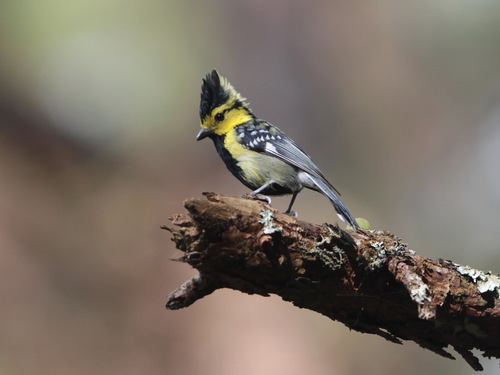
Cinereous Tit

Cinereous Tit

Parus cinereus

Silhouette: Ferran Sayol · PhyloPic

Daily sighting probability <5% · Rare
at Royal Manas National Park

In 3 days <5% in a week ~10%

12 Verified sightings at Royal Manas National Park From 2019 to 2026
10,413 In all 29 parks
February Best month
☀️ Diurnal When it's spotted

About the Cinereous Tit

The cinereous tit or Asian tit (Parus cinereus) is a species of bird in the tit family Paridae. This species is made up of several populations that were earlier treated as subspecies of the great tit (Parus major). These birds are grey backed with white undersides. The great tit in the new sense is distinguishable by the greenish-back and yellowish underside. The distribution of this species extends from parts of West Asia across South Asia and into Southeast Asia. The Japanese tit was formerly treated as a separate species but is now grouped together with the cinereous tit.

The cinereous tit was formally described in 1818 by the French ornithologist Louis Vieillot under the binomial name Parus cinereus. He specified the type location as Batavia, now Jakarta, on the Indonesian island of Java. The cinereous tit was formerly considered as conspecific with the great tit (Parus major).

Twenty subspecies are recognised: P... Wikipedia →

Sounds

Song0:32

Malaysia · 2024

© Lim Ying Hien 林勇贤 · XC1080809 · CC BY-NC-ND 4.0

Call0:38

Malaysia · 2025

© Ding Li Yong · XC1068126 · CC BY-NC-ND 4.0

Begging call0:16

Malaysia · 2023

© Lim Ying Hien · XC786063 · CC BY-NC-ND 4.0

Global Distribution

Parks Where Found

# Park Country Daily sighting probability
1 Nikko National Park 🇯🇵 Japan
~80%
2 Horton Plains National Park 🇱🇰 Sri Lanka
~70%
3 Ranthambore National Park 🇮🇳 India
~60%
4 Royal Bardia National Park 🇳🇵 Nepal
~50%
5 Gir National Park 🇮🇳 India
~50%
6 Jim Corbett National Park 🇮🇳 India
~40%
7 Periyar National Park 🇮🇳 India
~40%
8 Chitwan National Park 🇳🇵 Nepal
~40%
9 Nagarhole National Park 🇮🇳 India
~30%
10 Mudumalai National Park 🇮🇳 India
~30%
11 Hemis National Park 🇮🇳 India
~30%
12 Bandhavgarh National Park 🇮🇳 India
~20%
13 Bandipur National Park 🇮🇳 India
~20%
14 Satpura National Park 🇮🇳 India
~20%
15 Doi Inthanon National Park 🇹🇭 Thailand
~20%
16 Kaziranga National Park 🇮🇳 India
~20%
17 Bali Barat National Park 🇮🇩 Indonesia
~20%
18 Kanha National Park 🇮🇳 India
~20%
19 Jiuzhaigou National Park 🇨🇳 China
~10%
20 Manas National Park 🇮🇳 India
~10%
21 Sundarbans National Park 🇮🇳 India
~10%
22 Komodo National Park 🇮🇩 Indonesia
~10%
23 Cuc Phuong National Park 🇻🇳 Vietnam
~10%
24 Eravikulam National Park 🇮🇳 India
~10%
25 Sinharaja Forest Reserve 🇱🇰 Sri Lanka
<5%
26 Kerinci Seblat National Park 🇮🇩 Indonesia
<5%
27 Yala National Park 🇱🇰 Sri Lanka
<5%
28 Keoladeo National Park 🇮🇳 India
<5%
29 Royal Manas National Park 🇧🇹 Bhutan
<5%

Cities Where Found

# City Country Daily sighting probability
1 Sapporo 🇯🇵 Japan
~90%
2 Seoul 🇰🇷 South Korea
~90%
3 Sendai 🇯🇵 Japan
~80%
4 Gwangju 🇰🇷 South Korea
~80%
5 Guiyang 🇨🇳 China
~80%
6 Nanjing 🇨🇳 China
~70%
7 Suzhou 🇨🇳 China
~70%
8 Tokyo 🇯🇵 Japan
~70%
9 Changsha 🇨🇳 China
~70%
10 Fukuoka 🇯🇵 Japan
~70%

Zoos & Centres Where Found

# Zoo / Centre Country
1 Ueno Zoological Gardens (West Garden) 🇯🇵 Japan In captivity
2 Hong Kong Zoological and Botanical Gardens 🇨🇳 China In captivity
3 Edward Youde Aviary 🇭🇰 Hong Kong SAR China In captivity

Before you go

What are the chances of seeing a Cinereous Tit in Royal Manas National Park?

Rare

Under 5% of wildlife watchers report a Cinereous Tit sighting in Royal Manas National Park on a given day, based on 12 verified sightings from GBIF citizen-science data from 2019 to 2026. It is the 310th most-seen of the 388 birds we can rate there. Over three days the chance rises to under 5%, and over a week to about 10%, if each day is a fresh chance.

When is the best time to see a Cinereous Tit in Royal Manas National Park?

February and June

In those months about 10% of wildlife watchers report a Cinereous Tit in Royal Manas National Park on a given day, against under 5% in March–May, July and October–January, the lowest months. August and September have too few records to rate.

What time of day is best to see a Cinereous Tit?

Between 9 am and noon

Across all the parks we cover, that three-hour window holds the most Cinereous Tit sightings with a recorded time, and about 9 in 10 of them come between 6 am and 6 pm: it is a daytime animal.

Which relatives of the Cinereous Tit live in Royal Manas National Park?

Same genus: Parus

The closest relatives of the Cinereous Tit that you can see in Royal Manas National Park (genus Parus, Great Tits and Allies) are Green-backed Tit (about 20%) and Yellow-cheeked Tit (about 10%), with each one's daily chance of a sighting.

Where does the Cinereous Tit sighting chance come from?

GBIF citizen-science records

It is estimated from how often the Cinereous Tit is recorded against all the birds logged in Royal Manas National Park (12 verified sightings from 2019 to 2026), calibrated against known sighting rates. Figures are rounded to the nearest 10% because citizen-science data supports honest approximations, not decimals, and months with records from fewer than five people show "—". How it works.

← Back to Royal Manas National Park