Ruddy Pigeon

Ruddy Pigeon

Patagioenas subvinacea

Silhouette: Ferran Sayol · PhyloPic

LCLeast ConcernNTVUENCR
Daily sighting probability <5% · Rare
at Sierra de la Macarena National Park

In 3 days ~10% in a week ~30%

38 Verified sightings at Sierra de la Macarena National Park From 2019 to 2026
9,280 In all 26 parks
April Best month
☀️ Diurnal When it's spotted

About the Ruddy Pigeon

The ruddy pigeon (Patagioenas subvinacea) is a largish pigeon which breeds from Costa Rica south to western Ecuador, Bolivia, and central Brazil. It belongs to a clade of small and rather plain species of Patagioenas with characteristic calls that constitute the subgenus Oenoenas. Like the other New World pigeons, it was formerly united with their Old World relatives in Columba, but today the New World genus Patagioenas is recognized as distinct again.

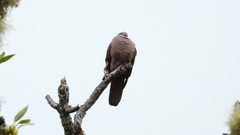
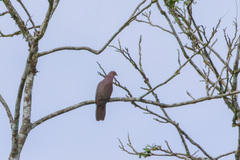
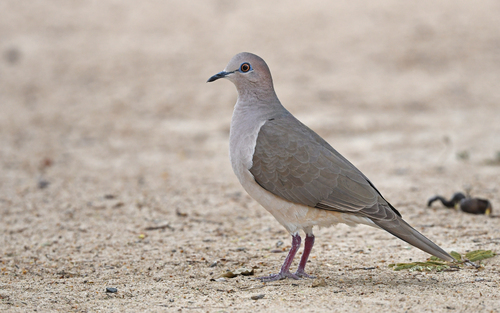
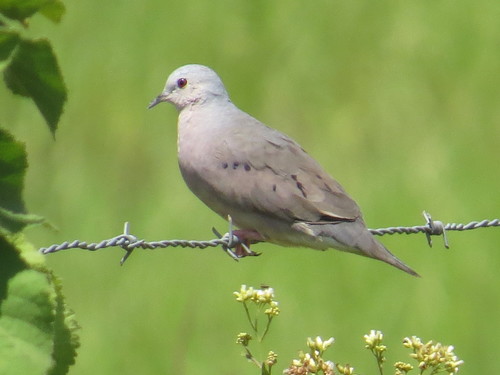
The ruddy pigeon is 28 cm (11 in) long and weighs 170 g. It is unpatterned and mainly wine-purple in colour, becoming more rufous on the back. The tail and primary flight feathers are dark brown, the bill is black, and the legs are purple-red. The iris is typically red, but can, at least in the Amazon basin, sometimes be dull yellow (however, due to the red eye-ring, the iris never appears as conspicuously white as in adults of the sympatric subspecies of the plumbeous pigeon, P. plumbea). The female is slightly duller and browner than the male, and the juvenile bird has a greyish brown head, neck and breast, with cinnamon or rufous scaling on the head and upperparts.

It has a loud and fairly high-pitched coo, ko'COO coo call, with considerable pauses between calls just as in its relatives. There are some geographical variations in its voice, with some populations singing four-noted songs, while others sing three-noted songs.

In Central America, the ruddy pigeon is replaced at lower altitudes by its close relative, the very similar short-billed pigeon (P. nigrirostris). The two species are best separated by call, which is faster and less complex in P. subvinacea.

In Central America it is found in highland forest canopy and semi-open woodland from 1500 m (5000 ft) ASL to the timberline. In South America it occurs in the canopy of humid forest from near sea-level to 1500 m (5000 ft) ASL, occasionally higher; exceptionally, they may range up to 3000 m ASL or more. It is not uncommon across its wide range but due to projected deforestation is thus classified as a Least Concern species by the IUCN.

It is normally seen in pairs as it forages in the tree tops for fruits and berries—being particularly fond of mistletoe fruit – but may occasionally be seen on tracks and roadside seeking grit. It builds a rudimentary platform nest out of twigs 5 m high in a small tree, and lays one white egg. Wikipedia →

Sounds

Call0:17

Brazil · 2026

© JAYRSON ARAUJO DE OLIVEIRA · XC1186099 · CC BY-NC-SA 4.0

Song0:15

Ecuador · 2024

© Manuel Sánchez-Nivicela · XC1162935 · CC BY-NC-ND 4.0

Uncertain1:05

Colombia · 2021

© A Edwar H Guarín · XC676462 · CC BY-NC-SA 4.0

Global Distribution

Parks Where Found

# Park Country Daily sighting probability
1 Cuyabeno Wildlife Reserve 🇪🇨 Ecuador
~30%
2 Brownsberg Nature Park 🇸🇷 Suriname
~30%
3 Los Quetzales National Park 🇨🇷 Costa Rica
~20%
4 Anavilhanas National Park 🇧🇷 Brazil
~20%
5 Yasuní National Park 🇪🇨 Ecuador
~20%
6 Amacayacu National Natural Park 🇨🇴 Colombia
~20%
7 Chirripó National Park 🇨🇷 Costa Rica
~20%
8 Monteverde Cloud Forest Reserve 🇨🇷 Costa Rica
~20%
9 Tapantí-Macizo de la Muerte National Park 🇨🇷 Costa Rica
~20%
10 Darién National Park 🇵🇦 Panama
~10%
11 Manu National Park 🇵🇪 Peru
~10%
12 Tambopata National Reserve 🇵🇪 Peru
~10%
13 Volcán Barú National Park 🇵🇦 Panama
~10%
14 Henri Pittier National Park 🇻🇪 Venezuela
~10%
15 Farallones de Cali National Natural Park 🇨🇴 Colombia
~10%
16 Sierra de la Macarena National Park 🇨🇴 Colombia
<5%
17 Braulio Carrillo National Park 🇨🇷 Costa Rica
<5%
18 La Amistad International Park (Panama) 🇵🇦 Panama
<5%
19 Amboró National Park 🇧🇴 Bolivia
<5%
20 Poás Volcano National Park 🇨🇷 Costa Rica
<5%
21 Arenal Volcano National Park 🇨🇷 Costa Rica
<5%
22 Machalilla National Park 🇪🇨 Ecuador
<5%
23 Chingaza National Natural Park 🇨🇴 Colombia
<5%
24 Podocarpus National Park 🇪🇨 Ecuador
<5%
25 Los Nevados National Natural Park 🇨🇴 Colombia
<5%
26 Tenorio Volcano National Park 🇨🇷 Costa Rica
<5%

Cities Where Found

# City Country Daily sighting probability
1 Guayaquil 🇪🇨 Ecuador
<5%
2 Valencia 🇻🇪 Venezuela
<5%
3 San José 🇨🇷 Costa Rica
<5%
4 Panama City 🇵🇦 Panama
<5%
5 Bogota 🇨🇴 Colombia
<5%
6 Caracas 🇻🇪 Venezuela
<5%

Before you go

What are the chances of seeing a Ruddy Pigeon in Sierra de la Macarena National Park?

Rare

Under 5% of wildlife watchers report a Ruddy Pigeon sighting in Sierra de la Macarena National Park on a given day, based on 38 verified sightings from GBIF citizen-science data from 2019 to 2026. It is the 200th most-seen of the 418 birds we can rate there. Over three days the chance rises to about 10%, and over a week to about 30%, if each day is a fresh chance.

When is the best time to see a Ruddy Pigeon in Sierra de la Macarena National Park?

April

In that month about 20% of wildlife watchers report a Ruddy Pigeon in Sierra de la Macarena National Park on a given day, against under 5% in February–March, June and August–December, the lowest months.

What time of day is best to see a Ruddy Pigeon?

Between 7 and 10 am

Across all the parks we cover, that three-hour window holds the most Ruddy Pigeon sightings with a recorded time, and nearly all of them come between 6 am and 6 pm: it is a daytime animal.

Is Sierra de la Macarena National Park the best place to see a Ruddy Pigeon?

16th of 26

Of the 26 parks where we can rate Ruddy Pigeon sightings, Sierra de la Macarena National Park ranks 16th at under 5%. The best odds are in Cuyabeno Wildlife Reserve (Ecuador, about 30%), Brownsberg Nature Park (Suriname, about 30%) and Los Quetzales National Park (Costa Rica, about 20%).

Which relatives of the Ruddy Pigeon live in Sierra de la Macarena National Park?

Same genus: Patagioenas

The closest relatives of the Ruddy Pigeon that you can see in Sierra de la Macarena National Park (genus Patagioenas, New World Pigeons) are Pale-vented Pigeon (about 20%), Scaled Pigeon (about 10%) and Plumbeous Pigeon (about 10%), with each one's daily chance of a sighting.

Where does the Ruddy Pigeon sighting chance come from?

GBIF citizen-science records

It is estimated from how often the Ruddy Pigeon is recorded against all the birds logged in Sierra de la Macarena National Park (38 verified sightings from 2019 to 2026), calibrated against known sighting rates. Figures are rounded to the nearest 10% because citizen-science data supports honest approximations, not decimals, and months with records from fewer than five people show "—". How it works.

← Back to Sierra de la Macarena National Park