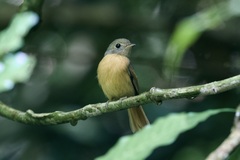
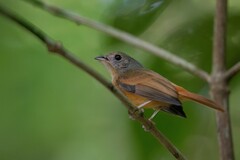

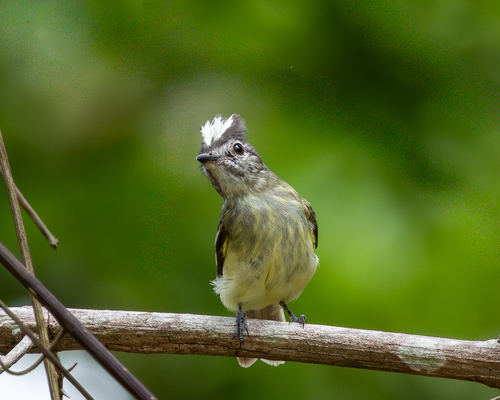
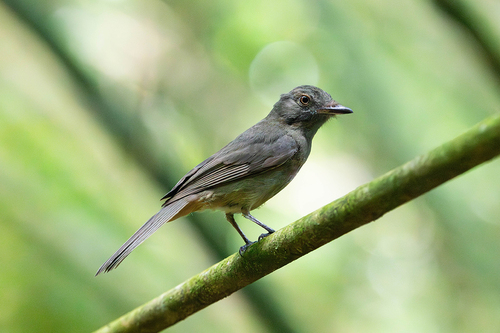
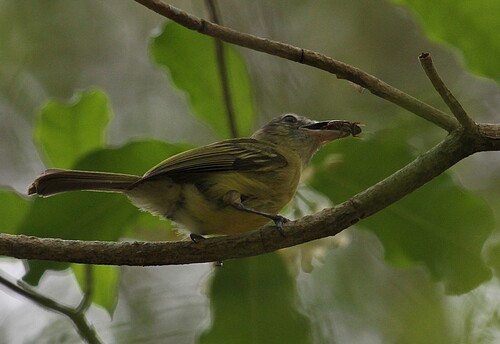
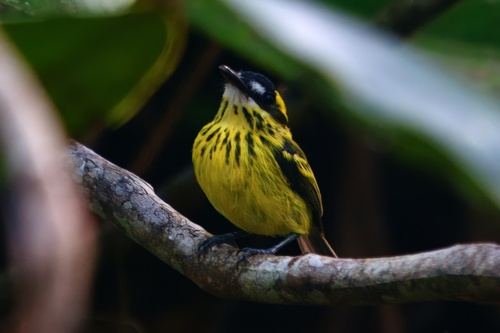
Ruddy-tailed Flycatcher

Ruddy-tailed Flycatcher

Terenotriccus erythrurus

Silhouette: Sheatherius · PhyloPic

LCLeast ConcernNTVUENCR
Daily sighting probability ~10% · With luck
at Tambopata National Reserve

In 3 days ~30% in a week ~50%

317 Verified sightings at Tambopata National Reserve From 2019 to 2026
5,482 In all 27 parks
July Best month
☀️ Diurnal When it's spotted

About the Ruddy-tailed Flycatcher

The ruddy-tailed flycatcher (Terenotriccus erythrurus) is a small passerine bird in the family Onychorhynchidae. It was previously place in family Tityridae. Its range extends from southeast Mexico south to the Amazon rainforest. It is the only member of the genus Terenotriccus, but some authorities place it in genus Myiobius. However, it differs in voice, behaviour, and structure from members of that group.

The ruddy-tailed flycatcher was formally described and illustrated in 1847 by the German ornithologist Jean Cabanis under the binomial name Myiobius erythrurus. The type locality is Cayenne in French Guiana. The specific epithet combines the Ancient Greek ερυθρος/eruthros meaning "red" with -ουρος/-ouros meaning "-tailed". The ruddy-tailed flycatcher is now the only species placed in the genus Terenotriccus that was introduced in 1905 by the American ornithologist Robert Ridgway. The genus name combines the Ancient Greek τερενος/terenos meaning "soft" or "delicate" with τρικκος/trikkos, an unidentified small bird which in ornithology signifies a tyrant flycatcher.

Eight subspecies are recognised: Wikipedia →

Sounds

Song0:24

Brazil · 2023

© JAYRSON ARAUJO DE OLIVEIRA · XC782458 · CC BY-NC-SA 4.0

Call0:18

Ecuador · 2001

© Olaf Jahn · XC262208 · CC BY-NC-SA 4.0

Alarm call1:17

Brazil · 2012

© Thiago Orsi Laranjeiras · XC138898 · CC BY-NC-SA 3.0

Global Distribution

Parks Where Found

# Park Country Daily sighting probability
1 Soberanía National Park 🇵🇦 Panama
~20%
2 Darién National Park 🇵🇦 Panama
~20%
3 Carara National Park 🇨🇷 Costa Rica
~10%
4 Cahuita National Park 🇨🇷 Costa Rica
~10%
5 Tambopata National Reserve 🇵🇪 Peru
~10%
6 San Lorenzo Protected Forest 🇵🇦 Panama
~10%
7 Chagres National Park 🇵🇦 Panama
~10%
8 Podocarpus National Park 🇪🇨 Ecuador
~10%
9 Parque Natural Metropolitano 🇵🇦 Panama
~10%
10 Braulio Carrillo National Park 🇨🇷 Costa Rica
~10%
11 Corcovado National Park 🇨🇷 Costa Rica
~10%
12 Amacayacu National Natural Park 🇨🇴 Colombia
<5%
13 Tikal National Park 🇬🇹 Guatemala
<5%
14 Tapantí-Macizo de la Muerte National Park 🇨🇷 Costa Rica
<5%
15 Pico Bonito National Park 🇭🇳 Honduras
<5%
16 Piedras Blancas National Park 🇨🇷 Costa Rica
<5%
17 Manu National Park 🇵🇪 Peru
<5%
18 Tayrona National Natural Park 🇨🇴 Colombia
<5%
19 Brownsberg Nature Park 🇸🇷 Suriname
<5%
20 Marino Ballena National Park 🇨🇷 Costa Rica
<5%
21 Gandoca-Manzanillo Wildlife Refuge 🇨🇷 Costa Rica
<5%
22 Yasuní National Park 🇪🇨 Ecuador
<5%
23 Bastimentos Island National Marine Park 🇵🇦 Panama
<5%
24 Farallones de Cali National Natural Park 🇨🇴 Colombia
<5%
25 La Amistad International Park (Panama) 🇵🇦 Panama
<5%
26 Arenal Volcano National Park 🇨🇷 Costa Rica
<5%
27 Tortuguero National Park 🇨🇷 Costa Rica
<5%

Before you go

What are the chances of seeing a Ruddy-tailed Flycatcher in Tambopata National Reserve?

With luck

About 10% of wildlife watchers report a Ruddy-tailed Flycatcher sighting in Tambopata National Reserve on a given day, based on 317 verified sightings from GBIF citizen-science data from 2019 to 2026. It is the 147th most-seen of the 550 birds we can rate there. Over three days the chance rises to about 30%, and over a week to about 50%, if each day is a fresh chance.

When is the best time to see a Ruddy-tailed Flycatcher in Tambopata National Reserve?

July

In that month about 20% of wildlife watchers report a Ruddy-tailed Flycatcher in Tambopata National Reserve on a given day, against under 5% in March–April and November–January, the lowest months. That is one of Tambopata National Reserve's driest months, with about 45 mm of rain against 420 mm in February.

What time of day is best to see a Ruddy-tailed Flycatcher?

Between 8 and 11 am

Across all the parks we cover, that three-hour window holds the most Ruddy-tailed Flycatcher sightings with a recorded time, and about 9 in 10 of them come between 6 am and 6 pm: it is a daytime animal.

Is Tambopata National Reserve the best place to see a Ruddy-tailed Flycatcher?

5th of 27

Of the 27 parks where we can rate Ruddy-tailed Flycatcher sightings, Tambopata National Reserve ranks 5th at about 10%. The best odds are in Soberanía National Park (Panama, about 20%), Darién National Park (Panama, about 20%) and Carara National Park (Costa Rica, about 10%).

Which relatives of the Ruddy-tailed Flycatcher live in Tambopata National Reserve?

Same family: Tyrannidae

The closest relatives of the Ruddy-tailed Flycatcher that you can see in Tambopata National Reserve (family Tyrannidae, Tyrant Flycatchers) are Tropical Kingbird (about 20%), Boat-billed Flycatcher (about 20%) and Forest Elaenia (about 20%), with each one's daily chance of a sighting.

Where does the Ruddy-tailed Flycatcher sighting chance come from?

GBIF citizen-science records

It is estimated from how often the Ruddy-tailed Flycatcher is recorded against all the birds logged in Tambopata National Reserve (317 verified sightings from 2019 to 2026), calibrated against known sighting rates. Figures are rounded to the nearest 10% because citizen-science data supports honest approximations, not decimals, and months with records from fewer than five people show "—". How it works.

← Back to Tambopata National Reserve