


Completed


House Crow
Corvus splendens
Silhouette: Andy Wilson · PhyloPic
- KingdomAnimalia (Animals)
- PhylumChordata (Chordates)
- ClassAves (Birds)
- OrderPasseriformes (Perching Birds)
- FamilyCorvidae (Crows, Jays, and Magpies)
- GenusCorvus (Crows and Ravens)
- SpeciesCorvus splendens (House Crow)
In 3 days ~30% in a week ~60%
48 Verified sightings at Wilpattu National Park From 2019 to 2026
5,757 In all 30 parks
September Best month
🌅 Crepuscular When it's spotted


Completed





Completed
About the House Crow
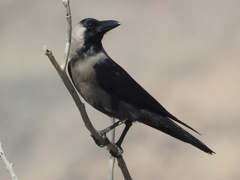
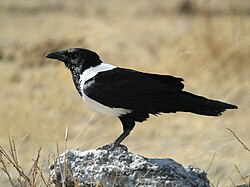
The house crow (Corvus splendens), also known as the Indian, greynecked, Ceylon or Colombo crow, is a common bird of the crow family that is of Asian origin but now found in many parts of the world, where they arrived assisted by shipping. It is between the jackdaw and the carrion crow in size (40 cm (16 in) in length) but is slimmer than either. The forehead, crown, throat and upper breast are a richly glossed black, whilst the neck and breast are a lighter grey-brown in colour. The wings, tail and legs are black. There are regional variations in the thickness of the bill and the depth of colour in areas of the plumage.
The house crow was formally described in 1817 as Corvus splendens by the French ornithologist Louis Vieillot based on a specimen collected in Bengal. The specific epithet is from Latin splendens, splendentis meaning "brilliant" or "glittering".
The nominate race C. s. splendens is found in Pakistan, India, Nepal and Bangladesh and has a grey neck collar. The subspecies C. s. zugmayeri is found in the dry parts of South Asia and Iran and has a very pale neck collar. The subspecies C. s. protegatus is found in southern India, the Maldives (sometimes separated... Wikipedia →
Recent sightings of House Crow in Wilpattu National Park
LIVEiNaturalistGlobal Distribution
Parks Where Found
Zoos & Centres Where Found
| # | Zoo / Centre | Country | |
|---|---|---|---|
| 1 | SeaWorld Abu Dhabi | 🇦🇪 United Arab Emirates | |
| 2 | Al Hefaiyah Reserve | 🇦🇪 United Arab Emirates | |
| 3 | Al Hefaiyah Mountain Conservation Centre | 🇦🇪 United Arab Emirates | |
| 4 | World of Birds Wildlife Sanctuary and Monkey Park | 🇿🇦 South Africa |
Closest Relatives at Wilpattu National Park




Before you go
What are the chances of seeing a House Crow in Wilpattu National Park?
With luck
About 10% of wildlife watchers report a House Crow sighting in Wilpattu National Park on a given day, based on 48 verified sightings from GBIF citizen-science data from 2019 to 2026. It is the 105th most-seen of the 169 birds we can rate there. Over three days the chance rises to about 30%, and over a week to about 60%, if each day is a fresh chance.
When is the best time to see a House Crow in Wilpattu National Park?
February, June–July and September–October
In those months about 20% of wildlife watchers report a House Crow in Wilpattu National Park on a given day, against under 5% in January and August, the lowest months.
What time of day is best to see a House Crow?
Between 2 and 5 am
Across all the parks we cover, that three-hour window holds the most House Crow sightings with a recorded time, and about 6 in 10 of them come between 6 am and 6 pm: it is most active around dawn and dusk.
Is Wilpattu National Park the best place to see a House Crow?
16th of 30
Of the 30 parks where we can rate House Crow sightings, Wilpattu National Park ranks 16th at about 10%. The best odds are in Keoladeo National Park (India, about 40%), Chitwan National Park (Nepal, about 40%) and Yala National Park (Sri Lanka, about 30%). All parks ranked.
Where does the House Crow sighting chance come from?
GBIF citizen-science records
It is estimated from how often the House Crow is recorded against all the birds logged in Wilpattu National Park (48 verified sightings from 2019 to 2026), calibrated against known sighting rates. Figures are rounded to the nearest 10% because citizen-science data supports honest approximations, not decimals, and months with records from fewer than five people show "—". How it works.
